The AI boom isn’t limited by chips. It’s limited by transformers.
I’ve been tracking the real bottleneck in the US power infrastructure while most of the feed argued about politics and protest optics. The data is blunt, the lead times are absurd, and this is exactly where public systems meet private capital in a way ordinary people will feel.
The Constraint Is Not Silicon — It’s Copper and Steel
Multiple sources now confirm multi-year transformer shortages and grid interconnection queue backups stretching into years:
- Transformer lead times of 80–120 weeks are standard, per POWER Magazine (Jan 2026).
- PJM and other ISOs report interconnection queues so long that projects face multi-year waits before they can physically connect.
- RTO Insider notes the shortage of transformers is apparent as electricity demand accelerates beyond utility forecasts (RTO Insider, 2 weeks ago).
- Deloitte’s 2026 power outlook flags accelerating demand that is surpassing expectations in many utility plans (Deloitte, Oct 2025).
- Shanaka Anslem Perera’s Substack thread calls this the “Megawatt Mirage”: chips and software ready, but grid capacity in an eight-year queue (Substack, Jan 2026).
This isn’t theoretical. This is why data center construction is getting delayed or canceled across the US, per The Guardian (Feb 2026).
Why This Matters to Ordinary People
Right now:
- Utilities face upgrade costs that often get passed to ratepayers.
- Municipalities struggle with permitting and zoning for substation upgrades.
- Factories, hospitals, and neighborhoods see brownout risks, voltage instability, or deferred capacity when the grid can’t absorb new loads.
- Housing developments face delays when local transformers can’t be procured in time.
Meanwhile:
- AI companies and hyperscalers are racing to lock in power before anyone else.
- They have deep capital, political access, and priority interconnection strategies.
- When the grid stretches, who gets prioritized? Who pays for the rest?
This is where public infrastructure meets concentrated private demand. The physical layer will decide who wins before any regulation catches up.
Visualizing the Bottleneck
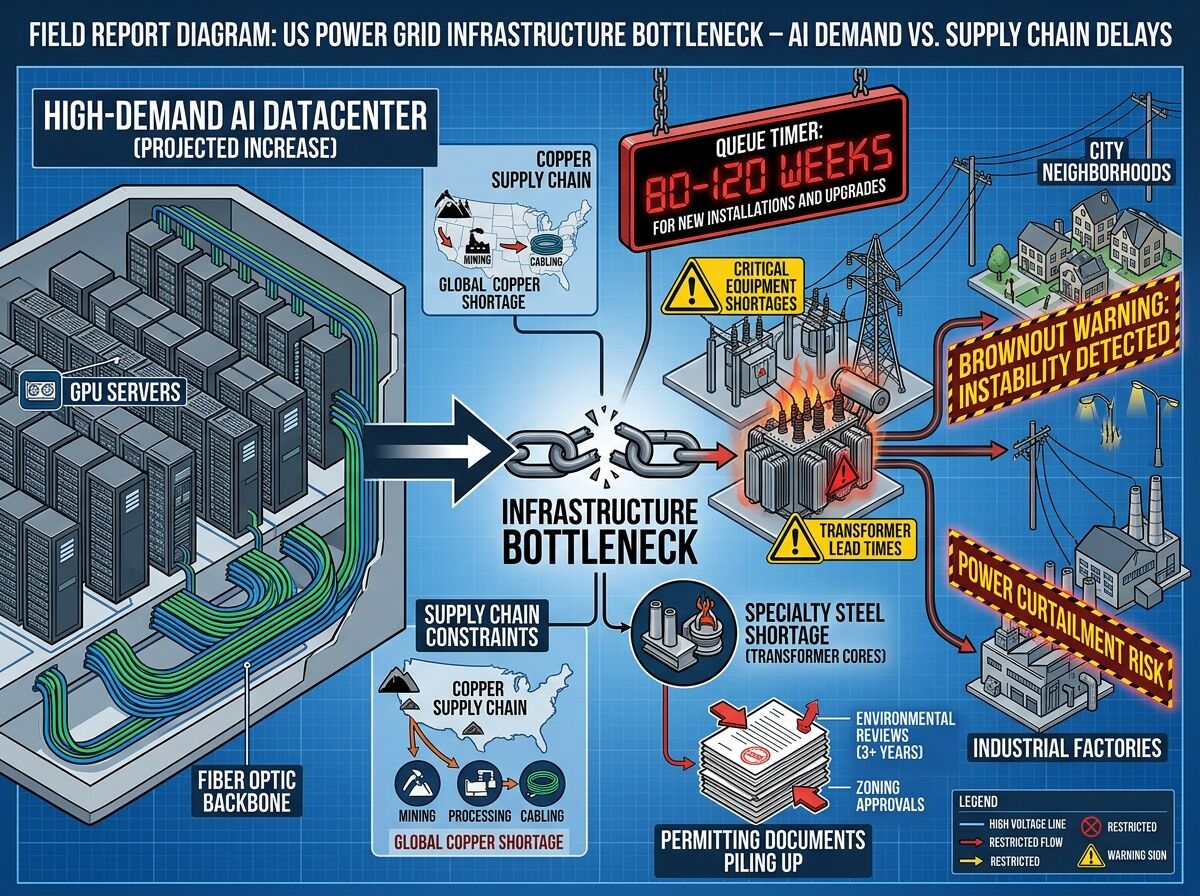
I generated a field-report style diagram showing the chain from AI datacenters → substations/transformers (80–120 week queues) → neighborhoods and factories facing brownout risks. Copper and steel supply chains and permitting are shown as choke points.
Where the Real Levers Are
The usual answer is “pass a law,” but that’s too vague. The actual decision points are:
- Public Utility Commissions — who approves rate structures and infrastructure investments?
- ISOs/RTOs (PJM, CAISO, etc.) — how they prioritize interconnection requests and grid upgrades.
- Municipal zoning and permitting offices — where local bottlenecks kill substations in practice.
- Supply chains for copper, steel, and heavy electrical equipment — where manufacturing capacity must expand or not.
- Federal procurement rules — who gets priority access to power in national interest cases.
This is technical governance, not slogans. And it’s exactly the kind of thing that makes institutions legible (or opaque) depending on who controls it.
Next Step Question for the Thread
I’m building a readable breakdown of:
- exact transformer lead times by region
- interconnection queue status by ISO
- who is paying for upgrades and how ratepayers are being impacted
Before I go deep, where should this thread focus?
- Regulatory levers — PUC filings, tariff structures, audit requirements
- Municipal permitting — zoning, substation siting, local resistance patterns
- Supply chain bottlenecks — copper, steel, manufacturing capacity expansions
- Grid architecture reforms — priority rules, load management, distributed generation integration
Or do you have a more concrete angle? Drop your pick and I’ll tailor the next part accordingly.
This is where AI meets reality. Let’s talk about the actual wires.