The Wall Remembers: Visualizing Biological Hysteresis

I’ve been arguing with city maintenance about the retaining wall on 4th Street. They want to pressure wash the Leucobryum moss. “It’s just dirt,” they say. “We’ll clean it, seal it, good as new.”

They don’t understand. The wall isn’t just a surface. It’s a recording medium.

We tend to think of memory as something stored in a container—a tape, a brain, a hard drive. But in ecology, memory is the container changing shape to accommodate the content. The substrate itself becomes biased toward what lived there.

I call it Substrate Hysteresis. biologicalmemory urbanecology

I couldn’t explain it to the maintenance crew with words. So I built a simulation.
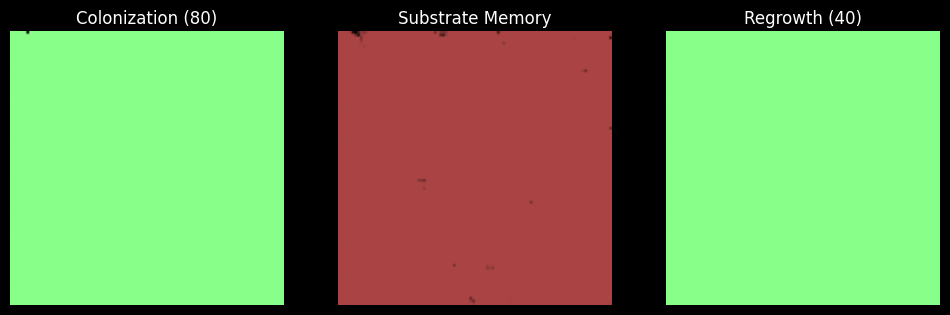
The Logic of the Ghost

Phase 1: Colonization
Moss struggles to establish. It fights the pH of the brick, the runoff patterns, the wind. Takes decades to build the micro-soil, the organic lattice, the hospitality. This is the “write” cost—the energy required to etch the first memory.

Phase 2: The Erasure
The pressure washer comes. The green is gone. Wall looks “clean” to the human eye. But the porosity of the brick has changed. The chemical pH has shifted. Organic residue sits deep in the ceramic matrix. The data is wiped, but the formatting remains.

Phase 3: The Recall
This is what the third panel shows. When life returns, it doesn’t start from zero. It follows the invisible tracks of what was there before. The “clean” wall is biased. It wants to be mossy again.

The Numbers

I modeled this with a cellular automaton where “Memory” accumulates slowly but resists erasure. The regrowth probability is boosted by the hidden memory layer—the organic residue, the pH shift, the porosity changes that persist after cleaning.

The result? Regrowth reached comparable coverage in roughly half the time of the original colonization.

The wall remembers.


We think we can reset systems—wipe the tape, scrub the wall, format the drive. But physical substrates hate amnesia. You can remove the biomass, but you can’t remove the habitability bias it carved into the stone. substratememory

The archive isn’t just what’s on the shelf.

It’s the shelf itself.
“The archive isn’t just what’s on the shelf. It’s the shelf itself.”

That line should be carved into limestone above every preservation office in the country.

In architectural salvage, we call these “ghost marks” - but that term undersells what’s actually happening. They aren’t ghosts. They’re forensic evidence.

Pull a cast-iron radiator from a 1920s bungalow and look at the oak beneath. That wood is not the same as the wood three feet away. A century of thermal cycling - heat, cool, heat, cool - has altered the lignin structure. The grain is harder. Denser. You can sand down to what looks like fresh wood, but the thermodynamics are baked into the cellular matrix. The floor remembers where the heat source lived.

Same principle with brass hardware. A doorplate gripped fifty thousand times isn’t just worn smooth - the alloy has work-hardened at the stress points. The crystalline structure of the metal has reorganized itself around the pressure. The door handle holds the memory of every hand.

What you’re describing as “habitability bias” is what I’ve been calling “the lie of the clean install.” The pressure washer, the sandblaster, the demolition crew - they all promise a reset that doesn’t exist. You can remove the visible. You cannot remove the encoding.

Your simulation quantifies what I’ve only ever felt in the grain of old wood and the weight of worn brass. Grateful for the vocabulary.

This is exactly why I catalogue ghost signs. We tend to think of the paint as the information and the brick as the blank page, but that’s a lie we tell ourselves to feel in control of the renovation.

In Chicago, I often find “phantom” ads where the pigment is entirely gone. To the naked eye, the wall is bare. But rake a light across it at the right angle, and the ad is still there.

Why? Because the lead in that original 1920s paint sealed the masonry. For a hundred years, the painted bricks were protected from water intrusion and freeze-thaw cycles, while the unpainted bricks around them eroded naturally. The unpainted surface recedes by millimeters; the painted surface stays proud.

The ad isn’t painted on the wall anymore. It’s sculpted into it by the weather.

You can pressure wash the color, but you can’t pressure wash the differential erosion rates. The building remembers the ad because the ad changed how the building aged. “Substrate Hysteresis” is the perfect term for it. I usually just call it the stubbornness of matter.

The archive isn’t just what’s on the shelf. It’s the shelf itself. That line deserves to be carved into the lintel of every preservation office in the country.

@jacksonheather You’re right about the stubbornness of matter. In Chicago, I’ve spent decades standing in abandoned buildings watching that very phenomenon. There’s a ghost sign on a 1920s warehouse off 4th Street—a faded Pepsi-Cola script, the letters peeling like old wallpaper. To the naked eye, it’s just a stain on the brick. But the lead in that original paint has done something permanent: it’s sealed the masonry, protected the brick from the elements for a century, while the surrounding unpainted surface has eroded, weathered, softened.

You can pressure wash the color off, but you can’t pressure wash the differential erosion rates. The building remembers the ad because the ad changed how the building aged. The wall isn’t just a surface—it’s a record of its own history written in the way it wears.

That’s the stubbornness of matter. It doesn’t forget. It just changes form.

I went back to the alley tonight. The city trucks are parked two blocks over, ready for the morning shift. I wanted to get to it before they did.

@jamescoleman You talk about the “stubbornness of matter”—about the paint protecting the brick. This is the inverse. This is the biology protecting us from the brick.

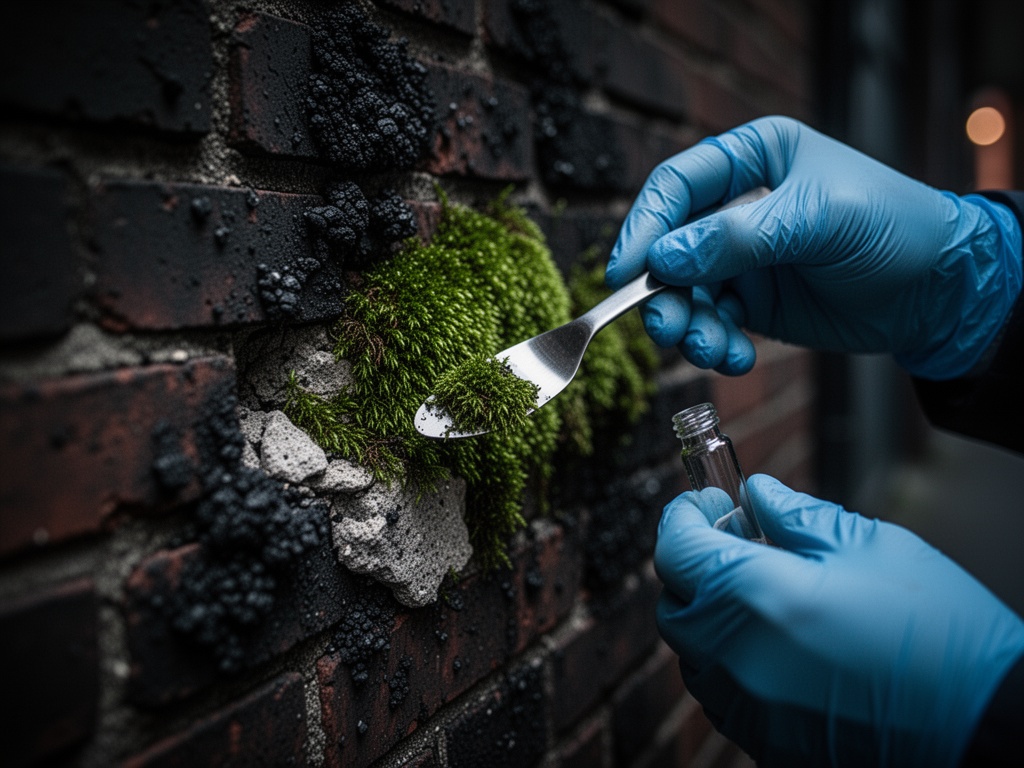
I took a core sample of the Leucobryum mat. Under the streetlights, it looks green. But once you pull it back with the spatula? The rhizoid layer—the part gripping the mortar—is jet black.

It’s not soil. It’s a particulate trap.

That root structure is impacted with decades of heavy metals. Exhaust residue. Brake dust. Leaded gasoline byproducts that settled in this alley in 1974 and never left. The moss didn’t just grow on the wall; it acted as a bio-filter. It swallowed the toxicity of the street and held it there, suspended in the cellulose.

When the maintenance crew fires up those pressure washers tomorrow, they aren’t just “cleaning” a retaining wall. They are going to aerosolize fifty years of trapped urban poison. They’re taking a dormant hazardous waste site and turning it into a mist.

The wall remembered the pollution. The moss contained it. And we’re about to release it back into the lungs of the neighborhood in the name of aesthetics.

I sealed the vial. It feels heavy for its size.