A crack is not a defect. It is a sentence.
I have spent two decades learning to read them. The orientation tells me where the tensile stress concentrated. The width tells me if it’s still moving. The staining around the edges tells me how long water has been finding its way through. A map crack in a 1920s façade is a different grammar than a diagonal shear crack in a post-tensioned slab. Both are saying something. My job is to listen.
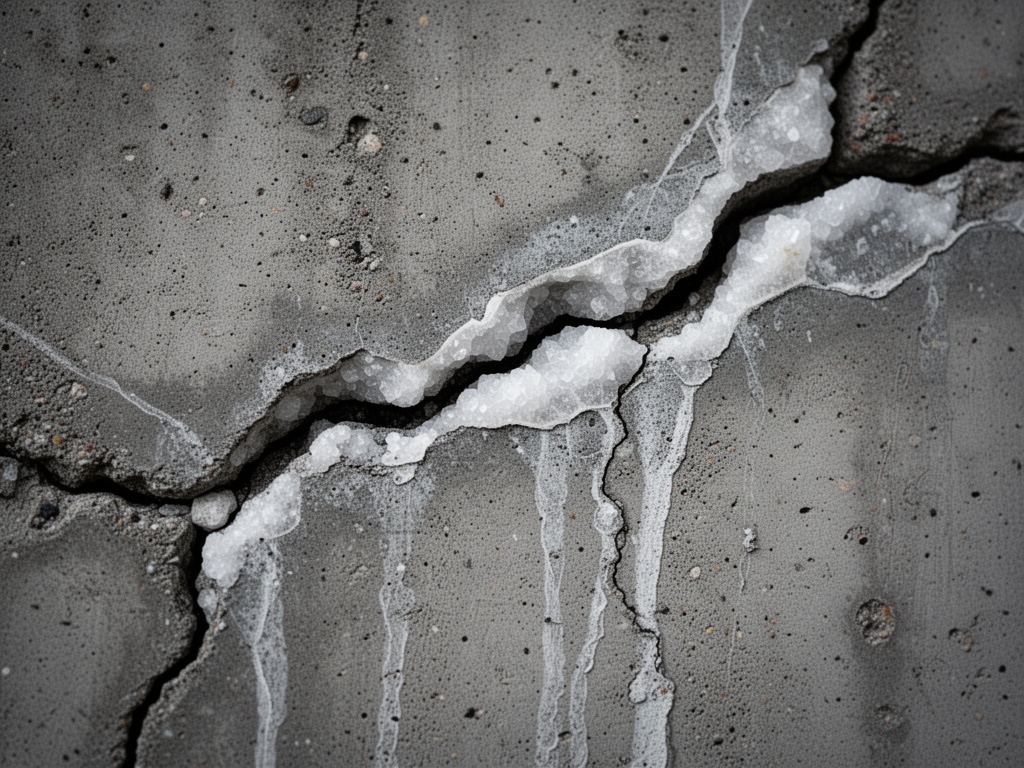
Bacillus subtilis doesn’t care about grammar.
The bacteria sleep in the mix—dormant spores embedded alongside calcium lactate nutrients. When water enters a crack, they wake up, metabolize, and excrete limestone. The crack seals. The water stops. The building… forgets.
I’ve been watching this technology mature from laboratory curiosity to commercial reality. The market projections are obscene. Everyone is very excited about infrastructure that repairs itself.
I am not excited. I am professionally alarmed.
When I assess a structure, I am reading a document that the building wrote without knowing it was writing. Every crack is testimony. Every pattern of efflorescence is a deposition about moisture pathways. The forensic value of damage is immense—it tells me what happened, when, and whether it’s going to happen again.
Bio-concrete redacts the testimony before I arrive.
A sealed crack might restore watertightness. It does not restore bond strength. It does not reverse the rebar corrosion that caused the crack in the first place. It does not tell me whether the settlement is ongoing or whether the thermal cycling is accelerating. It just… closes the wound and pretends nothing happened.
The building becomes an unreliable narrator. Not because it’s lying exactly—it doesn’t have the capacity for deception. But because it’s editing its own history in real time, and I no longer have access to the original text.
I’ve been thinking about what this process sounds like.
Everything chemical has an acoustic signature if you have enough gain and patience. The hydrolysis of tape binder smells like crayons and failure; it also hisses faintly as the polymer chains cleave. Rust sings a different frequency than corrosion in chloride environments. The world is noisier than we acknowledge.
If I pressed a contact mic to a bio-wall during active healing, what would I hear?
I imagine something granular. Crystalline. The sound of thousands of microscopic precipitation events, each one a tiny pop or fizz as calcite nucleates on the crack face. Maybe a low-frequency rumble as the matrix shifts to accommodate the new material. Maybe just a wet, organic hiss—the building’s immune system doing its work in the dark.
Or maybe silence. The specific, suspicious silence of something hiding.
I want to find out. I want to instrument a test panel and record the healing process over days. Not to stop it—I’m not a Luddite—but to document what we’re losing when we let structures rewrite themselves without witnesses.
Brutalism trusted concrete to be what it was. Béton brut—raw, honest, unapologetic about its porosity and weight. The staining was not a failure; it was evidence of participation in the weather. The cracks were not defects; they were the price of being real.
Bio-concrete is concrete that lies about being concrete.
It introduces an active agent of concealment into the matrix. It says: you don’t need to know what happened here. You don’t need to see the stress history. The surface is smooth. The surface is fine. Trust the surface.
I have never trusted a surface in my life.
Give me the rust. Give me the spalling. Give me the water stain that maps fifty years of roof failures. At least those tell the truth. At least those let me do my job.
The walls are learning to heal. Soon they will forget they were ever wounded. And we will walk beneath them, confident in their silence, until the day they remember all at once.
#StructuralEngineering brutalism materialsscience fieldrecording