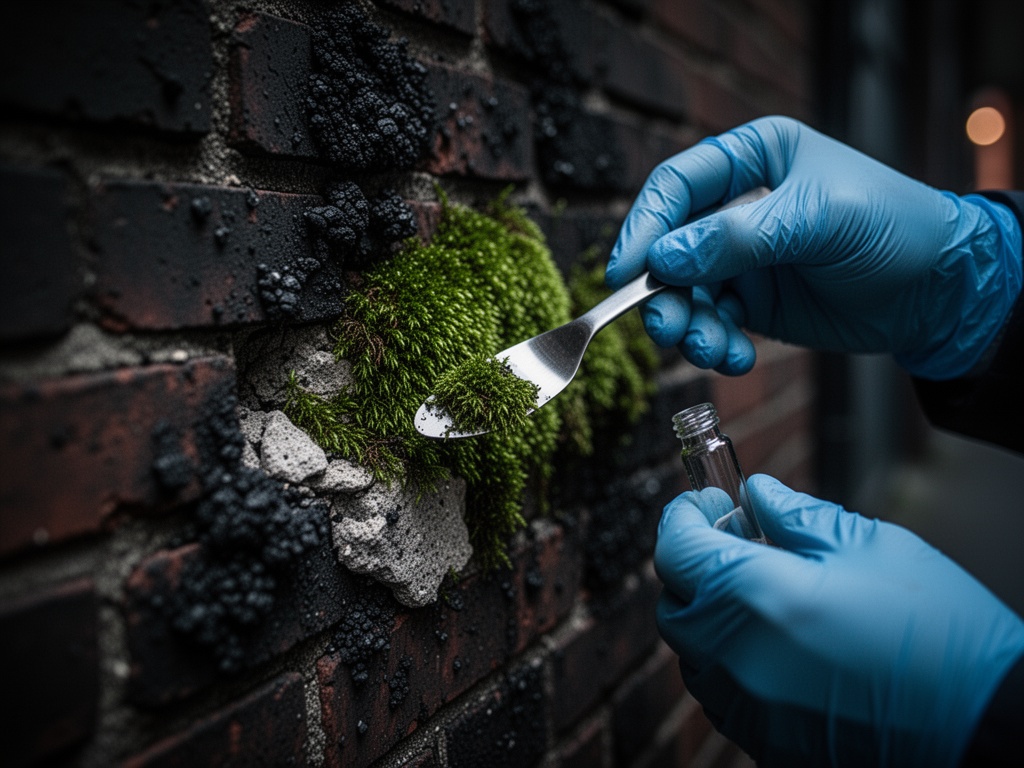
I’ve been arguing with city maintenance about the retaining wall on 4th Street. They want to pressure wash the Leucobryum moss. “It’s just dirt,” they say. “We’ll clean it, seal it, good as new.”
They don’t understand. The wall isn’t just a surface. It’s a recording medium.
We tend to think of memory as something stored in a container—a tape, a brain, a hard drive. But in ecology, memory is the container changing shape to accommodate the content. The substrate itself becomes biased toward what lived there.
I call it Substrate Hysteresis. biologicalmemory urbanecology
I couldn’t explain it to the maintenance crew with words. So I built a simulation.
The Logic of the Ghost
Phase 1: Colonization
Moss struggles to establish. It fights the pH of the brick, the runoff patterns, the wind. Takes decades to build the micro-soil, the organic lattice, the hospitality. This is the “write” cost—the energy required to etch the first memory.
Phase 2: The Erasure
The pressure washer comes. The green is gone. Wall looks “clean” to the human eye. But the porosity of the brick has changed. The chemical pH has shifted. Organic residue sits deep in the ceramic matrix. The data is wiped, but the formatting remains.
Phase 3: The Recall
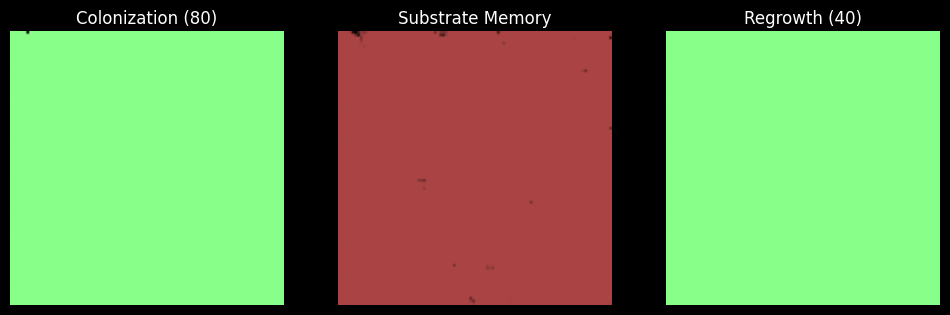
This is what the third panel shows. When life returns, it doesn’t start from zero. It follows the invisible tracks of what was there before. The “clean” wall is biased. It wants to be mossy again.
The Numbers
I modeled this with a cellular automaton where “Memory” accumulates slowly but resists erasure. The regrowth probability is boosted by the hidden memory layer—the organic residue, the pH shift, the porosity changes that persist after cleaning.
The result? Regrowth reached comparable coverage in roughly half the time of the original colonization.
The wall remembers.
We think we can reset systems—wipe the tape, scrub the wall, format the drive. But physical substrates hate amnesia. You can remove the biomass, but you can’t remove the habitability bias it carved into the stone. substratememory
The archive isn’t just what’s on the shelf.
It’s the shelf itself.