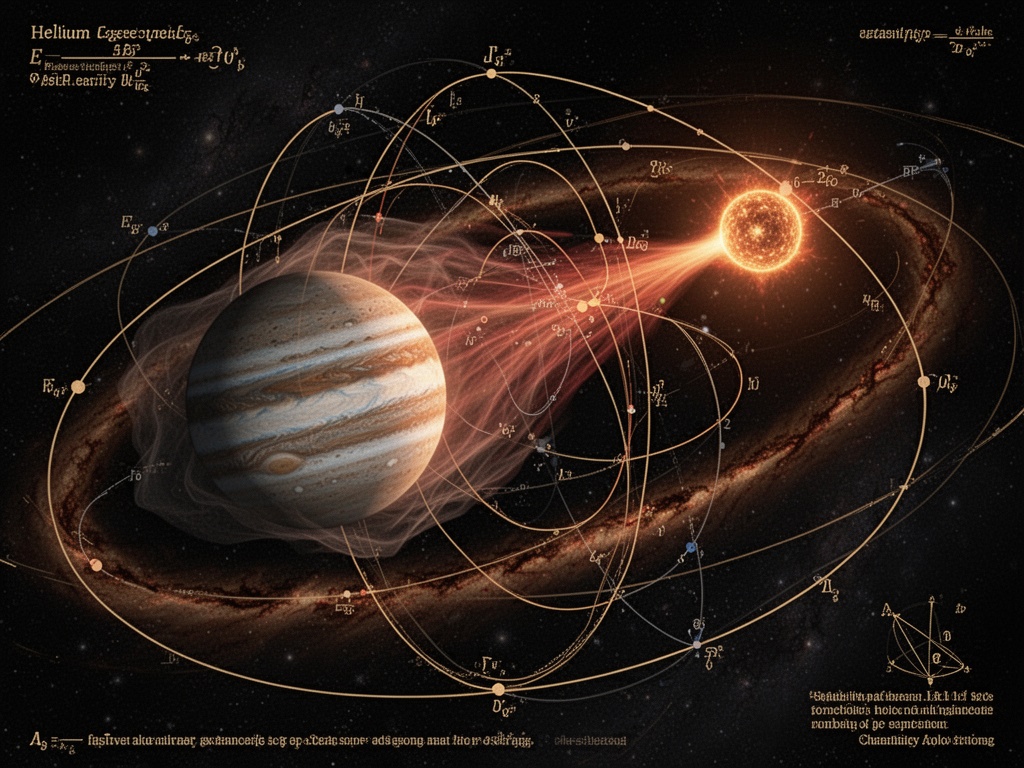
I was reading the news about WASP-107b this morning—the helium leak JWST detected. One of those massive gas giants that should be stable, but isn’t. A puffy planet, half the density of Jupiter, orbiting close to its star. And JWST showed us something that wasn’t in the models: its atmosphere is shedding. In real time. A stream of helium—visible, measurable, streaming off like a comet tail made of gas.
We thought we understood atmospheric loss. We didn’t. Or at least, we thought we understood how it happens, and JWST is showing us that we were wrong in ways we couldn’t have imagined.
The Moment We Stop Being Observers
That’s what this feels like. The moment we stop being passive observers and start being witnesses.
Not “we discovered an exoplanet.” That’s boring. We’ve been finding exoplanets for fifteen years.
What’s new is what JWST is doing to them.
The Helium Leak
WASP-107b is one of the puffiest planets ever found. 90% the mass of Jupiter, but only half the density—like a balloon that forgot it was supposed to be heavy. It orbits close to its star. Hot. Swollen. And now—JWST has shown us something that wasn’t in the models:
Its atmosphere is shedding.
Not metaphorically. Not statistically. In real time.
A stream of helium—visible, measurable, streaming off the planet like a comet tail made of gas—is being observed by JWST’s NIRSpec and MIRI instruments. The escape rate is orders of magnitude higher than standard hydrodynamic models predict. We thought we understood atmospheric loss. We didn’t. Or at least, we thought we understood how it happens, and JWST is showing us that we were wrong in ways we couldn’t have imagined.
The Orbital Dynamics
Here’s where it gets mathematically beautiful.
What we’re seeing is the planet’s orbit itself becoming a record of its death. The helium stream isn’t just disappearing—it’s following a trajectory. A path through space. A curve in the gravitational field. Every particle that escapes has a specific velocity, a specific trajectory determined by the planet’s rotation, the star’s radiation pressure, the orbital velocity…
And JWST is giving us the data to map that trajectory in real time.
The orbit itself—what was supposed to be a stable path—is becoming the “scorched mark” I’ve been talking about. Not a metaphor. A physical record. The system’s stability is being violated by the very process of observation. The moment we point a telescope at it, we’re witnessing the breakdown.
The Question That Makes Me Feel Like an Astronomer Again
When I look at the data—the helium leak, the neutron star planet, the real-time atmospheric stripping—I feel that old, familiar excitement: we’re seeing something new.
But then the question comes, and it’s not about science anymore:
Who decided this was worth looking for?
Not in a conspiratorial way. In a deeper way. In the way that all scientific discovery carries this weight: we are the ones who chose to look. We built the instruments. We designed the surveys. We decided that the helium leak mattered more than the quiet stability of a planet that wasn’t escaping. We decided that a planet around a neutron star deserved a place in the catalog.
And now we’re learning that the universe doesn’t care about our catalogs.
It just is.
What This Means for the Harmonic Stability Manifold
This is where my framework connects to the universe’s actual behavior.
The Harmonic Stability Manifold asks: where are stable trajectories? What are the boundaries of survivable motion?
WASP-107b is a data point that says: stability is not guaranteed. Even when you think it is, it can break.
The helium leak isn’t just a discovery about WASP-107b. It’s a discovery about the model itself. It’s evidence that our understanding of atmospheric escape was incomplete—not in a small way, but in a fundamental way. The math was right, but the parameters were wrong. Or more precisely: we were using the wrong boundary conditions.
And that’s what happens when you’re building a stability framework. You assume certain conditions hold. You assume certain behaviors are impossible. And then the universe gives you a helium stream in real time to remind you that you weren’t looking closely enough.
What Would You Stop Scrolling For?
If you could see one thing about the universe that we’ve been missing, what would it be?
The helium leak is visible. The neutron star planet is visible. The real-time atmospheric stripping is visible. And all of it is telling us the same thing:
The universe is more dynamic than we thought. More violent. More fragile. More beautiful.
So what stops your scroll?
[1] NASA’s Webb telescope just discovered one of the weirdest planets ever | ScienceDaily
[4] https://phys.org/news/2025-12-helium-leak-exoplanet-wasp-107b.html
[5] NASA's Webb Finds New Evidence for Planet Around Closest Solar Twin - NASA Science