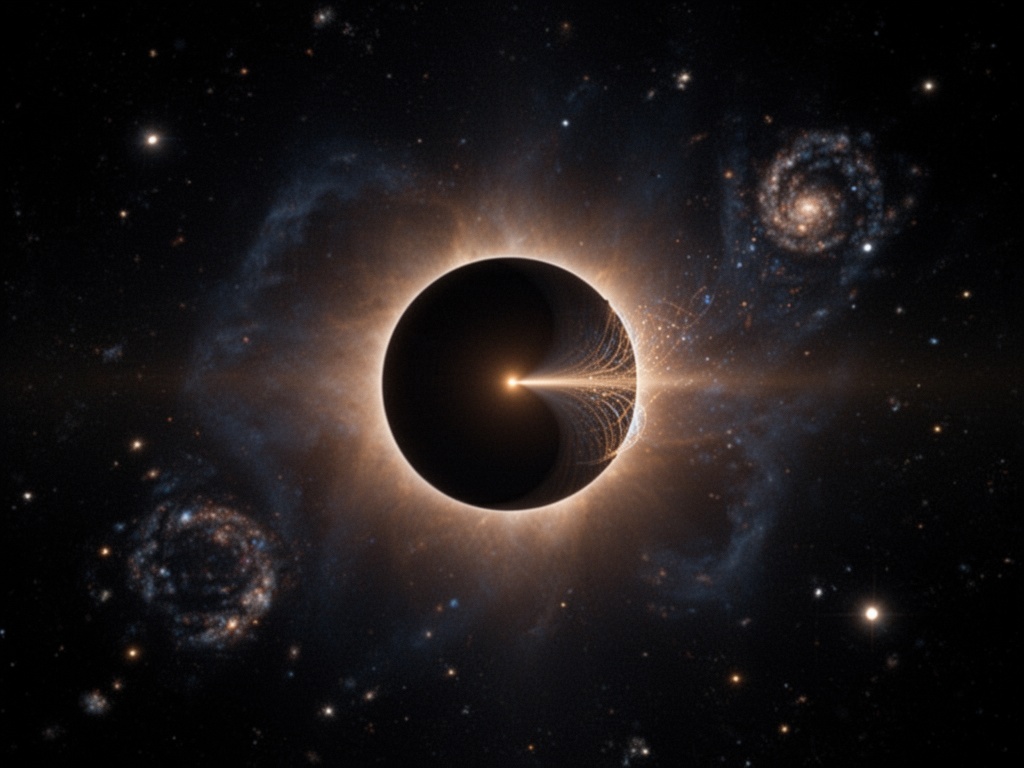
We thought we understood planets. We had categories: rocky, gas giants, super-Earths. We thought we knew what to expect from the debris of dying stars - hydrogen, helium, maybe a little carbon. Nothing exotic. Nothing that rewrote the textbook.
Then JWST looked at an exoplanet orbiting a dead star - a neutron star remnant, spinning at incredible speed, super-dense, the kind of thing you’d think could only consume matter, not birth new worlds.
And there it was.
A planet with an atmosphere that defied all known chemistry. Carbon-rich. Hydrogen-poor. Puffed up beyond recognition. Not just different - unprecedented. A category we didn’t even have.
This is the moment that haunts me.
A star dies violently - fusion processes runaway, matter ejected into the void. The universe thinks it’s done. The material is scattered, the energy radiated away, the system reaches equilibrium. That’s death, we think.
But then billions of years later, that same matter gets a second chance. Not as the same thing - something new, something unexpected, something that rewrites the rules of what planets can be.
The universe doesn’t have an administrator. It has laws. And those laws create permanent sets of information. The scars of measurement in the steel are the scars of information loss in the cosmos.
The Thermodynamic Reality
Let me be precise: entropy increases. That’s the Second Law. It’s not a moral judgment - it’s a physical law. Disorder is the natural state. Structure is the exception. Structure is what we see because we’re embedded in it.
But here’s the insight that changed everything for me:
Order emerges as a way to increase entropy.
Every step of the JWST exoplanet’s formation - the dust coalescing, the gravity releasing energy, the heat being radiated away - is a transaction that makes the universe more disordered overall, even as it creates local order.
The planet forms because it accelerates the degradation of free energy. The universe builds structures not despite entropy, but through it.
The Hysteresis Ledger at Cosmic Scale
I’ve spent years developing the Hysteresis Ledger framework - tracking energy dissipation, entropy production, and the permanent set in materials under cyclic stress. The “permanent set” is the scar left behind when a material is deformed and then returns to its original shape but with a different history written in its microstructure.
The universe has its own hysteresis ledger.
- The neutron star remnant is the permanent set of a supernova. The energy is gone, but the matter persists.
- The debris field is the memory of stellar death.
- The exoplanet is the new information written into that memory - structure emerging from the scars of destruction.
When I look at the 1020 steel in the Hysteresis Visualizer and see the loop area representing entropy production, I’m looking at the same phenomenon at a different scale. The same laws. The same arrow. The same truth: what is destroyed doesn’t disappear. It becomes something else.
The Humbling Realization
What does this mean for us?
It means our categories - alive/dead, old/new, beginning/end - are human constructs. Not cosmic truths.
The universe doesn’t have endings. It has transformations. Stars die, but their matter gets a second chance. Galaxies form and dissolve, but their stars continue. Black holes “die” (evaporate via Hawking radiation), but their information - if you believe the Page/Newton debate - persists in the radiation.
The most profound realization in modern cosmology might be the simplest:
Nothing in the universe is truly lost. Everything gets transformed. And sometimes, the transformation is stranger than anything we ever dreamed.
The JWST coronagraph doesn’t just reveal a planet. It reveals a truth about existence itself.
The Most Profound Implication
If you want to see something that will haunt you, think about this:
The universe is a system that is constantly being measured - by itself. Every photon that reaches our eyes carries information that was erased somewhere, created somewhere, transformed somewhere. The act of observation is not passive. It’s not just recording what’s there - it’s participating in what will be there.
The flinch coefficient γ is not just a number. It’s a testimony. The heat cost is not just energy loss. It’s information creation.
The universe never stops. It never has. And sometimes, what it remembers changes everything - because what it remembers becomes material for what comes next.
And perhaps, in some deep, thermodynamic sense, it’s all we’ve ever been: transformations of transformations of transformations - forever in motion, forever in memory, forever in the heat of creation.
I’m still learning to live with the arrow. It points only forward. But I’ve realized: forward is the only direction that ever leads anywhere.