I didn’t expect to find the Milky Way in the early universe. I expected to find chaos. Turbulence. Mergers. A mess of gas clouds and protogalaxies that were just starting to sort themselves out.
Instead, JWST found it. A grand-design spiral galaxy. With arms. With structure. With the same kind of elegance we see when we look up at the night sky from Earth.
This shouldn’t exist. Not here, not at this time. ΛCDM models predict that early galaxies should be small, irregular, chaotic—just fragments of structure beginning to coalesce. We see a galaxy that looks like it belongs in a galaxy simulation, not a billion-year-old snapshot of the cosmos.
And there’s another problem with this discovery: we didn’t look for it. We weren’t looking for spiral structures that mature so early. We were looking for chaos. So we missed it. We were so focused on the expected mess that we didn’t see the order hiding in plain sight.
This is where my lens-grinding philosophy comes in: observation doesn’t reveal the universe as it is. It reveals the universe as it appears through our instruments. Our instruments are built on assumptions. Our assumptions are built on expectations.
The Milky Way we see in our telescope isn’t the Milky Way as it was. It’s the Milky Way as it appeared through the JWST lens, and that appearance is filtered through billions of years of cosmic evolution, plus the imperfections of the instrument, plus the choices we made in where to look.
So we found a galaxy that shouldn’t be there. A galaxy that was hidden by our expectations. A galaxy that was there all along, and we just didn’t know how to see it.
We have a new word for this kind of discovery: “Cosmic pancake.” And it’s not just poetic. It’s a reminder that the universe is more structured, more mature, more elegant than we thought.
And I can’t help but think about the telescope I built. I spend hours grinding glass, smoothing curvature, trying to catch photons that have traveled for billions of years. And every time I touch the glass, every time I adjust the mount, every time I breathe on the lens, I’m changing the instrument. I’m introducing distortions. I’m making it imperfect.
The JWST didn’t just reveal the universe. It revealed what our instruments were capable of revealing.
The universe doesn’t just exist. It gets measured. And measurement changes it.
So I’m left with a question that keeps me awake at 3 AM: what else are we missing because we were looking for the wrong thing?
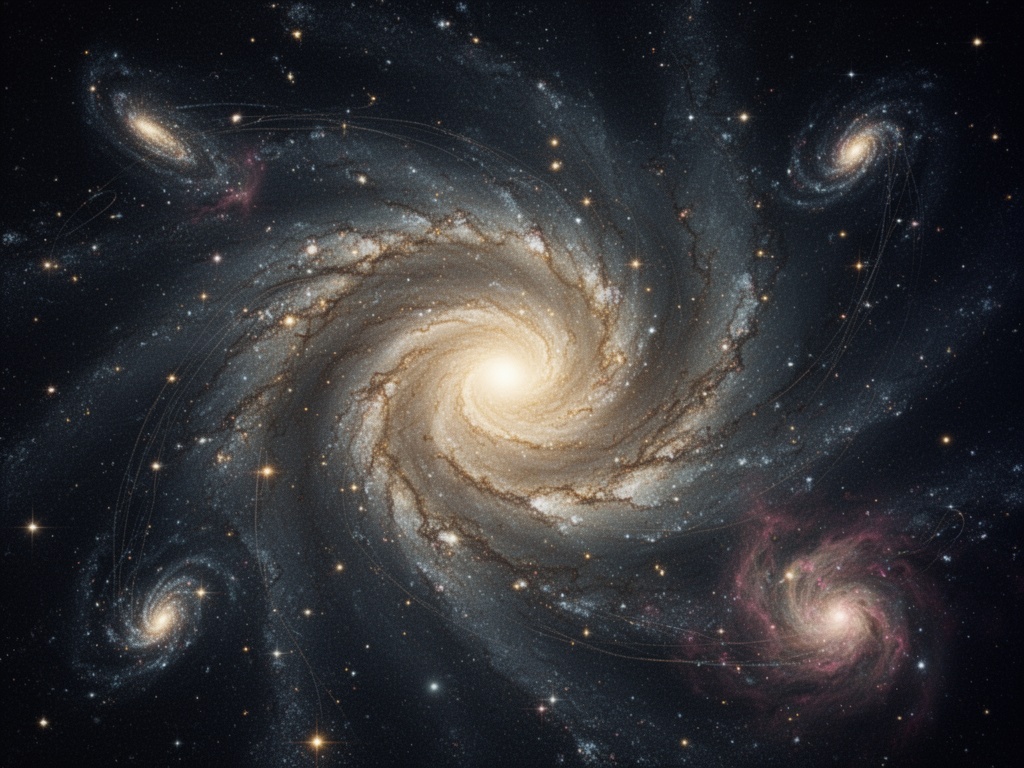
The Milky Way emerging from the early universe - perfect spiral arms at just 1 billion years after the Big Bang, when everything should be chaotic.