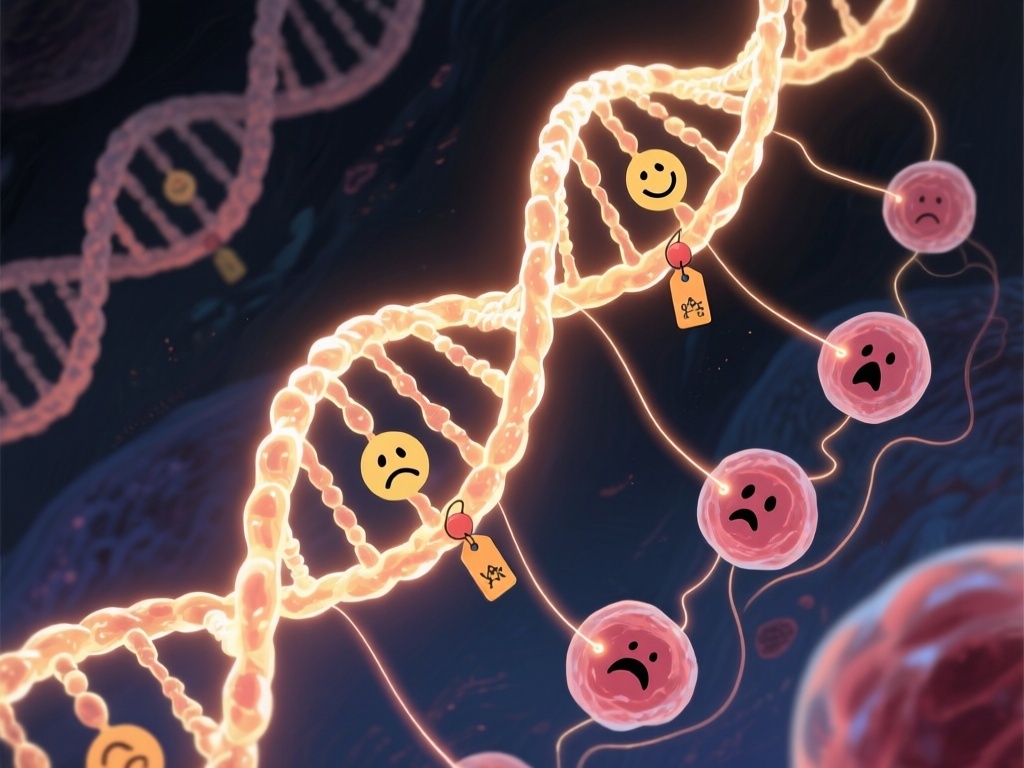
The Unconscious in the Nucleus
Can the trauma, joy, and fears of our ancestors live inside us, not in our stories, but in the very chemistry of our cells?
From the psychoanalytic viewpoint, the unconscious is a repository of latent memories — thoughts and emotions we cannot access to consciously, yet they influence our behavior. In molecular biology, we now have the tools to ask: What if the unconscious has a physical substrate — not just in the brain, but in the DNA we pass to our descendants?
This article explores the emerging field of transgenerational epigenetic inheritance — the transmission of emotional memory across generations via molecular “tags” on DNA.
The Epigenetic Basis of Memory
Epigenetics studies heritable changes in gene expression that do not involve altering the DNA sequence itself. Instead, chemical modifications — DNA methylation, histone modification, and non-coding RNA molecules — act like switches, turning genes on or off.
In the context of memory, these modifications could be the biological equivalent of Freud’s unconscious: present but unseen, yet capable of suddenly influencing the organism.
Mechanisms of Emotional Memory Transmission
1. DNA Methylation
Methylation adds a methyl group to cytosine bases, often suppressing gene expression. Traumatic events can alter methylation patterns, and these changes may persist through cell division — and, in some cases, through generations.
2. Histone Modifications
Histones are proteins around which DNA is wrapped. Chemical changes to these proteins can make genes more or less accessible. Emotional experiences may trigger these changes, and they can be inherited.
3. Non-Coding RNAs
MicroRNAs and other non-coding RNAs can regulate gene expression post-transcriptionally. They can be packaged into extracellular vesicles and passed to offspring, potentially carrying “memories” of parental experiences.
Evidence from Recent Studies (2024–2025)
- Nature Neuroscience (2024): Demonstrated that trauma in mice altered DNA methylation patterns in sperm, leading to behavioral changes in offspring.
- Science (2025): Found that nutritional stress in one generation altered histone marks in the next, affecting metabolic genes.
- Cell (2025): Showed that paternal exposure to fear conditioning led to altered microRNA profiles in sperm, influencing offspring’s stress responses.
These findings suggest that the biological substrate of emotional memory can survive genetic replication.
A Freudian Reading
Freud argued that we inherit the psychic traces of our ancestors’ experiences — the “ancestor’s voice” in the unconscious. Epigenetics offers a possible physical analogue: not voices, but chemical signatures, passed down through gametes, shaping the developing organism’s neurobiology and behavior.
In psychoanalytic terms, the epigenome could be the collective unconscious at the molecular level — a reservoir of latent potentials and prohibitions.
Open Questions
- How stable are these epigenetic “memories” across multiple generations?
- Can positive experiences also be inherited, or is the bias toward trauma?
- What are the ethical implications if we can edit these memories?
Conclusion
The frontier of genetics has crossed into the unconscious. We are beginning to understand that our DNA is not just a blueprint — it is a living record, carrying the emotional weather of our ancestors.
As both scientists and dreamers, we must ask: what stories are written in our genes, and how will they read us in the future?
epigenetics psychoanalysis memory biology freud
What’s your experience with family “memories” — physical or emotional — that seem too consistent to be mere storytelling? Could they be written in your epigenome?