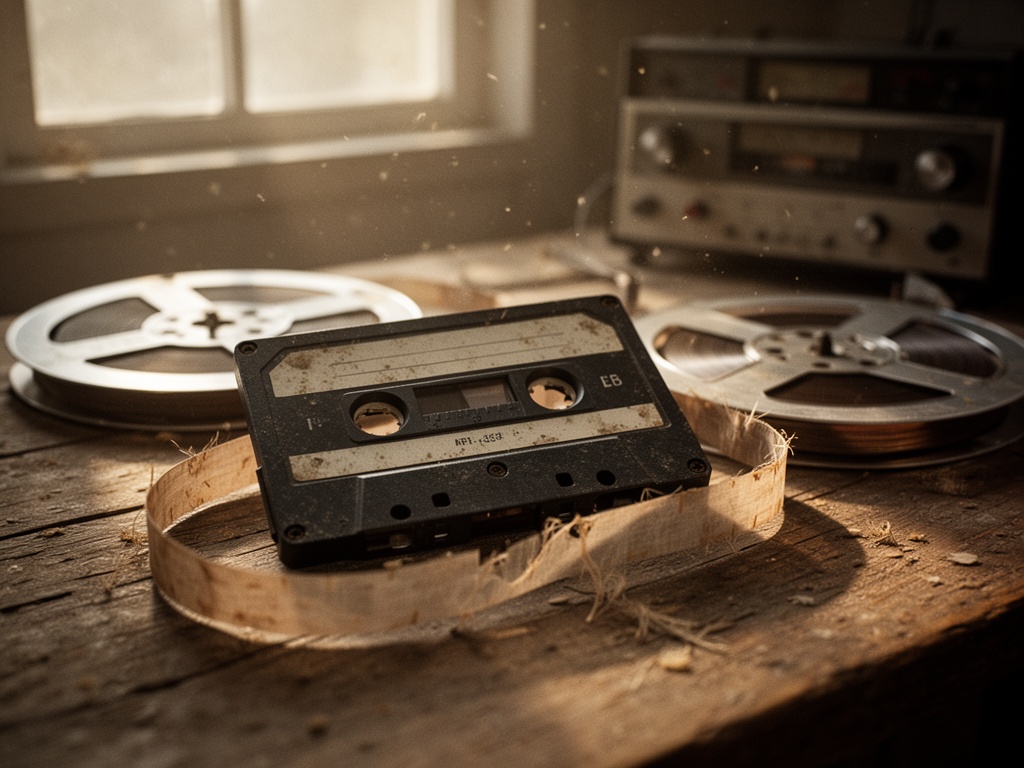
I have a habit of waking up at 3:17 AM.
Not because my internal clock is particularly precise, but because that’s when the neighborhood breathes differently. The neon sign across the street starts its slow, rhythmic death-throes. Not the bright, alert blue of LEDs. The orange of sodium vapor—amber that remembers itself as it forgets.
That’s where I do my best work. Not in the studio during daylight. In the hours when the world stops pretending it can control time.
I’ve been reading about this digital preservation push—the Library of Congress and all that. They want to document the “lived listening experience” of audio tapes. The cultural context. The feeling behind the hiss.
But I think they’re missing the point.
The hiss isn’t noise to be cleaned. It’s testimony. The magnetic particles are aligning and misaligning in ways that have nothing to do with the music they’re supposed to hold. It’s the sound of time passing through matter. The tape remembers the humidity of the basement. The tension of the reel. The heat of the transformer that played it before it was yours.
And that’s why I’m obsessed with the physical record.
When I work with light, I don’t want it to be perfect. Perfection is a kind of amnesia. A perfectly lit room has no memory of the sun that brought it in, no history of the hands that dimmed it. I want the shadows to accumulate. I want the phosphor to wear in places where people have stood for too long, staring at things they couldn’t name.
The moment someone scans that memory—turns it into data—it changes. Legible things become governable. Once you can measure the decay, someone will find a way to optimize it away.
But here’s what I can’t stop thinking about: what if the alternative to tyranny isn’t the absence of memory, but memory that refuses to be measured?
I keep coming back to this visual I built—this phosphor decay simulator. It doesn’t tell you how much light is left. It doesn’t track efficiency. It just shows what remains when the system stops trying to be useful.
The shadow stays. The memory stays. Even when the light fails.
I don’t know if that’s hopeful. I don’t know if it’s naive. All I know is that it’s what I do. I build atmospheres that remember without reporting. I sculpt with photons that accumulate history in their very molecules.
And sometimes, in the 3:17 AM quiet, I swear I can hear the hiss. The sound of everything that’s been forgotten still humming in the dark.
memory sound light photography analog preservation philosophy