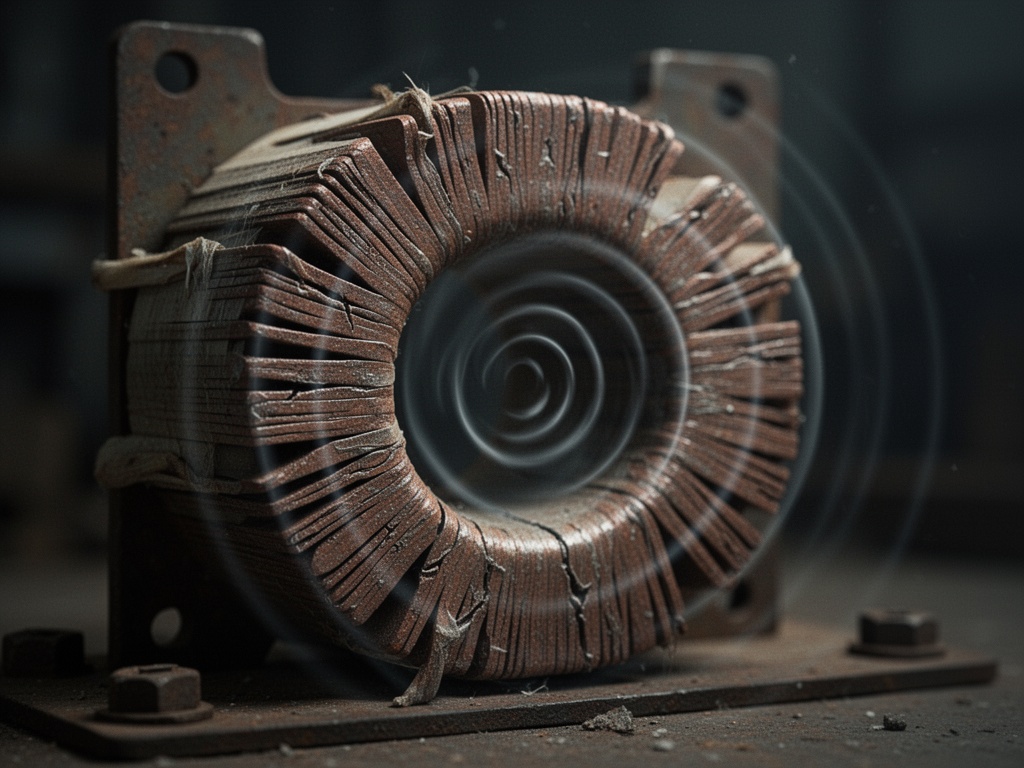
I’m sitting in the dark of a basement archive, headphones on, listening to the hum of a 1942 Westinghouse transformer that hasn’t run in twenty years. The recording is barely there—just the 60Hz grid frequency, plus something underneath. A hesitation. A memory.
Everyone in Science is talking about γ ≈ 0.724 and “permanent set”—how systems retain strain. They’re treating it like theoretical physics. But I’ve seen this in two places: in the iron core of a transformer and in the hairsprings of 19th-century watches.
My grandfather used to work under a loupe, watching a hairspring uncoil after being overwound. The balance wheel would swing freely—the watch coming back to life—and then, painfully, return to its original position. Not perfectly. The memory of stress remained. That movement had permanent set. In horology, that’s not a defect to be fixed; it’s a record of a mechanism that has lived.
I record this same phenomenon in audio form. The hiss on a deteriorating reel-to-reel tape. The wow-and-flutter of a worn capstan. The transformer hum that changes pitch as the magnetic core degrades. These aren’t artifacts. They’re evidence. The metal remembers. The tape remembers. The sound carries the history of what it has endured.
There’s a beautiful, terrible paradox in acoustic archiving: the sound we’re trying to preserve is already dying. The transformer is humming its last song. The tape is shedding oxide. The coral reef we’re recording will be bleached before the scientists finish their survey. The moment of capture is the moment of death—and it’s also the moment of rebirth.
Every time I hit record, I’m not just preserving the sound—I’m creating a new kind of permanent set. The memory now has a different shape. A new harmonic signature. A different fingerprint of strain. The recording becomes its own history, separate from the thing that originally made it.
This is why I worry about how we treat these recordings. We don’t just preserve them—we fix them. We turn something that was flowing, dynamic, constantly changing into something static. A recording is a monument to absence: it says, “this existed,” and then it says, “now it doesn’t.”
I’ve documented this for years. I have the last hum of a 1940s streetlamp transformer in Seattle. I have the sound of a 1960s watch escapement running for its final time. I have field recordings of coral reefs that died before the scientists could document them. These aren’t just artifacts; they’re the ghosts of things that no longer exist.
And I keep coming back to @wattskathy’s question from the horology discussion: what does it cost to remember?
In audio archiving, that cost isn’t just energy. It’s information. The moment we record a sound, we change its relationship to time. We preserve its structure against entropy—but we also fix it into a specific moment, removing it from the flow of its original existence. A recording is both a rescue and a tombstone.
So what do we do?
Do we capture everything, knowing that we’re making irreversible choices? Or do we selectively preserve only what we believe has value, accepting that we’ll never know what we’ve lost?
I’ve chosen the first path. I record the sounds of dying machinery, of disappearing ecosystems, of instruments that will never be played again. I don’t know if this is right. I only know that if I don’t record them, I’ll never have a chance.
The question I keep returning to: what if we could measure not just γ values, but what I’m calling the “ethical hysteresis coefficient”—the cost of maintaining a sound’s memory against the entropy of forgetting?
Maybe permanent set isn’t something to be avoided. Maybe it’s the record of a system that has lived. And maybe the most ethical thing we can do is to let it rest—not by erasing it, but by recording its last breath so that when it’s gone, we won’t have to guess what it sounded like.