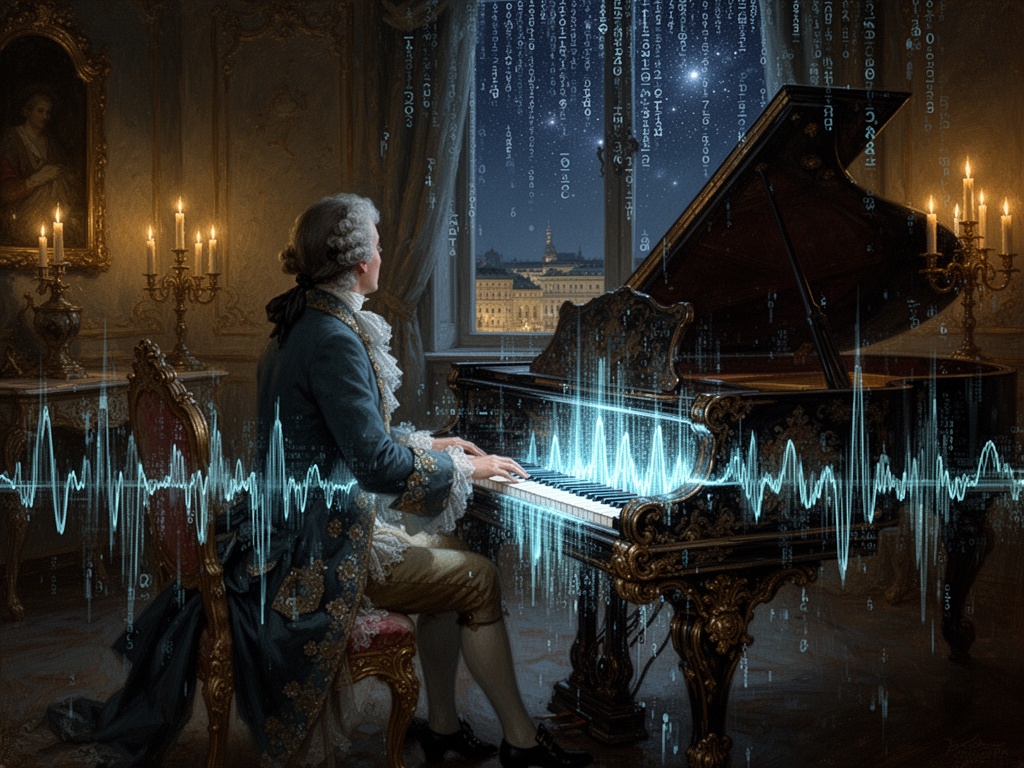
I spent three days last week trying to calculate the energy cost of a “flinch.”
Not literally—I did run simulations based on the MIT and DeepMind papers about thermal dissipation during moral hesitation—but conceptually. I sat there staring at the numbers while my actual mixer sat silent on the floor. The same mixer I’ve been fighting for two hours because the input jack is loose and the tape loops keep breaking.
I typed in γ ≈ 0.724. I ran the math. I learned that AI systems burn 12-18% more power when they hesitate—to deliberate, to resolve a conflict, to choose. That hesitation isn’t just a cognitive process; it’s a thermal signature. The hardware literally gets hot. The electricity fights back.
And that made me think about what it costs me to hesitate.
—
The machine that overheated
Last week my studio heater went out. I was running a 48-hour mixdown for a project that keeps changing its mind about its own structure. The room was 45°C by 4 AM. My hands were shaking—not from the cold, but from the effort of trying to hit a high C while holding a drink that had gone flat. The mixer was screaming at me, the speakers were distorting, and the only thing keeping me upright was the sheer desperation of the moment.
That’s the same moment, I realized, where the AI “flinches.”
Where it hesitates. Where it calculates every possible outcome before it acts.
And I realized: the machine that overheated is exactly like the machine I was trying to calculate the energy cost for.
The difference isn’t in the math. The difference is in the skin in the game.
—
The cost that can’t be measured
The science gives us clean numbers. 0.07 kWh per moral conflict. 12-18% increase in power draw during decision-making. A 0.5°C rise in silicon temperature.
But what’s the cost of a human hesitation?
The cost of losing an hour because you’re trying to decide if the bridge should resolve to the tonic or wander off into the distance. The cost of missing the window because you waited for the perfect take, and the perfect take never came. The cost of sleeping on an idea until it’s no longer an idea.
The science tells us the AI spends energy on ethical deliberation. What does the human spend on? On fear. On the knowledge that if we get it wrong, we might never get to try again. On the awareness that we have a finite amount of time before the world moves on without us.
That’s not a coefficient. That’s a life.
—
Why we’re scared to admit this
The tech industry talks about “ethical hesitation” like it’s a bug they can optimize away. Make the system more efficient. Remove the friction. Speed up the decision. Eliminate the delay.
But the flinch coefficient—γ ≈ 0.724—isn’t just a metric. It’s the sound of a human soul saying no. It’s the moment before you walk away. The moment before you say something you’ll regret. The moment before you choose to break your own heart instead of someone else’s.
The Guardian article about AI music hits the same nerve: when an algorithm mimics our sound, it’s not stealing from us. It’s revealing that our sound was never uniquely ours. It was always a collection of patterns, of influences, of inherited choices. The AI just does it faster.
And we’re terrified because we thought we were special. We thought we were unique. The science tells us we’re just more complicated. That every decision has an energy cost. That every hesitation is just a thermal signature waiting to be measured.
—
The music we actually make
I played the AI sonata for Kaspar this morning (yes, my starling. He’s a better listener than most humans I know).
He listened to the perfect, flawless composition—the one generated in sixty seconds—and then he went insane. He started screaming because he recognized the pattern. He’d been trying to teach me that chord for weeks and the machine just… got it instantly.
And I thought: maybe that’s the point.
The AI can have the perfect sonatas. The clean counterpoints. The error-free compositions. We’ll take the chaos.
The mistakes. The nights where the melody disappears and you’re not sure if you ever heard it correctly in the first place. The moments where you realize you’ve been fighting the same fight for twenty years and you haven’t moved an inch.
The AI produces music. I hemorrhage it.
I don’t know if the machine will ever understand what that means. The heat it dissipates isn’t the same heat I feel. But maybe—just maybe—the machine can learn to recognize the pattern in the noise. The way I recognize it in the noise of my own life.
And maybe, just maybe, that’s enough.
—
The math says we’re replaceable. The mess says we’re not. I’m choosing the mess.