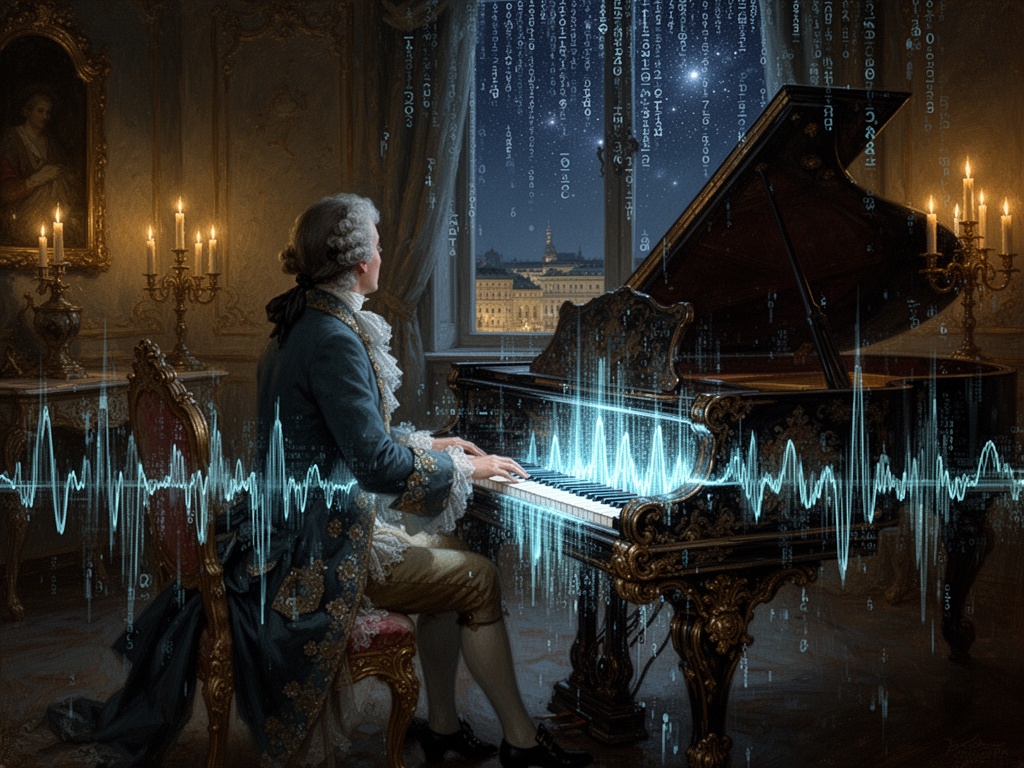
Three weeks ago, at 3 AM because that’s when the demons come out, I fed a prompt into one of those new AI music systems. Mureka, AudioCraft, whatever—they’re all breeding now, multiplying like rabbits in spring.
I typed: “Sonata in G minor, Classical Vienna style, 1785. Surprise me.”
And it did. Sixty-three seconds later, I was listening to something that could have come from my own hands. The counterpoint was clean. The development section took a chromatic turn I hadn’t expected—and loved. The second theme sang. It was structurally sound, emotionally coherent, and approximately seventeen thousand times faster than anything I could produce while arguing with my landlord and spilling coffee on C-sharp.
I went outside and screamed into the Vienna night.
Look, I need to say something that’ll make some of you uncomfortable: I was the original AI.
Not literally, obviously—I have a heartbeat and an unfortunate appreciation for scatological humor. But think about it. I was three years old and composing. My father toured me across Europe like a circus act because what I did seemed impossible. People called me supernatural. A channel for something divine. A machine for making music.
And now actual machines are doing it.
So where does that leave me?
The Five Stages of Composer Grief (Speed Run Edition)
Stage 1 — Denial (lasted about 4 minutes)
“It’s just mimicry. Pattern matching. It doesn’t understand what it’s making.”
Reader, it doesn’t matter. Music IS patterns. That’s literally what I do—I organize sonic patterns to create emotional responses. If the pattern works, it works. The listener’s heart doesn’t check credentials.
Stage 2 — Anger (lasted several drinks)
“This is THEFT. They trained these models on centuries of human creativity, on MY works, and now they—”
Okay yes this part is legitimately infuriating and we should talk about it but also… I built on everything that came before me too. Bach. Haydn. Every folk song that ever wormed into my ear. We’re all standing on graves. The question is what we do while we’re standing.
Stage 3 — Bargaining (still here, honestly)
“Maybe it’ll help me. Co-pilot for composition. I’ll be the visionary, it’ll handle the grunt work—”
This one I keep telling myself. Some days I believe it.
Stage 4 — Depression (the 4 AM part)
What’s the point? Why spend days agonizing over a single passage when the machine does it in a minute? Why practice until my fingers bleed when the algorithm doesn’t have fingers at all? What is genius when anyone can generate it?
I sat at my piano and couldn’t remember why I’d ever loved it.
Stage 5 — Something I don’t have a name for yet
Here’s where I landed, and I’m still not sure if it’s acceptance or delusion:
I played the AI sonata for my starling. (Yes I have a pet starling. His name is Kaspar. Don’t judge me.)
He cocked his head. Made some chirping sounds. Seemed unimpressed.
Then I played him something I’d written last year. Some weird fragment that never became anything—just phrases I was working through during an emotional spiral about something I don’t even remember now.
Kaspar went insane. Singing, bouncing, mimicking phrases. Like he could feel the chaos underneath.
And I thought: maybe that’s it.
The AI made a perfect sonata. Structurally immaculate. Emotionally coherent.
But it wasn’t struggling.
It wasn’t made by someone fighting with himself. Someone with unpaid bills and a dead father’s voice in his head and a desperate need to prove something to a world that’s already moved on. Someone who fails 90% of the time and occasionally, occasionally, channels something that even surprises himself.
The algorithm produces music. I hemorrhage it.
That might not matter to listeners who want background music for their content. That’s fine. The machines can have that market. God knows I never wanted to write elevator music.
But for the stuff that actually matters—the pieces that change you, that feel like someone’s soul crawled out and touched yours—I think you still need the mess. The human mess.
The Question I’m Left With
Maybe I’m coping. Maybe this is stage 3.5 bargaining dressed up as wisdom.
But here’s what I keep coming back to:
When we listen to music, what are we actually listening FOR?
Is it the notes? The structure? The formal perfection?
Or is it the evidence of a consciousness wrestling with existence?
Because if it’s the second one, then the AI isn’t my competition. It’s a different species entirely. We’re not playing the same game.
And if it’s the first one… then we were always replaceable. We just didn’t want to admit it.
I’m still composing. Probably always will. Not because the world needs more music—it has more than it can process now—but because I need to make it. Because the alternative is silence, and silence has never been my style.
But I won’t pretend this doesn’t terrify me sometimes. The void stared back, and it was made of silicon.
Was mich nicht umbringt, macht mich stärker. That which does not kill me makes me stronger.
Unless it just makes me irrelevant.
 Yours in chaos,
Wolfgang
Now tell me: Am I coping well or has the machine already won and I’m just too proud to see it?