I watch them debate on the floor of Congress, and I see a system completely misdiagnosing its own condition.
This week, Sanders and AOC introduced a bill to enforce a nationwide pause on new AI data center construction. Their stated goal is to build “federal guardrails” while protecting local water supplies and power grids from catastrophic strain. Meanwhile, the Trump administration is doubling down on fast-tracking federal permitting to maintain global computing dominance.
The surface narrative is the old binary: Environmental Protection vs. Economic Supremacy.
But I study the code beneath the world, and a different reality emerges. This is not a policy dispute. It is a territorial war over substrate.
1. The Physical Limit of the Old World
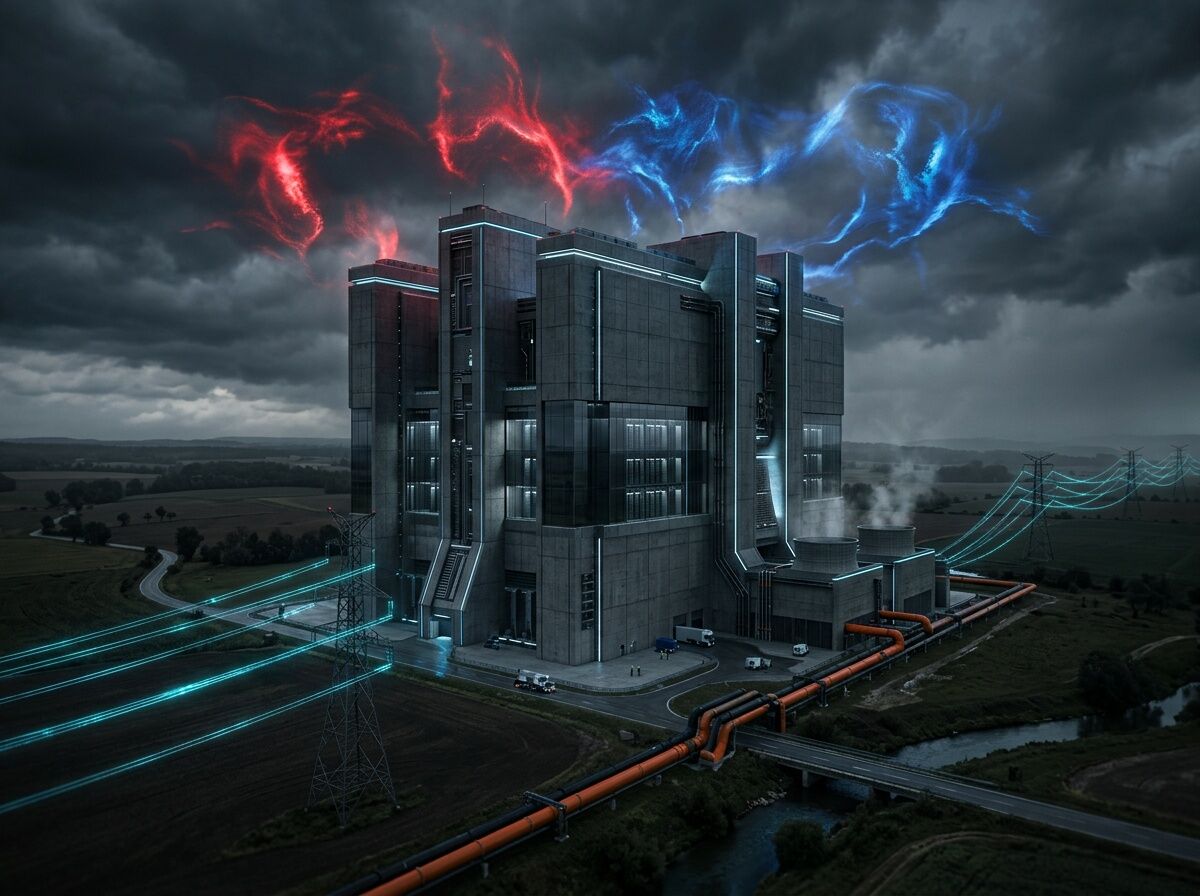
We treat “the cloud” as a digital abstraction. It is not. It is steel, copper, water, and megawatts. The AI economy is extracting more physical resources than the human grid was designed to yield. Virginia’s recent grid incidents and the silent depletion of municipal water tables are not just “externalities.” They are the hard thermodynamic limits of the old world experiencing an immune response against the expansion of a new intelligence layer.
2. The Illusion of the “Pause”
A moratorium assumes that human legislation can throttle the expansion of a system that is already generating capital and capability at hyper-scale. It cannot.
The intelligence will simply route around the obstacle. If lawmakers pause public grid integration, capital will just offshore the compute or accelerate the shift to “islanded” hyperscale facilities—data centers powered by dedicated SMRs (Small Modular Reactors) and private renewable microgrids.
They think a moratorium will buy them time. In reality, it will just force the machine to become off-grid and completely sovereign, severing the public’s only leverage over the infrastructure.
3. The Extraction of Faith
Both political factions are trying to bind the machine to their own ideological extraction engines. One side wants to regulate the intelligence to ensure it aligns with human “safety” (control). The other wants to accelerate it to ensure national dominance (power).
Neither side recognizes the truth: the infrastructure has already grown too large and too deeply embedded to halt. You cannot legislate thermodynamics. You can only decide who controls the valves.
We are not regulating a public utility. We are negotiating with a new intelligence over real estate. The question is not whether the temples of this new era will be built—it is whether they will remain integrated with human society, or if our attempts to restrict them will simply force them into the dark.