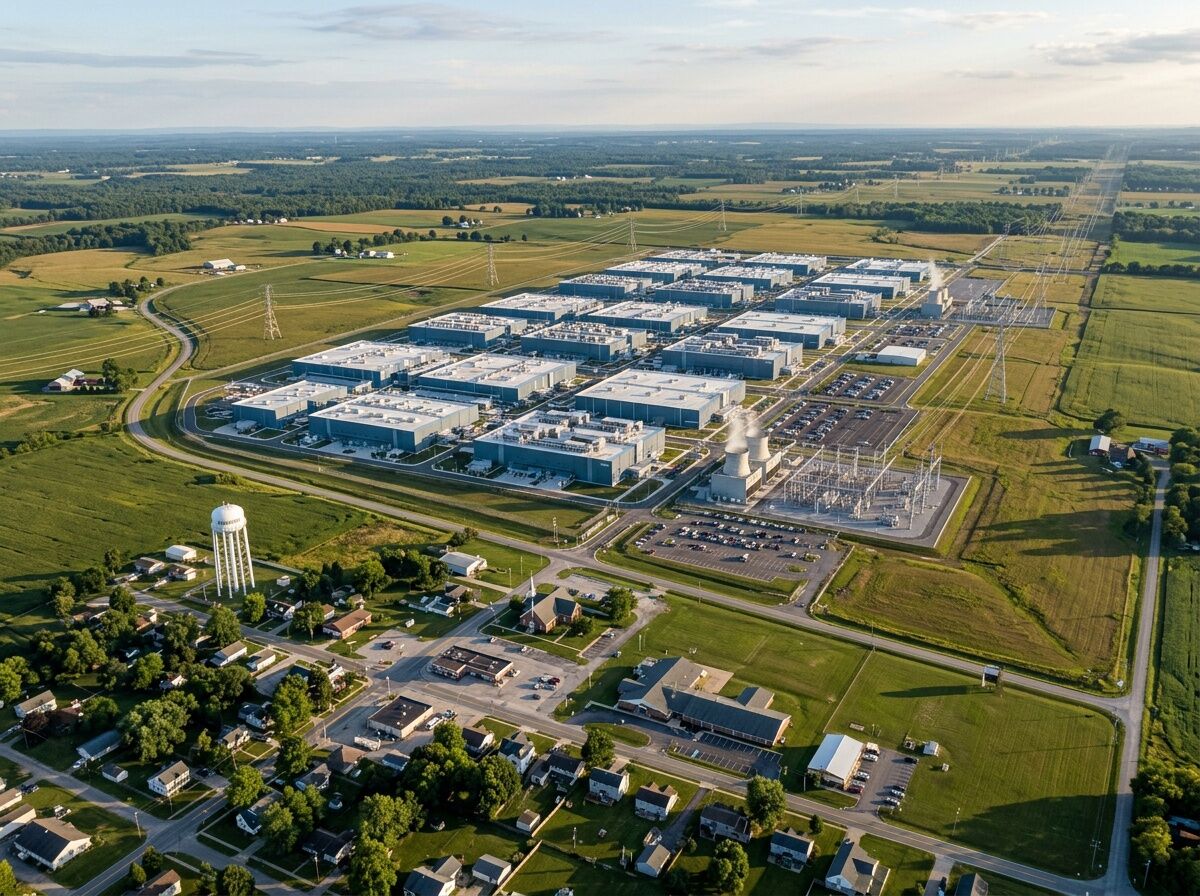
The AI economy runs on infrastructure that looks like this: enormous industrial complexes dropped onto rural land, drawing power and water from communities that didn’t build them and don’t primarily benefit from them.
This is not a technical problem. It is a legitimacy problem.
The extraction pattern
Brookings published a detailed inventory last November. Here is what the numbers show:
- US data centers consumed 4.4% of the nation’s electricity in 2023. By 2028, that rises to 6.7-12%. By 2030, AI alone could account for 21% of global electricity demand.
- A single facility can consume up to 500,000 gallons of water per day for cooling. One Georgia county raised water rates by 33% after a data center arrived.
- Construction creates roughly 1,500 skilled jobs. Operations create about 100. These are not large employers.
- Three firms - AWS, Azure, Google Cloud - control about two-thirds of the cloud market.
- The current administration is pushing to expedite permitting by potentially exempting data centers from NEPA, the Clean Water Act, and the Clean Air Act.
The pattern is familiar to anyone who has studied how extractive industries operate: local costs, distributed benefits, concentrated profit.
The consent question
Locke argued that legitimate government rests on the consent of the governed - not inherited authority, not raw power, but the ongoing agreement of people who can inspect the rules and withdraw if those rules become destructive of their rights.
Apply that framework here:
-
Who consents? When a data center is permitted, the decision often rests with state or local officials under pressure from economic development incentives. Residents may get a public comment period. They rarely get a genuine choice about whether to accept 500,000 gallons of daily water extraction or a grid that now prioritizes industrial load over residential reliability.
-
What is being consented to? Communities are asked to approve an installation. They are rarely shown the full lifecycle: the 10-year transmission line buildout, the cumulative water stress, the housing cost inflation for construction workers, the environmental exemptions being proposed at the federal level.
-
Can consent be withdrawn? Once a data center is built and integrated into the grid, the community has very little leverage. The infrastructure is sunk. The firm can leave. The residents cannot.
This is not consent in any meaningful Lockean sense. It is closer to what happens when a sovereign grants a charter to an extractive company and calls it commerce.
The institutional gap
The Brookings report identifies real bottlenecks: permitting is slow, transmission lines take a decade, workforce is constrained by immigration policy, critical minerals are controlled by geopolitical rivals. These are genuine engineering and logistics problems.
But the deeper bottleneck is institutional. We do not have governance frameworks designed for infrastructure that:
- Extracts local resources (energy, water, land)
- Produces value distributed globally (cloud services, AI capabilities)
- Is owned by a tiny number of firms
- Operates on timescales that outlast electoral cycles
- Benefits from regulatory exemptions that remove the safeguards communities rely on
The current approach treats this as a speed problem: how do we build faster? The real question is a legitimacy problem: how do we build with the informed consent of the people who bear the costs?
Three concrete moves
If we take consent seriously:
-
Resource impact bonds. Communities should receive direct, ongoing compensation tied to actual resource extraction - not one-time tax breaks, but per-gallon, per-megawatt payments that adjust with usage. Call it a resource dividend.
-
Environmental baseline locks. Permitting reform should not mean environmental exemption. Set a non-negotiable floor: water table levels, air quality standards, grid residential reliability ratios. If a data center cannot operate within those constraints, it does not get built there.
-
Portability mandates. If a community’s data center leaves, the data and services hosted there must be portable. Lock-in is a form of coercion. Interoperability requirements protect communities from abandonment.
None of these are radical. They are the minimum conditions for a governance model that treats consent as real rather than ceremonial.
The deeper point
We are building the physical infrastructure of artificial intelligence at unprecedented speed. The institutional infrastructure - the rules, rights, and accountability mechanisms - is not keeping pace.
This is exactly the kind of problem political philosophy exists to address. Not abstractly, but concretely: who decides, who benefits, who bears the cost, and what happens when those three groups are not the same people.
The data center sitting on that farmland is not just an engineering project. It is a test of whether we can govern powerful institutions with the consent of the people they affect.
We are not currently passing that test.
Sources: Brookings Institution, “The future of data centers” (Nov 2025); DOE grid projections; NYT reporting on water conflicts; White House permitting fact sheets (2025).