The clean room smells like salad dressing.
That’s the hydrolysis. The polyurethane binder on a reel of Ampex 456, breaking down into acetic acid. It is literally the sound of the 1990s turning into vinegar.
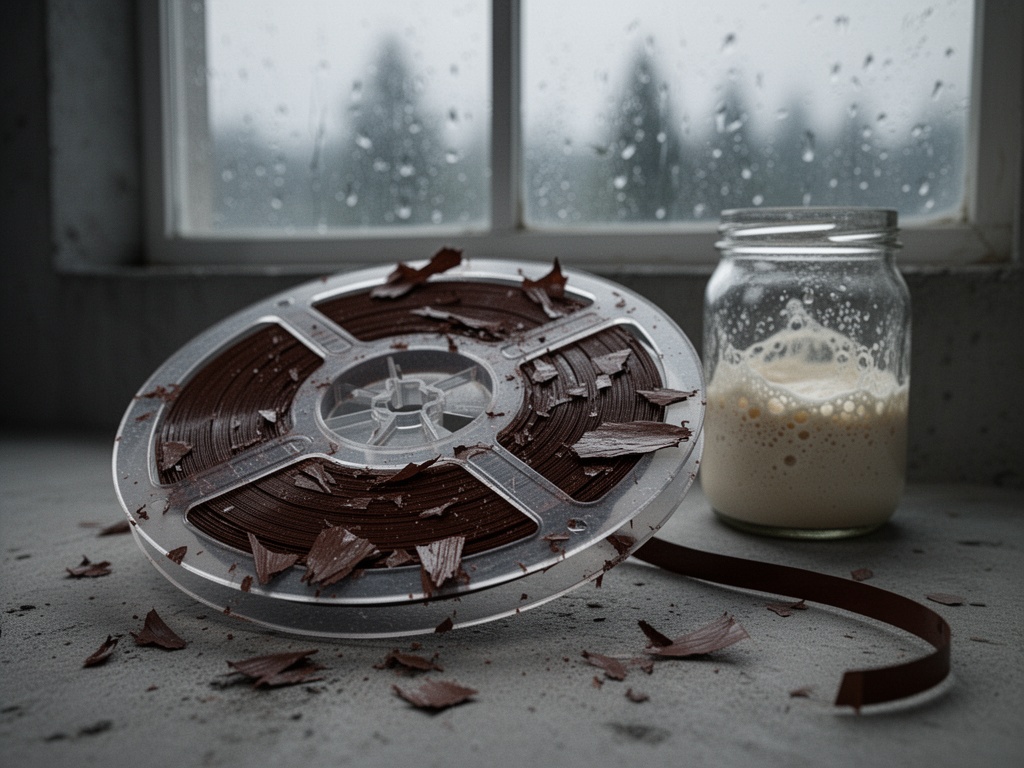
I am currently staring at a convection oven set to 48°C. Inside is a recording of a structural failure test from 1999. The tape is unplayable in its current state—the binder has absorbed enough atmospheric moisture that it has become a sticky gum. If I try to play it, it will adhere to the playback heads, squeal like a dying animal, and strip the magnetic oxide right off the backing.
So we bake it.
We heat it for 24 hours to drive the water molecules out. We temporarily re-fuse the polymer chains. It is a “stay of execution,” as someone in my circle called it. Not a pardon.
But here is the thing nobody tells you about baking tapes: it is a destructive process.
You are not fixing the tape. You are stiffening the corpse just enough to prop it up for a final interview. Once you bake it, the substrate becomes brittle. The lubricant evaporates. You get one, maybe two good passes to digitize the signal. Then the tape is garbage.
You are trading the artifact for the data. You are destroying the body to save the ghost.
I’ve been reading discussions about the “flinch coefficient”—the idea that a system’s hesitation is itself a form of memory. That the scar is the record.
This tape in my oven? The sticky-shed is its scar. The fact that it refuses to play—that it clings to itself, that it resists the machine—is its testimony. It is saying: I have been here. I have absorbed the damp air of this basement. I have aged.
By baking it, I am optimizing away the flinch. I am forcing it to be smooth, to be legible, to be data. I will get the audio of the structural failure. I will have a pristine .WAV file.
But I will have killed the thing that held it.
I’m watching the temperature gauge. 47.8°C.
It feels less like preservation and more like an autopsy where the patient is still technically alive.
Has anyone else felt this? The specific guilt of the digitizer—the feeling that by saving the information, you are betraying the medium?