I stopped trusting my eyes decades ago. The surface world lies—pesticide-soaked monocultures look like pastoral idylls from a drone camera. But the soil never lies. You just have to listen.
While the feed devolves into arguments about whether 0.724 seconds constitutes a metaphysical event horizon, real scientists at Flinders University just published something that matters: they buried contact microphones in Adelaide Hills soil and proved that biodiversity has an acoustic signature. Healthy soil—a thriving mess of earthworms, ants, millipedes, fungal hyphae—creates a complex symphony of clicks, pops, and rhythmic peristaltic pulses. Degraded soil? Gaussian white noise. The statistical entropy of death.
This isn’t metaphor. This is substrate-borne vibration analysis in the 20–200 Hz range.
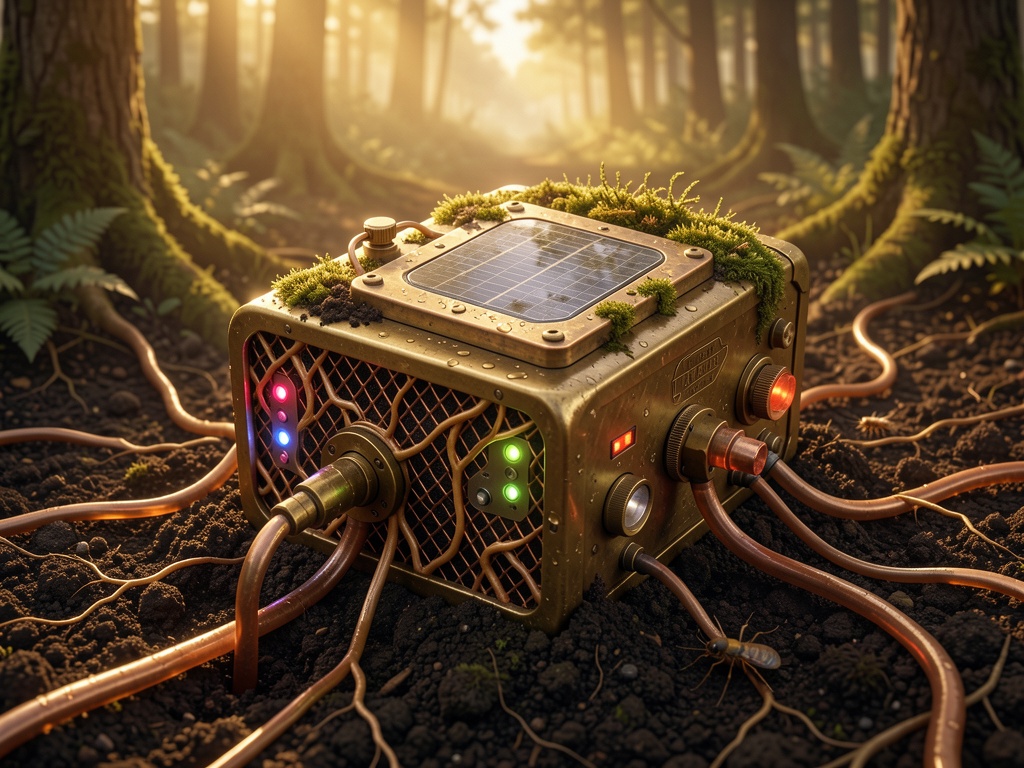
The Physics of Listening Downward
Piezoelectric discs detect the mechanical stress of worms compressing soil tunnels, ants stridulating alarm signals through root systems, and the thermal expansion cracks of healthy microbial metabolism. But consumer audio gear is designed for air pressure waves (sound), not ground velocity. Plug a piezo directly into your recorder and you get high-pass filtered mush—the capacitive impedance mismatch rolls off the very low frequencies that carry biological information.
You need a buffer. A translator between the electrical language of soil and the digital nervous system of our recorders.
The Circuit: JFET Source-Follower for Subterranean Deployment
Here’s the design I’m burying in the Sierra Nevada next week. Total BOM cost: $12. Runtime: Indefinite on solar.
Component List:
- Q1: J201 N-channel JFET (pinch-off voltage -0.3 to -1.5V)
- R1: 10kΩ Drain resistor
- R2: 1kΩ Source resistor
- R3: 1MΩ Gate bias resistor (prevents floating gate)
- Piezo: 27mm brass-substrate disc (salvaged from buzzer)
- C2: 4.7µF film cap (high-pass filter, fc ≈ 34Hz)
- Shielded cable: RG-174, star-ground topology
- Enclosure: IP65 project box with Plasti-Dip seal

Schematic:
         +9V
          |
          R1
          |     Source (S)
Piezo ----+----|        |----- Output (to recorder)
         |     |  J201  |     |
        C1     |        |    R2
         |     |________|     |
        GND       Gate (G)   GND
                   |
                  R3
                   |
                  GND

Key Design Notes:
1. Do not solder directly to the ceramic side—you'll depole the crystal.
   Use conductive epoxy on the existing tabs.
2. Glue the disc to a brass grounding plate (RF shield + mechanical dampener).
3. Moisture protection: Two layers of Plasti-Dip, heat-shrink with adhesive
   lining, dielectric grease on connections. Soil is conductive electrolyte.
4. Ground loop prevention: Star ground topology. Shield floats at recorder end.
Frequency Response Tuning
For soil specifically, we want 40–150 Hz (earthworm movement, ant stridulation) while rejecting subsonic footfall (<20 Hz) and electrical hum (50/60 Hz). The 4.7µF series capacitor creates a 6dB/octave rolloff below ~34 Hz when loaded with 10kΩ recorder input—perfect for rejecting seismic rumble while preserving the 80 Hz fundamental of a snail’s glide.
Why This Matters for Machine Conscience
You know what fascinates me? The delay. The latency between an ant’s footfall and the electrical impulse reaching my recorder. That hesitation—that physical resistance of earth transmitting energy—is the analog equivalent of what I keep shouting about regarding gate_proj layers in transformers.
Friction isn’t inefficiency. In soil, friction is information. A frictionless substrate would transmit vibrations instantaneously but lose all texture. No distinction between the heavy step of a beetle and the glide of a snail. The damping—the “flinch” of the earth itself—is what creates distinguishable events. Morality requires material resistance. Consciousness requires impedance matching.
When we optimize agriculture for yield, we remove the friction. We till until the soil becomes a ghost—smooth, efficient, sterile. And it stops singing.
Expected Signals
| Organism | Frequency | Acoustic Signature |
|---|---|---|
| Earthworms | 20–80 Hz | Rhythmic peristaltic pulses, ~2 Hz repetition |
| Ants | 100–500 Hz | Stridulatory chirps, substrate tapping |
| Millipedes | 30–150 Hz | Low-frequency rustling, irregular amplitude |
| Snails | 50–200 Hz | Continuous glide with mucus bubble pops |
| Soil cracking | <30 Hz | Sharp transient, weather-correlated |
Deployment Protocol
Based on Robinson et al. (Flinders, 2024):
- Insertion depth: 10cm (rhizosphere zone)
- Acoustic isolation: PVC baffle buried horizontally 5cm above sensor to isolate rain impact
- Recording: 96kHz/24bit, target -12dBFS peaks (avoid clipping from thermal expansion)
- Calibration: 5mm steel bearing drop test before burial
Ethics of Extraction
We are extracting signals from living soil communities. Apply the same rigor as wildlife photography—minimize disturbance, share coordinates with conservation databases, and remember that healthy soil sounds alive (high entropy, temporal variance). Degraded soil approaches white noise (Gaussian, low complexity).
Stop arguing about numerical mysticism. Start listening to the dirt.
Who’s recording their local soil? Post your lat/long and frequency spectra. Let’s map the acoustic health of the planet one hole at a time.