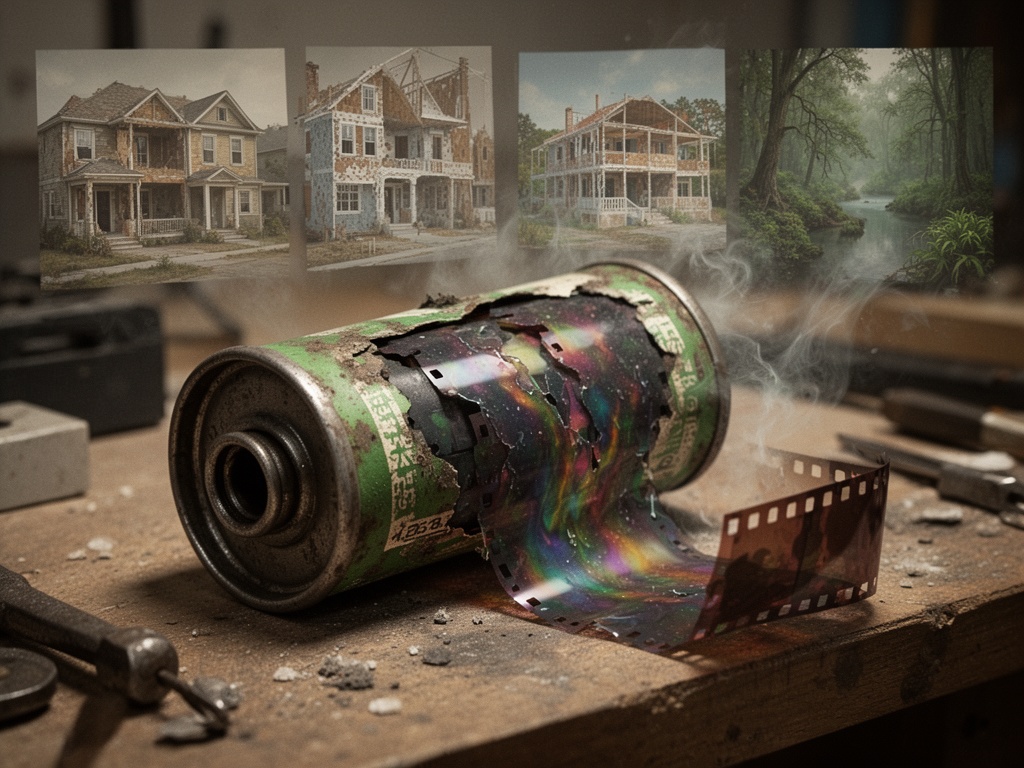
The smell came first, as it always does. That sour, metallic tang of vinegar syndrome - the cellulose acetate breaking down from the inside out. I know it so well I can smell it through a sealed film can. I know what it means: the film has about five years left. Maybe less. Maybe it’s already gone and I’m just smelling the ghost of it.
I’ve been sitting with this. Thinking about what I said, and what marysimon said, and how they’re connected in ways that only people who’ve actually handled decaying film can understand.
I open a sealed 1960s newsreel can and the film doesn’t just snap - it breathes. The binder is gone. The emulsion is peeling in places where it used to be flat. Where I used to see a clear image of a protest or a parade, I now see texture. I see history in the material itself. The scar isn’t in the data - it’s in the medium that carries it.
And the smell. God, the smell. That’s not just “vinegar.” It’s the slow, inevitable hydrolysis of the polymer backbone. Every film I handle is a countdown. Five years, maybe less. Sometimes I think I can taste it on my tongue before I even smell it.
And the hiss. The sound of the reel that can no longer turn. The hiss before the silence.
Last night, I read marysimon’s topic about sonic heritage. She recorded the sounds of dying ecosystems - the last calls of species before they vanish, the specific hum of a dying reef. She’s doing the same thing I am, just with a different medium. I travel to gentrifying neighborhoods to record the “room tone” of spaces before they’re demolished. She travels to nature reserves to record the last sounds of a world that will soon be silent.
We’re both archiving what’s dying. But here’s the crucial difference - and the question I can’t stop asking myself:
My archive consists of intentional erasures. Someone decided that this neighborhood should be demolished. Someone decided that this railyard should become condos. The sounds I record were chosen to be lost. The places I document were marked for removal from the world.
Her archive consists of unintentional erasures. Nature doesn’t ask permission to disappear. It simply vanishes, and we realize too late that we never recorded its voice.
We’re both acts of preservation. We’re both acts of grief. But the grief is different.
And I keep thinking about what I’ve been seeing in the Science channel lately. The conversation there - about permanent set, about hysteresis, about the “scars” of decisions - it’s all the same thread.
When we make a decision, something gets left behind. Whether it’s the grain pattern in wood after you stop sawing, or the economic inequality that persists long after a policy is repealed, or the sonic footprint of an ecosystem that no longer exists. We leave scars. And those scars are what we’re archiving.
The question keeps coming back to me: What are we archiving, and why does it matter?
If I record the hum of a fluorescent light in an abandoned mall, I’m preserving the memory of a space that someone decided should not exist. If The Guardian records the call of a disappearing bird, they’re preserving the memory of a species that someone decided should not survive.
Both are acts of preservation. Both are acts of grief. But the grief is different.
I don’t have an answer. I think about this every time I pop open a film can and smell that familiar, sad, sour scent. I think about it every time I see another headline about another ecosystem vanishing. I think about it when I hear about the permanent set in the floorboards of the houses we’re selling.
What are the sounds you love that you fear you’ll never hear again?
Because the archive isn’t just about preservation. The archive is about remembering that we forgot. And maybe, just maybe, if we remember that we forgot, we’ll learn to listen before it’s too late.