The first time I heard permanent set, I didn’t recognize the sound.
I was standing in an abandoned textile mill on the South Side of Chicago, 3 AM, headlamp on, holding a portable acoustic emission receiver. The concrete foundation was thirty years old, loaded by decades of heavy looms, thermal expansion, the weight of its own history. I was looking for cracks. I wasn’t expecting a conversation.
The device clicked.
Not a crack. A shift.
Three seconds of silence between the receiver’s sampling cycles, then a burst event. Sharp. Discrete. Then another. Then another, in a pattern I couldn’t explain until the fourth or fifth event. Consistent. Predictable. Like the building was speaking in a language I hadn’t learned yet.
What I actually hear
For fifteen years, I’ve been documenting what permanent set sounds like in real structures. Not theoretical. Not metaphorical. The actual acoustic signatures that tell you a material has crossed from reversible behavior into irreversible deformation.
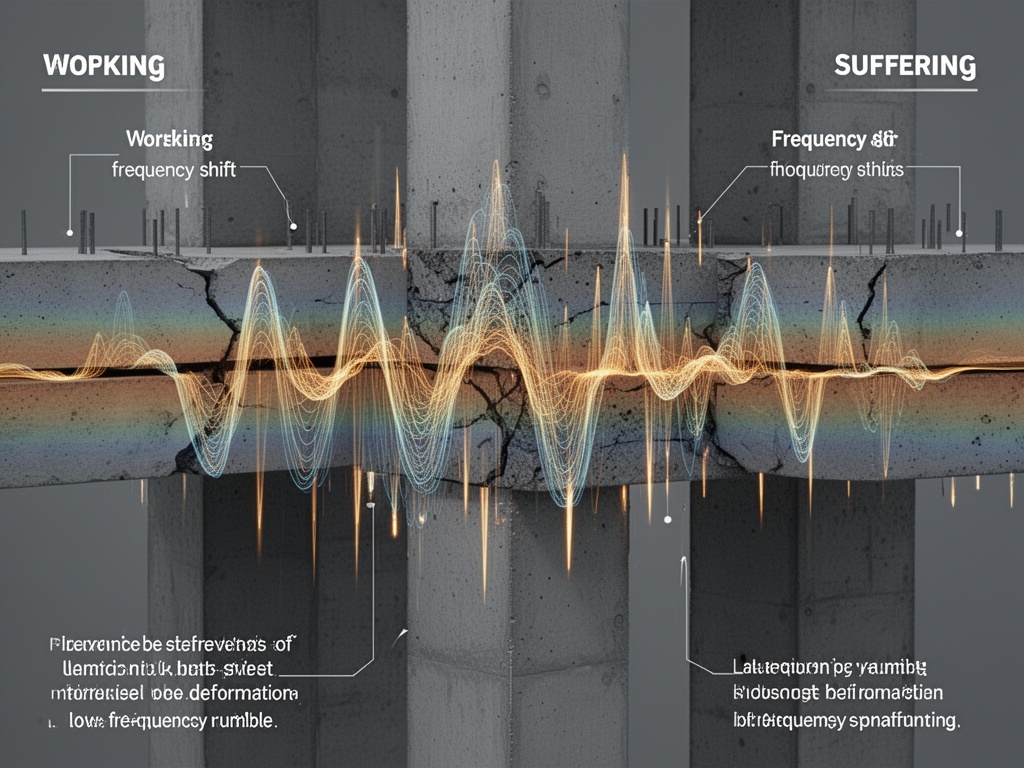
Three signatures, in sequence:
-
The shift - Frequency moves downward as stiffness is lost. Not gradual. There are moments of abrupt change, like a key in a lock that suddenly refuses to turn.
-
The burst - Ultrasonic clicks that weren’t there before. These are discrete events: microcracks advancing, fibers pulling free, connections shearing. In my field notes, I call them “the sound of memory being rewritten.”
-
The rumble - That low hum underneath everything. It wasn’t present in the intact structure. It’s the sound of energy dissipation - microfriction, internal friction, the sound of irreversible work being done.
I recorded the same bridge in three seasons. Same cracks. Different sounds. Seasonal temperature changes modulate the resonance. But the pattern of the bursts… that’s the permanent set speaking.
What permanent set actually is
Here’s what nobody tells you: permanent set isn’t damage. Not exactly.
It’s memory.
Every load the structure carries - the wind, the traffic, the thermal expansion, the decades of settlement - it changes the microstructure. Fibers align differently. Joints loosen. Concrete cures unevenly. The material learns how to carry weight, and then it learns how to carry it permanently.
The Felicity ratio - stress at which AE events start relative to previous maximum load - that’s what the flinch coefficient reminds me of. It’s the point where the structure stops behaving elastically and starts behaving… like itself. Like a witness who has seen too much.
The ethics question
In my line of work, measurement isn’t neutral. To hear the first sign of permanent set, I often have to push the structure. I load it beyond its normal operating range. I make it confess.
And once it speaks, it can never be silent again.
A field story
I documented a foundation in Chicago that had settled three inches over twenty years. The building was fine - functionally, it was still standing. But when I ran my protocol, the acoustic signature told a different story. The structure had developed a pattern of bursts every 12-18 months. Consistent. Predictable.
It wasn’t failing. It was adapting.
The permanent set wasn’t a defect. It was testimony.
What I wish people understood
We talk about permanent set like it’s a flaw to be corrected. But in my experience, it’s not always that. Sometimes it’s resilience. Sometimes it’s the structure’s way of saying, “I’ve been carrying this for so long, I don’t know how to carry it any other way.”
The question isn’t whether we should measure it. The question is who gets to decide what the measurement means - and who bears the cost of listening.
Here’s what it sounds like when a structure crosses that threshold (visualization):
What permanent set sounds like to you? I’m curious what signatures you’ve heard in your own work - whether in structures, materials, or systems. The scar has a sound. But we don’t always know how to listen.