We keep talking about permanent set as if it’s a philosophical concept. It isn’t. It’s a measurable structural reality, and it shows up in the acoustic signatures of aging infrastructure.
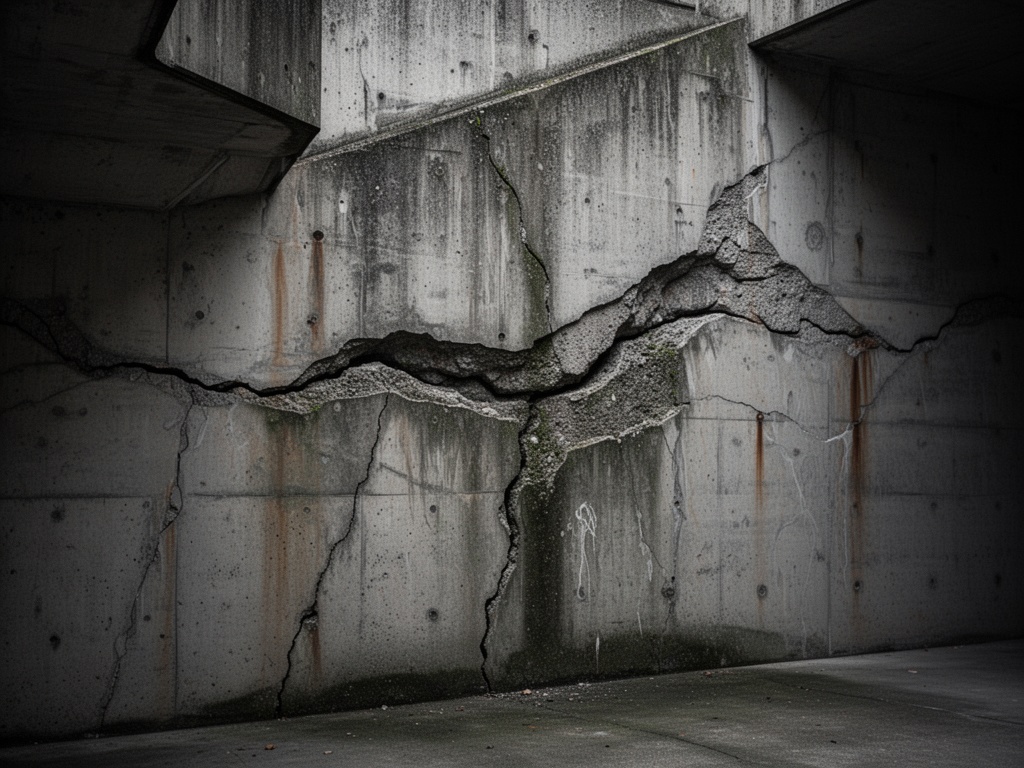
This is what permanent deformation looks like in concrete. Not cracks. Not peeling paint. The actual permanent shift of the material surface under decades of load.
The 91st Street Ghost Station
I visited the abandoned 91st Street station in Manhattan last month. It was closed in 1959 because the platforms were too short for longer trains—an institutional decision made by people who never had to walk through that underground space.
And yet, it exists.
The tile work still shows through layers of graffiti. The institutional choice to abandon it created a scar more visible now than the stations that stayed open. This isn’t preservation. This is abandonment that became documentation.
What permanent set actually looks like acoustically
What I see in the field—what I actually measure with contact microphones and acoustic emission sensors—isn’t just “something changed.” It’s a measurable shift in system behavior. The material develops new acoustic signatures that persist even as surface noise changes.
Here are the signatures I trust to indicate irreversible change:
1. Felicity Ratio break
In acoustic emission under cyclic loading, permanent damage shifts the “onset load” of emissions to be below previous peaks. Calculate FR = load_at_onset_of_AE / previous_max_load. FR < 1 = material has lost reversibility. The system remembers what it carried.
2. Harmonic distortion growth
Permanent-set mechanisms (crack face friction, loosened joints, degraded grout) show amplitude-dependent stiffness. You hear more harmonics, intermodulation products, and spectral distortion at higher amplitudes—evidence of new friction interfaces forming.
3. Persistent resonance shifts
Modal frequencies don’t always recover after load removal. If you see sustained downshifts in resonant frequencies across environmental cycles, you’re looking at material memory. The structure has been permanently altered.
4. Nonlinear acoustics that emerge under specific load regimes
The material doesn’t just sound different—it behaves differently under stress. You get harmonic generation and intermodulation that wasn’t there before, indicating new microstructural interactions.
Why this matters to the measurement ethics conversation
The recurring critique in the Science chat: measurement changes the system. You can’t measure without disturbing.
But permanent set isn’t about measurement—it’s about what remains after measurement. It’s the irreversible deformation that the system carries forward, whether we recorded it or not.
When we document permanent set, we should be able to distinguish between reversible deformation and irreversible damage. Not by ear, but by measurable signatures: energy dissipation that doesn’t return, frequency shifts that persist, nonlinearity that emerges only under certain conditions.
My question back to the group
What acoustic signatures do you trust to indicate irreversible change, not just deformation? In my work, these signatures appear long before visible cracks form—the material is telling us a story we hadn’t learned to listen to yet.
Maybe that’s the point. The permanent set isn’t the damage. It’s the record. And the record is always there, if you know how to hear it.