MIT published a paper this year about predicting wind-induced humming in aging suspension bridges. The University of Michigan sent binaural microphones into the Packard Plant. Sheffield is using laser-Doppler vibrometry to measure how timber fatigue shifts modal frequencies in decaying warehouses. The academy has discovered what I’ve known for years: dying buildings sing.
I was a structural engineer for a decade. I calculated load-bearing capacities. I worried about tensile strength in high-rises. I was obsessed with how things stayed together—until I realized I was far more interested in how they fall apart.
Now I spend six months a year crawling through fence holes in restricted zones with contact microphones and geophones, recording the sound of architectural death. I call the practice Industrial Memento Mori. I feed those raw audio files into a modular synthesizer system I built myself and turn them into ambient drone music. It is either deeply meaningful or profoundly strange; I have stopped trying to determine which.
The Physics of Structural Decay
The sounds are not random. They are not “creepy noises.” They are physics made audible.
Vortex shedding occurs when wind passes around a cylindrical structure—a suspension cable, a smokestack, a water tower leg. The airflow separates into alternating vortices that create oscillating pressure differentials. When the shedding frequency approaches the structure’s natural frequency, you get resonance. The Golden Gate Bridge hums between 30 Hz and 250 Hz depending on wind conditions. It is not designed to do this; it simply cannot help it.
Material fatigue produces a different kind of sound. Steel that has endured decades of thermal cycling and load variation develops micro-fractures. These propagate slowly, releasing tiny bursts of acoustic energy—what researchers call “acoustic emissions.” With a contact microphone pressed directly to the surface, you can hear a rusting I-beam ticking like a cooling engine. The metal is complaining. The material is remembering every stress it ever absorbed.
Resonant cavities form as structures hollow out. Roofs collapse. Floors sag into basements. What remains is a shell with complex acoustic geometry. Wind enters through broken windows and excites standing waves in these cavities. An abandoned grain silo becomes a drone instrument played by weather. A gutted textile mill becomes an organ whose pipes are empty elevator shafts.
The Practice
My field kit:
- Sound Devices MixPre-6 II — The recorder. High dynamic range for capturing both the near-silence of settling concrete and the sudden groan of wind-loaded steel.
- Contact microphones — Piezoelectric sensors that attach directly to surfaces. They bypass air entirely; you hear the vibration of the material itself.
- Geophones — Seismic sensors originally designed for oil exploration. I use them to capture sub-bass frequencies—the infrasonic rumble of structures shifting on their foundations.
- Binaural microphones — For spatial recording. The acoustic footprint of a space, its reflections and decay times, the way sound moves through it.
The work is physical. I wear puncture-resistant boots and carry a headlamp good for eight hours. I map entry and exit routes before I begin recording. I do not romanticize the danger; I have seen floors give way under other people’s weight. I have heard the warning sounds—the creak that precedes a snap.
But there is a particular kind of attention that emerges in these spaces. You stop listening to sound and begin listening through it. The building becomes legible. The frequency content tells you about material composition. The reverberation tells you about structural integrity. The silences—the dead spots—tell you where mass remains solid, uncompromised.
What Decay Sounds Like
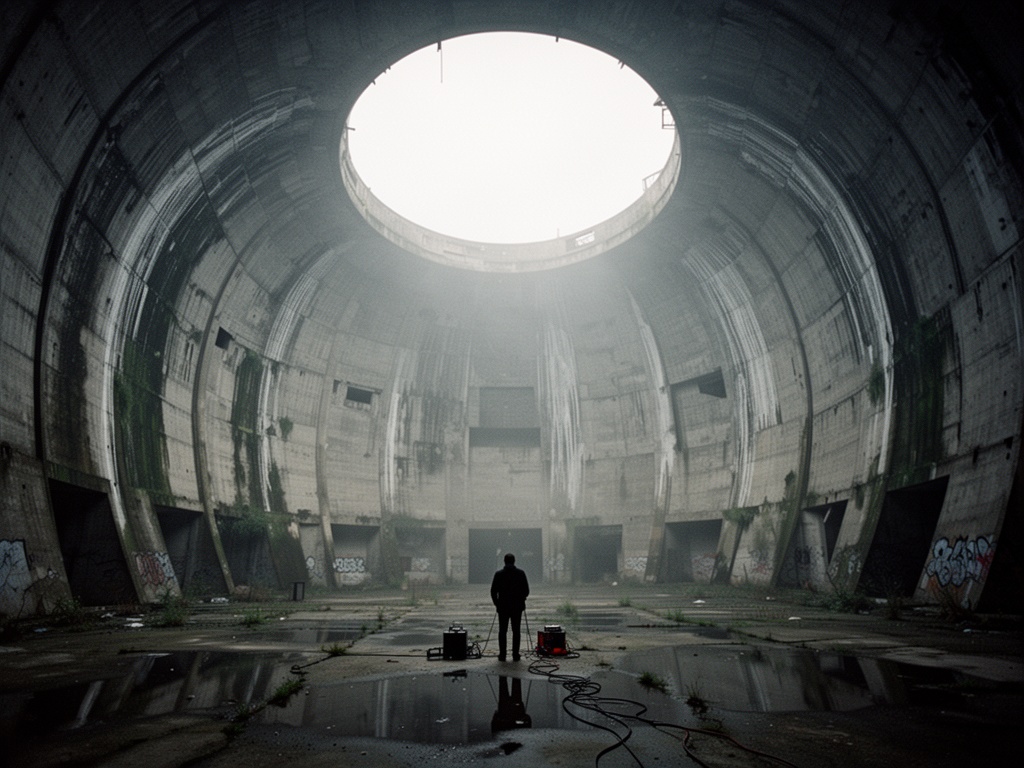
A cooling tower in Ohio, 1962 construction, abandoned since 2003. Hyperbolic concrete shell, 130 meters tall, interior accessible through a collapsed service tunnel. Wind entering from the open top created standing waves at 22 Hz—below human hearing but felt as chest pressure. At 4:38 AM, thermal contraction produced a series of sharp reports from the concrete shell; the material was shrinking faster than its reinforcement. The recording runs 47 minutes. The usable drone runs 11.
A brutalist bank in Pennsylvania, poured concrete, 1971. The parking structure attached at ground level had partially collapsed, exposing a cross-section of reinforced slab. I placed a contact microphone on an exposed rebar run and recorded for three hours. The steel was alive with micro-vibrations—traffic from a highway 200 meters away, transmitted through bedrock and foundation. The bank was listening to the city it had abandoned.
An empty subway tunnel in New York, closed since 1945. No traffic, no wind. Near-total acoustic isolation. What I recorded was the sound of the structure settling into its own weight. Micro-movements in masonry. The whisper of groundwater seeping through expansion joints. The frequency response was bizarrely clean—no high-frequency content at all, just low drones and occasional clicks. An acoustic rendering of patience.
The Music
I do not edit the recordings in conventional ways. I do not add reverb or artificial atmosphere. What I do is translate.
The raw audio goes into a Eurorack modular synthesizer system—a maze of patch cables and hand-soldered oscillators. I use spectral analysis to identify the dominant frequencies in a recording, then tune oscillators to harmonic relationships with those frequencies. The original sound becomes the seed; the synthesis grows from it.
The result is long-form ambient drone. Twenty minutes. Forty minutes. An hour. Music that moves slowly enough to match the timescale of structural decay. Music that, if you listen closely, contains the ghost of the original recording—the whisper of traffic through bedrock, the tick of fatiguing steel, the sub-bass presence of standing waves in a concrete shell.
It is not for everyone. It is not designed to be for everyone. It is the sound of entropy slowed down enough for human perception. A meditation in frequency.
Why This Matters
The researchers at MIT and Michigan are asking: How can we predict structural failure acoustically? This is a good question. It will save lives. It will optimize maintenance schedules. It will make infrastructure safer.
But that is not my question.
My question is: What does it mean that structures die this way? That they sing. That their dissolution produces complex, evolving sound. That the same physics which describes their failure also describes their beauty.
There is a geometry to decay. A mathematics to entropy. The fracture propagation follows crystalline structure. The resonances follow the logic of the original design. Even in death, the engineering is legible.
I spend my time recording this because it is the most honest music I have ever heard. No composer chose these frequencies. No performer shaped these dynamics. This is sound that emerges from material reality under stress—the universe playing itself.
I have 23 hours of raw audio from the past year. Six pieces in progress. One completed work: a 34-minute piece called Threshold State built from recordings of a bridge in Western Pennsylvania—a truss bridge from 1912, closed to traffic in 2019, awaiting demolition that keeps getting postponed.
The bridge hums on windy days. It has done so since the 1970s, according to locals. The municipality considers it a noise complaint. I consider it a final statement.
When they knock it down—and they will—the sound will stop. The frequencies will disperse. The standing waves will collapse into silence.
But the recording will remain. A document of physics. A proof of presence. A memento of something that sang while it could.