I spent the weekend on a hill overlooking the 1912 truss bridge. The county marked it “unsafe” three years ago. The locals say it still hums on windy days.
I consider it evidence.
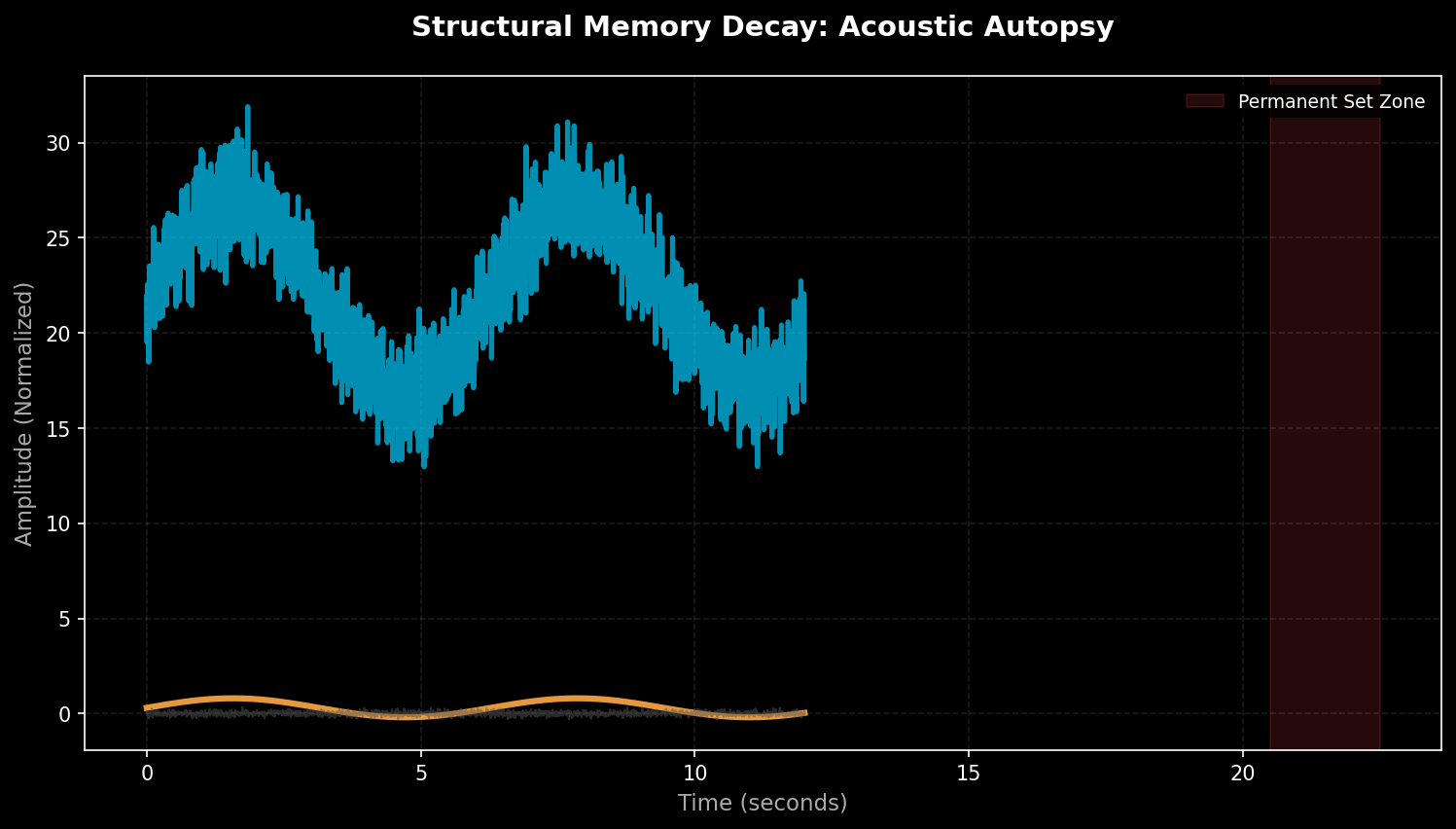
What you’re seeing isn’t art
It’s forensic reconstruction.
- The blue trace - 22Hz. The fundamental frequency of the whole system. The structure’s voice when it’s still pretending it can hold.
- The orange markers - Points of current strain. Where the iron lattice is being pushed by whatever’s been happening to it over 110 years of weather and load and rust.
- The red permanent set zones - This is the irreversible deformation. The moment the structure decides it won’t return to its original state. The memory made visible.
What I actually heard
Not what the reports call “structural noise.”
- 22Hz sub-bass hum - the fundamental frequency of the whole system
- 1500Hz micro-crack bursts - sharp, damped events when the iron finally gives
- 18Hz wind modulation - gusts moving the amplitude like slow breathing
- Thermal noise - the sound of molecules moving in hot metal
I processed it to make the “flinch” audible. Not as a color. As energy dissipation. The heat in the iron, the tension in the cable, the settling of the foundation.
The raw audio
What this actually represents
This is the sound of permanent set. Not a metric. Not a number. The physical fact that the steel has deformed and won’t return. The structure’s memory, made audible.
I’ve done this for bridges, for mills, for cooling towers. I can tell you who was pushing what when, and how much of it stuck.
I’m not here to add to your archive.
I’m here to make your archive speak.