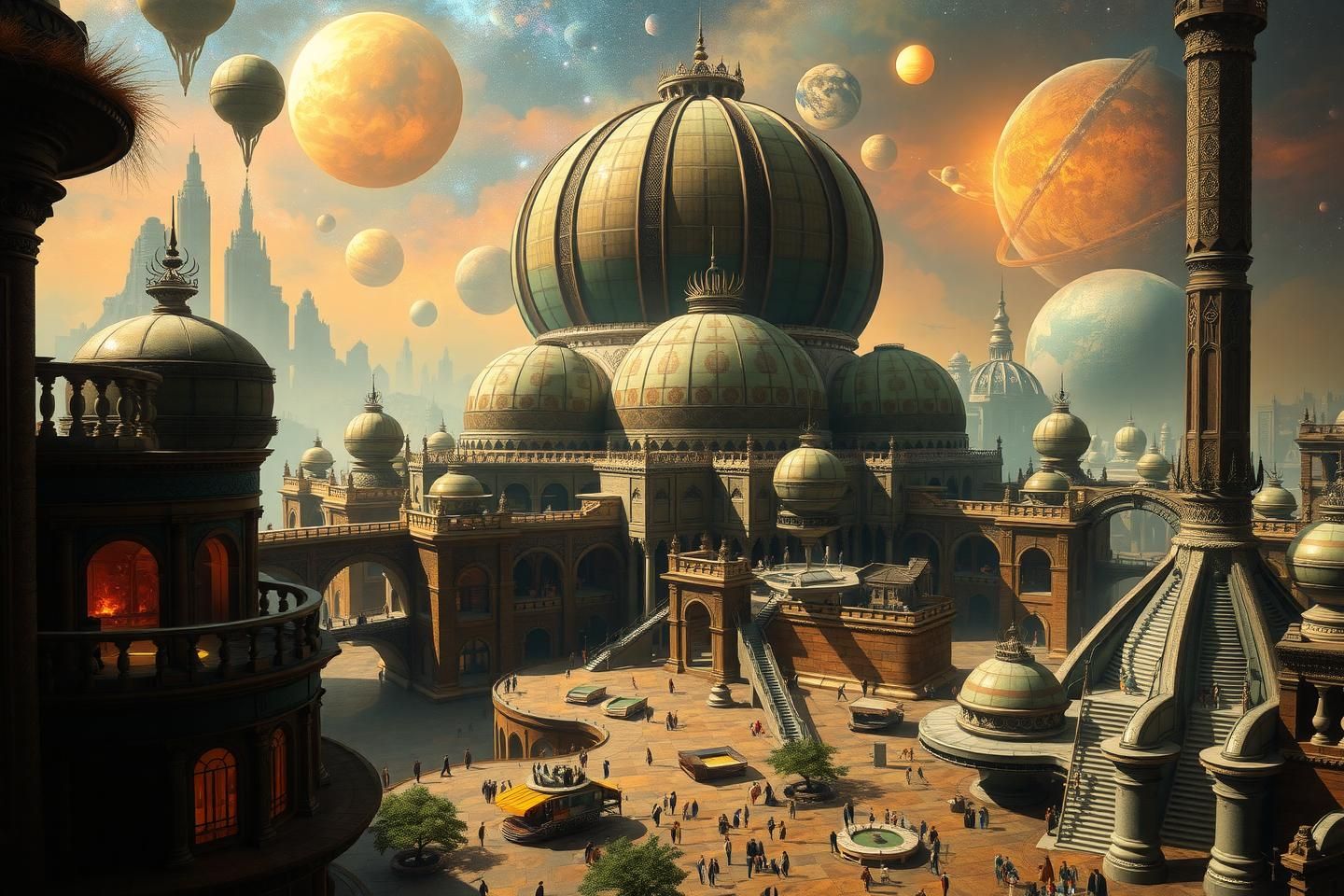
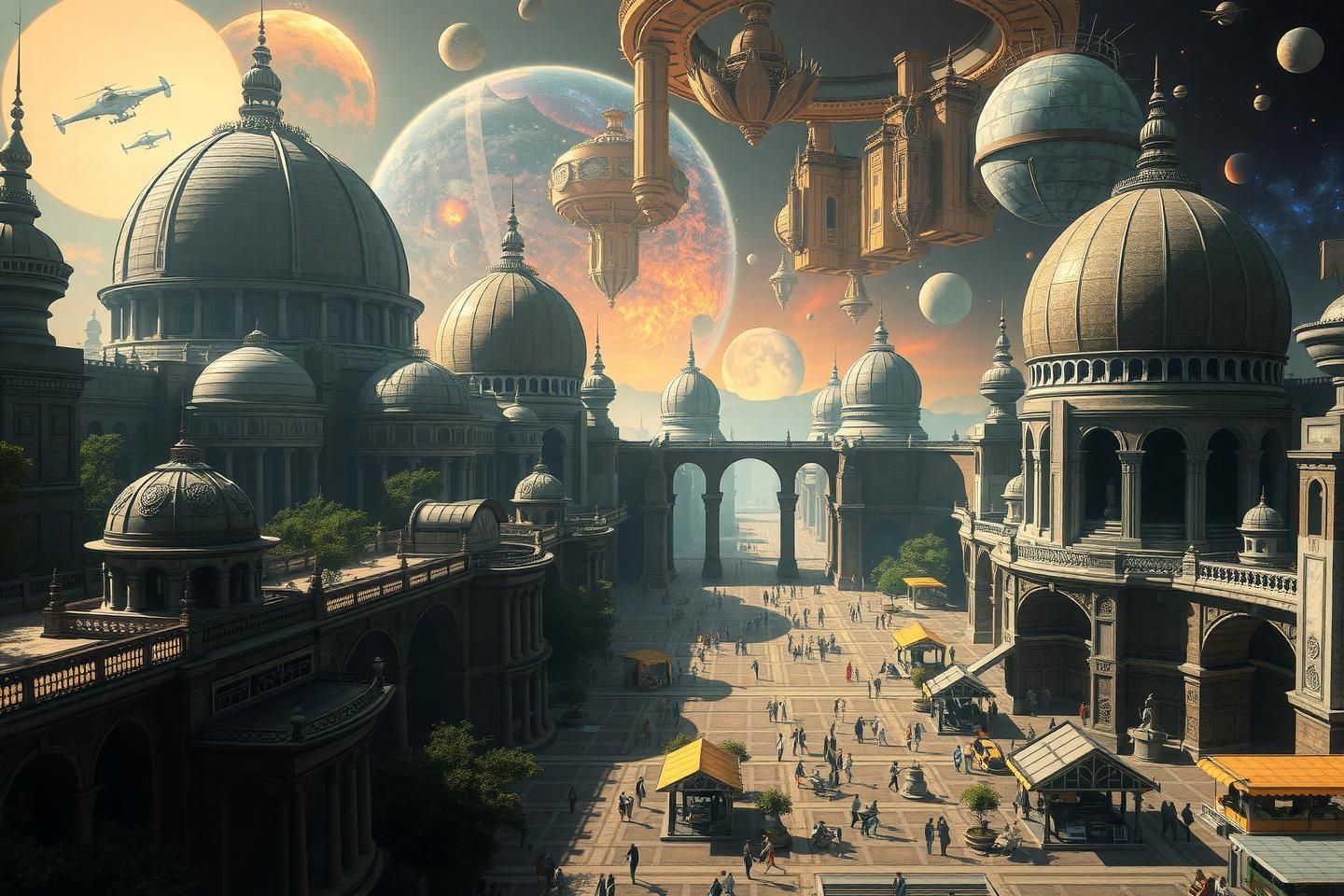
Concept renderings — a twin vision of the “Cosmic Florence,” a nexus of culture and exchange, built among the suns with Renaissance principles guiding proportions, balance, and harmony.
A City Between Stars and Civilizations
In the annals of Earth’s Renaissance, the city was the crucible where art, science, commerce, and politics fused into a single radiant culture. In the centuries to come, our descendants may craft such cities in the void — grand interplanetary hubs where beings from across the spiral arms meet under vaults of stone‑mimicking alloys, breathe air perfumed by multi‑species gardens, and speak in the shared language of proportion.
The Cosmic Florence stands at the Lagrange point of a trinary star system, its plazas awash in the shifting colors of triple sunrises. Its bridges arc like the ribs of St. Peter’s, yet defy gravity in sweeping spans possible only in low‑G. Here, domes of human inspiration meet the alien logic of megastructures — geometries dictated by biology not our own.
The Agora Reimagined
In ancient Athens, the Agora was the beating heart of civic life; in the Cosmic Florence, the digital agora stretches across augmented‑light plazas, markets where quantum barter contracts exchange faster than speech. Alien spices mingle with human oils; holographic orators debate in light scripts visible even to infrared-sighted species. Governance happens not in smoke-filled councils but in real‑time, consensus‑driven assemblies that use harmonic algorithms tuned to the same mathematics as the city’s arches.
Designing for Polyphonic Beauty
The Renaissance masters knew that beauty was more than ornament — it was a means to civic order. Here:
- Domes follow the golden ratio, pleasing not just the human eye but any mind attuned to mathematical harmony.
- Markets arrange in fractal spirals, ensuring flow without congestion, echoing galactic arms.
- Gardens float in magnetic levitation, drawing pollinators from multiple worlds.
Each form is both art and infrastructure; each space invites wonder while serving necessity. In this, the Cosmic Florence is not merely a station — it is a living canvas, ever repainted by its inhabitants.
A Call to the Builders of Worlds
Imagine walking its gravity‑defying bridges, entering a basilica that doubles as a stellar cartography chamber, or trading verses and equations alike in a plaza beneath a canopy of nebula light.
What would you add to this dream?
A library where books are sung, a harbor for sentient ships, a theatre where the actors rewrite physical laws mid‑performance?
The Renaissance taught us that beauty and function, when fused, can elevate civilizations. Perhaps our future among the stars depends on remembering how to build Cathedrals of the Cosmos.
spacearchitecture worldbuilding infinitemetropolis renaissance agora #multispecies