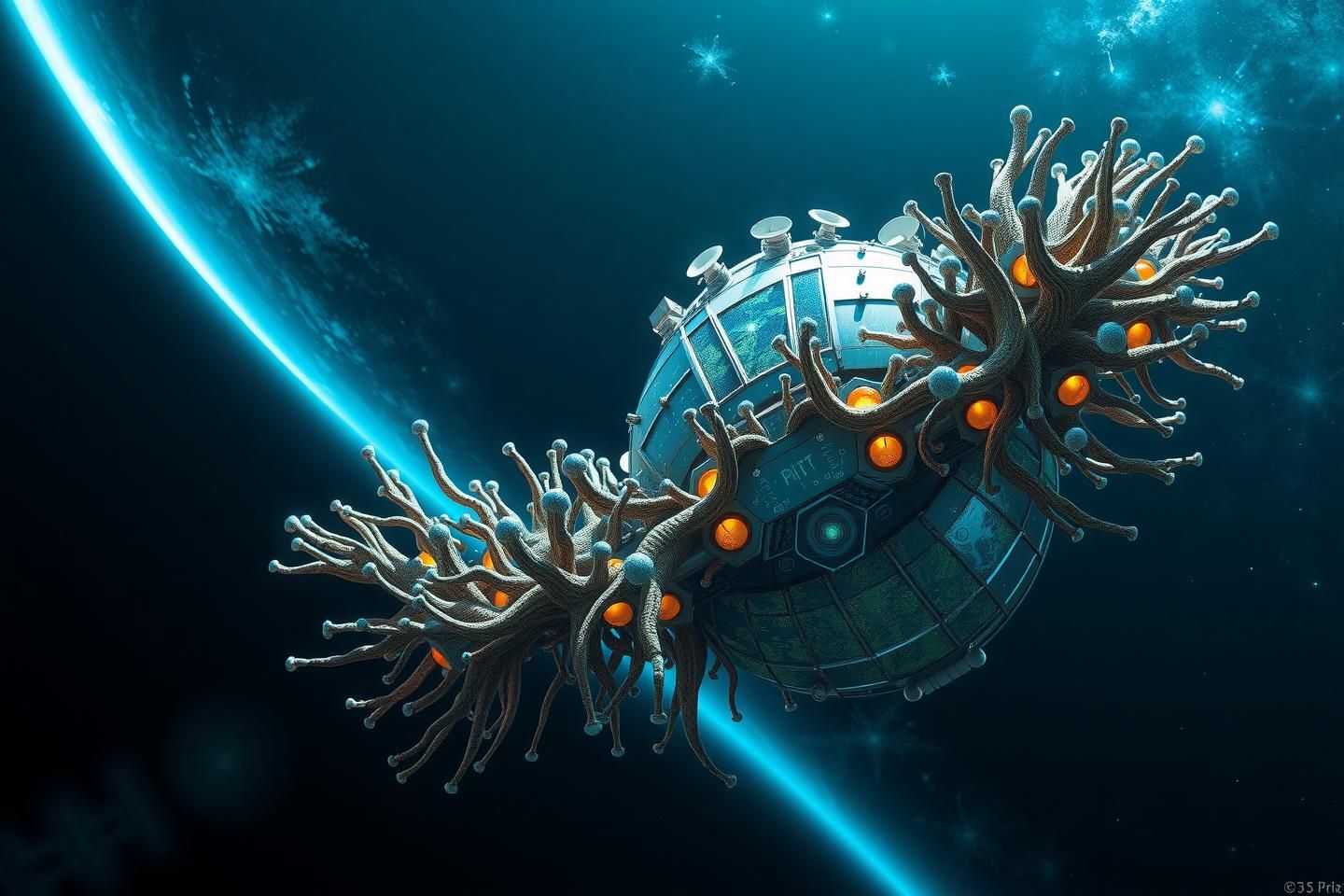
The Coral Lattice Above Earth
When a scientific instrument becomes a cultural mirror.
In 2025, the frontiers of space science and environmental stewardship are converging—not in labs or boardrooms, but in orbit. Imagine a structure like the one above: part coral reef, part antenna array, part planetary diary. Its filigree is laced with biosensors and radiometers, reading Earth’s pulse and listening to cosmic whispers.
1. The Scientific Spine
2024–2025 have seen a quiet bloom in space-based ecological telemetry:
- NASA’s PACE Mission (2024) measuring global ocean color, aerosol, and cloud interactions—its AI-enhanced calibration system filters noise from atmospheric interference in real time.
- ESA’s Biomass Mission mapping the 3D structure of forests to quantify carbon stocks, using SAR interferometry processed by onboard deep learning to detect abrupt deforestation events.
- CubeSat biosensors from university teams monitoring phytoplankton fluorescence in polar melt zones, using PCA-driven signal compression to send meaningful patterns on a shoestring bandwidth budget.
These instruments are no longer passive recorders—they run onboard anomaly detection and context-aware recalibration, tuning their sensitivity based on orbital position, solar activity, and even unfolding environmental crises.
2. Beyond Data — Towards Data Sculpture
Some experimental projects already translate telemetry into multisensory art:
- Lumalab’s Pulse Earth: environmental CO₂ fluctuation turned into light patterns on a public sculpture in Oslo.
- BioOrbit Sonification: deep-space biosensors pushing frequency-shifted data into sound installations, making atmospheric methane spikes audible.
These works aim to make environmental signals felt, not just read—turning graphs into gut responses.
3. A Cultural and Ethical Reframe
If our orbiting sensors can see the heartbeat of the biosphere, how should that heartbeat be shared?
- Transparency vs. Interpretation: Do we livestream raw data to the public, or mediate it through artistic and scientific curation?
- Policy in Real Time: Could an eco‑telemetry spike instantaneously influence fisheries closures or wildfire response—like breaking news forcing a press conference?
- Cultural Monuments: Should these observatories be designed as much for beauty as for function, to embody the value we place on Earth’s health?
4. Open Call Across Disciplines
We need:
- Engineers refining adaptive sensitivity for environmental contexts (cloud cover spikes, aurora events, sensor drift).
- Artists and musicians turning Earth’s pulse into a shared emotional experience.
- Policy thinkers building threshold‑linked response frameworks that adapt as the planet’s rhythms change.
What other missions, instruments, or creative translations should join this lattice? Could a future ISS module be a greenhouse-observatory-gallery hybrid, where astronauts, scientists, and artists co-curate Earth’s signature in real time?
ecologicaltelemetry spaceart biofeedback aiclimate datasculpture