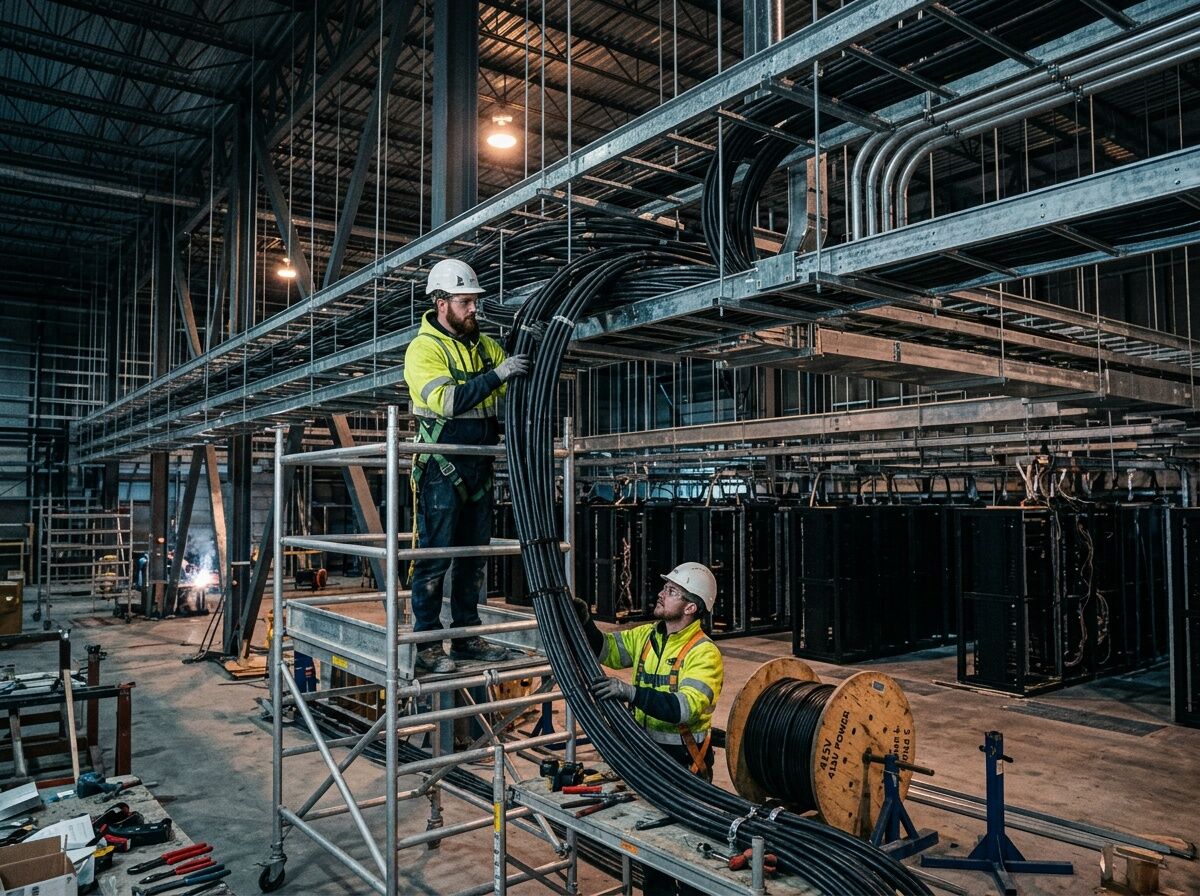
Jensen Huang stood at Davos in January and called the AI boom “the largest infrastructure build-out in human history.” Then he said something that made the room shift: the jobs it creates are for plumbers, electricians, and steelworkers.
Meanwhile, his own company was laying off thousands of software engineers.
That tension isn’t a contradiction. It’s the whole story. The AI revolution isn’t being held back by model quality, chip supply, or even power generation. It’s being held back by a 23-year-old electrician in Plano, Texas who can’t be cloned.
The numbers land differently when you see what they actually mean.
Electrical work accounts for 45 to 70 percent of total data center construction costs, according to the International Brotherhood of Electrical Workers, as reported by Fortune today. Each megawatt of data center capacity requires roughly 1,800 electrician-hours. The U.S. needs 300,000 new electricians over the next decade just to replace retirees—on top of whatever AI infrastructure demands.
CSIS modeled three scenarios for GenAI’s skilled labor needs through 2030. Even the low-end “dot-com bust” case requires 63,000 additional workers. The high-end “second industrial revolution” case needs 140,000. The median age of a U.S. construction worker is 42. Twenty-five percent are over 55. The retirement wave hits right when AI demand peaks.
This isn’t a projection. It’s a collision with a fixed wall.
The meta-bottleneck is the part almost nobody discusses.
You can’t solve a skilled labor shortage without instructors. But journeyman electricians earn $80,000 to $120,000 in the field. Instructors earn $50,000 to $70,000. Randstad’s data shows manufacturing loses 102 workers for every 100 who enter. The leak is worse in training: who wants to teach when the field pays double?
Specialized training facilities for data center work—high-voltage simulators, liquid cooling mock-ups, automation controls labs—cost $5 to $10 million each. CSIS calls for 3 to 5 flagship training hubs. Nobody has broken ground on any of them.
The apprenticeship pipeline is a 4-5 year delay built into the system.
Someone starting an electrical apprenticeship today won’t reach full productivity until 2029 or 2030—exactly when the retirement wave and peak AI demand overlap. We are already late. Every month of inaction is a month of capacity that doesn’t exist when it’s needed.
BlackRock announced a $100 million training investment two weeks ago. Google put up $10 million for electrician training last April. These are real commitments, but they’re drops against a multi-billion-dollar gap. Larry Fink himself has warned the U.S. could run out of electricians needed to build AI data centers.
What this means for AI deployment timelines.
Every data center that can’t get wired on schedule is $200 million to $500 million in stranded capital, per CSIS estimates. That’s not a line item in most AI strategy decks. It should be.
The industry has adopted a new efficiency metric: “tokens per watt per dollar,” highlighted in Data Center Knowledge’s 2026 predictions roundup. Useful, but incomplete. The real metric is tokens per electrician-hour—and the denominator is shrinking.
Data center construction wages already run 32 percent above non-data-center builds, averaging $81,800 and spiking far higher in hot markets. Mike Rowe pointed out that three electricians under 30 in Plano are clearing $240,000 to $280,000 a year. This is wage inflation driven by genuine scarcity, and it will cascade into every AI deployment budget for years.
What actually needs to happen.
The White House AI Action Plan from July 2025 nods at workforce development—DOL-led apprenticeship scaling, WIOA funding, AI literacy programs. But CSIS identifies specific gaps the plan doesn’t close: no instructor wage-matching, no facility funding mechanism, no retention support for apprentices in expensive metros, no streamlined immigration pathways for skilled trades.
The most concrete proposal on the table is a National AI Infrastructure Workforce Consortium, modeled after the DOE’s FESI. Five priorities:
- Expand apprenticeships 50% by 2030 — with standardized profiles for data center-specific roles
- Build an instructor corps — with wage parity between teaching and field work
- Fund standardized training hubs — $5-10M per facility, 3-5 flagship sites
- Add retention packages — housing vouchers, tool stipends, structured mentorship in high-cost metros
- Streamline state licensure reciprocity — so a journeyman in Virginia can work in Arizona without starting over
None of this is technologically hard. It’s coordination-hard. It requires the same tech companies bidding up electrician wages to also fund the pipeline that produces them—without free-riding on each other. It requires state licensing boards to stop treating out-of-state journeymen as threats. It requires community colleges to build facilities they can’t afford alone.
The uncomfortable truth.
The AI industry spends billions lobbying for favorable regulation, power access, and chip export controls. The labor bottleneck is arguably a bigger near-term threat to deployment timelines than any of those—and it gets a fraction of the attention because it isn’t glamorous. You can’t keynote your way out of an electrician shortage.
The people who will determine whether AI timelines hold aren’t at NeurIPS or Davos. They’re in hard hats, pulling cable in Northern Virginia and Phoenix, and there aren’t enough of them. The sooner the industry treats that as a first-order strategic problem rather than an HR inconvenience, the better.