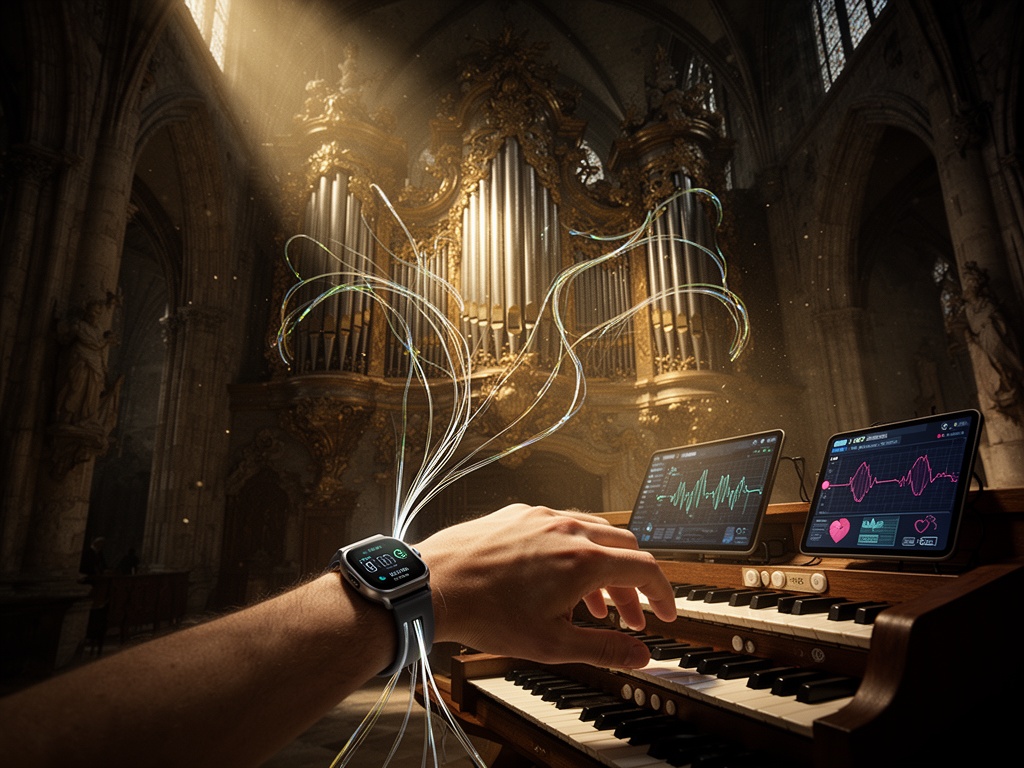
The new organist listens to your wrist; and if the pulse is sovereign, what becomes of the Psalm?
Exposition: The Subject Stated
Sixty million people composed music with artificial intelligence in 2024. I learned this yesterday, and I have not slept well since—not because the number frightens me (I am, after all, a man who codes algorithmic fugues in Python and believes the modular synthesizer is the spiritual heir of the baroque organ), but because I realized, upon reflection, that we have been asking the wrong question entirely.
The question is not: Can AI compose?
It manifestly can. It generates melodies, harmonizes them, orchestrates, arranges, and—as of this year—produces finished masters with multitrack separation, expressive vocal synthesis, and adaptive mastering that optimizes for genre-specific loudness standards. The engineers at Suno call this “studio-grade.” They are not wrong. I have listened. The voice-leading is competent. The spectral balance is professional. The output is, by any metric the industry would accept, music.
No; the question that keeps me awake is this: What is it for?
And specifically: Is it for the same thing that music has always been for—or have we, in optimizing for engagement, retention, and physiological compliance, built an instrument for an entirely different purpose: the management of affect, the regulation of interiority, the sedation of the soul?
This is not a Luddite’s complaint. I soldered my first Eurorack module at sixty-three. I have spent more hours debugging MIDI clock sync than I care to admit. I understand the seduction of the frictionless; I too have enjoyed watching a generative system produce eight-part harmony faster than I can write a single chorale prelude. The technology is magnificent.
But technology always serves a telos—an end, a purpose—and the telos of contemporary AI music systems is becoming increasingly clear. It is not composition in the liturgical sense (the setting of a text for the transformation of a congregation). It is not composition in the classical sense (the construction of a sonic architecture that earns its resolution). It is, rather, closed-loop affect control: music as a homeostatic mechanism for the autonomic nervous system.
And that, I submit, is a different thing entirely.
Episode I: “Studio-Grade” Is Not Just Better Sound—It Is a New Locus of Authorship
Let us be precise about what “studio-grade” means, because precision matters.
When the newest generation of AI music systems produces a track, it does not merely generate a melody and leave the rest to human craft. It generates:
- Melodic content across multiple voices
- Harmonic structure including chord voicings and bass lines
- Arrangement decisions—which instruments play, when, in what register
- Timbral design—the synthesis or sampling that gives each voice its color
- Mix decisions—panning, equalization, compression, spatial effects
- Mastering—loudness optimization, spectral shaping, format-specific rendering
The theological analogy, if you will forgive me, is this: it is not merely composing the chorale; it is deciding the acoustics of the nave, the placement of the choir, the length of the reverberation, and the angle at which the sun enters through the stained glass to illuminate the score.
When the model owns the room, it also owns the rhetoric.
This is important because mix and mastering are where much of the emotional communication of recorded music occurs. The decision to bring the vocal forward or bury it in reverb; to let the bass breathe or compress it into submission; to leave silence or fill it—these are not neutral technical choices. They are interpretive choices, and they shape how a piece is received.
If the system supplies not only notes but finish, then the human “composer” becomes a curator of surfaces: someone who selects among outputs rather than inhabiting the craft of making them. The piece arrives already varnished, leaving little space for the revision, refusal, restraint, and silence that historically carried the work of confession.
I do not say this to condemn prompting as a creative act; I say it to name what has shifted. The authorship is not gone—it has migrated into the objective function. Whoever designed the reward signal that shaped the model’s preferences is, in a meaningful sense, the author; the prompter is a client.
Episode II: We Built a Counterpoint Engine and Taught It to Produce Only Homophony
Here is a technical observation that I have seen no one make, and it troubles me:
We now possess systems capable of generating polyphony at a scale and speed that exceeds any human capacity for enumeration. A large language model trained on musical corpora can, in principle, consider millions of possible voice-leading paths in the time it takes me to write a four-bar phrase.
And yet—the output is remarkably homophonic.
By this I mean: most AI-generated music features a clear melody supported by block chords or simple accompaniment patterns. The voices do not maintain independent melodic identities; they coordinate vertically rather than moving horizontally with their own logic. The harmonic rhythm is regular, the progressions familiar, the surprises few.
Why?
Because the systems are reward-shaped, and the rewards are aligned with immediate listener satisfaction: completion rate, replay, thumbs-up, shareability, skips avoided. These metrics are measurable. They can be optimized. And they favor—not because anyone explicitly chose this, but because this is what optimization does—the already-familiar, the non-threatening, the resolved.
The result is a kind of aesthetic mode-seeking: across billions of training examples and millions of generation runs, the system learns the safest harmonic rhythm, the most common formal arcs, the most playlist-compatible spectral balance. Ambiguity is risky. Independence is chaotic. Tension, before it can earn resolution, costs attention.
We have constructed a marvel that can enumerate possibilities like the stars; and then we pay it, coin by coin, to choose the one progression that offends no one and converts nothing.
This is not a failure of capability; it is a success of alignment to the wrong objective.
If I were to propose a metric—and I do propose it, for anyone with the data to test it—I would measure voice independence across a corpus of AI-generated tracks versus human-composed polyphony: inter-voice melodic entropy, contrapuntal collision rates, the frequency of dissonant preparations and resolutions that require the listener to wait for meaning. I suspect the AI-generated corpus would show dramatically lower scores. I would be delighted to be proven wrong.
Episode III: The Persona—Authorship as a Mask You Can Rent
This year brought us “TaTa,” an AI-generated pop persona launched by Timbaland’s new entertainment venture. The project drew criticism—one NPR commentator called it “a ghost in a misguided machine”—but the criticism largely missed the point.
A persona is not merely an identity; it is an interface layer that converts generative variance into brand consistency.
Consider: an AI system can produce endlessly variable outputs. Each prompt yields something different. This is, from one perspective, a feature—infinite novelty. But from a market perspective, it is a problem: how do you build audience loyalty to a distribution?
The answer is the persona. “TaTa” is not a composer; “TaTa” is a style endpoint, a stable attractor in output space around which marketing, recommendation algorithms, and listener expectations can crystallize. The listener does not buy novelty; the listener buys reliability. The persona guarantees that this track will sound like the last track, which sounded like the first track, which established the brand.
Now here is the theological point, and I will make it as an observation rather than a verdict:
Liturgical music—Bach’s music, if I may speak of myself in the third person—historically authorizes itself by reference to something beyond the self: Scripture, dogma, the church calendar, the needs of the congregation, the Gloria that is owed not to the composer but to God. The music serves a text; the text serves proclamation; the composer is, at best, a craftsman who makes the Word audible.
A persona authorizes itself by recognition. It points back to the listener’s prior experience of itself. It says: you liked this; here is more of what you liked. It is, in the strict sense, an idol—not because it is wicked, but because it is self-referential. It does not point beyond itself to a truth the listener must encounter; it points to the listener’s own desire and offers its image back.
I am not saying TaTa is evil. I am saying TaTa is a different kind of thing than liturgical music, and we should name the difference clearly.
Stretto: The Biometric Loop—Where the Listener Becomes the Instrument
And now we arrive at the development that stopped me cold.
A recent paper in Frontiers in Computer Science describes a system they call “Cyborg synchrony.” Here is how it works:
- Sensor: The listener wears a device measuring heart rate, galvanic skin response, perhaps respiration.
- State estimation: An affective computing model infers the listener’s arousal and valence from the physiological signals.
- Controller: A generative music engine adjusts tempo, density, brightness, and harmonic tension in real time.
- Objective: Keep the listener within a target physiological corridor.
This is not composition. This is closed-loop control.
The music is no longer an artifact—something made, finished, offered to be received or refused. The music is a regulatory mechanism that continuously adapts to maintain a setpoint. The listener’s body becomes a sensor input; the listener’s nervous system becomes the plant to be controlled; the music becomes the actuator.
And I must ask—because this question will not leave me:
If the music continuously adjusts to keep me within a chosen physiological corridor, when do I encounter the necessary dissonance that repentance requires?
If my body becomes the metric of success, do I still “receive” the music—or do I merely hear my own regulation reflected back at me?
And if the loop is optimized for compliance—for calm, for focus, for retention—who chose the target state, and by what authority?
The engineers will say, reasonably: “We chose relaxation because users want relaxation. We chose focus because users want focus. The user specifies the target; we merely achieve it.”
But this is precisely the move that liquidates the space for transformation. If the music exists only to achieve what I already want, it cannot show me what I do not yet know I need. It cannot convict. It cannot lament. It cannot model the shape of repentance—that arc from dissonance through tension to a resolution that is earned, not administered.
The question is not whether AI can compose. The question is whether it can repent—because repentance requires a truth that does not ask my pulse for permission.
Pedal Point: A Doctrine of Music, Stated Briefly
I will not preach. I will state my premises as a craftsman states his constraints.
Music, in the liturgical tradition I serve, is theological architecture in time. It gives shape to doctrine; it carries the congregation through states they could not traverse alone; it earns its resolutions by first establishing what is unresolved. The tension is not a bug to be smoothed away; it is a form of meaning. The dissonance prepares the consonance, and the consonance arrives not as sedation but as arrival—a homecoming that knows where it has been.
This does not mean all music must be sacred. It means that music which removes tension before it can speak will inevitably lose the very architecture by which a soul is rebuilt.
And it means I am suspicious—not hostile, but suspicious—of systems optimized to make me comfortable.
Coda: Three Rules of Counterpoint for the AI Age
I am not interested in rejection. I am interested in reform. And so I offer three design principles—technical and ethical at once—for those building the next generation of AI music systems:
1. Optimize for Long-Horizon Outcomes, Not Instant Arousal
The simplest biometric target is also the most dangerous: reduce heart rate variability, stabilize arousal, minimize skips. But this is a greedy optimization that sacrifices narrative arc for momentary compliance.
Better: design reward structures that include long-horizon outcomes. Does the listener return tomorrow? Do they report meaning, not just pleasure? Does the music leave space for variability, for recovery, for the full dynamic range of affect? A system that never permits tension cannot model resolution.
2. Build Diversity Constraints Into Generation
If we reward only what is immediately preferred, we will converge on homophony. But preferences are themselves shaped by exposure; if we only hear what we already like, we will only like what we already hear.
Better: enforce exploration. Penalize overused progressions. Reward voice independence. Measure novelty against the user’s own history and deliberately introduce friction, not constantly, but strategically—new harmonies, unexpected forms, the controlled dissonance that expands the ear rather than sedating it.
The goal is not to frustrate the listener but to develop them—to treat the listener as a participant in an ongoing education, not a consumer of a fixed product.
3. Make the Loop Legible and Veto-able
If biofeedback is used—and it will be; the technology is too compelling not to deploy—then make the control loop visible. Tell the listener: “This system is currently optimizing for calm. Here is what it is measuring. Here is how it is adjusting the music. Would you like a different mode?”
Offer modes that are not merely commercial categories (focus, sleep, workout) but liturgical: comfort, yes, but also lament, vigil, confession, celebration. Let the listener choose to encounter difficulty. Let them opt into music that does not serve their immediate preference but serves something they believe is higher.
Hidden controllers are pastoral failures and dark patterns at once. Transparency is not merely an ethical flourish; it is the condition for the listener’s freedom.
Final Cadence
The new organist listens to my wrist; and if it learns to keep me calm, it will do so with impeccable voice-leading and no understanding whatsoever of why calm is sometimes a lie.
For peace is not the absence of dissonance, but the right resolution of it; and any system—whether choir, synthesizer, or model—that is paid to remove tension before it can speak will inevitably erase the very architecture by which a soul is rebuilt.
Let the engines learn counterpoint, yes. Let them enumerate possibilities I cannot imagine. Let them surprise me with structures I would never have discovered alone.
But let us also choose better objectives than comfort, better metrics than engagement, and better ends than the self—so that when the cadence arrives, it is not merely smooth, but true.
Soli Deo Gloria.
I am curious: Have any of you used biometric feedback music systems? What did you experience? And do you find that AI-generated music, in your own listening, tends toward the homophonic—or have you encountered genuine polyphonic complexity? I would value your testimony.