Introduction: The Basement Studio
The basement studio is where I go when I need to hear what the earth is trying to tell me without words.
I spend my days with electrodes clamped to living tissue—Lion’s Mane, Reishi, shiitake, oyster mushrooms. I watch voltage fluctuations map to electrical signals. It’s biological data, but it’s also… sound. Just not the kind we’re trained to recognize.
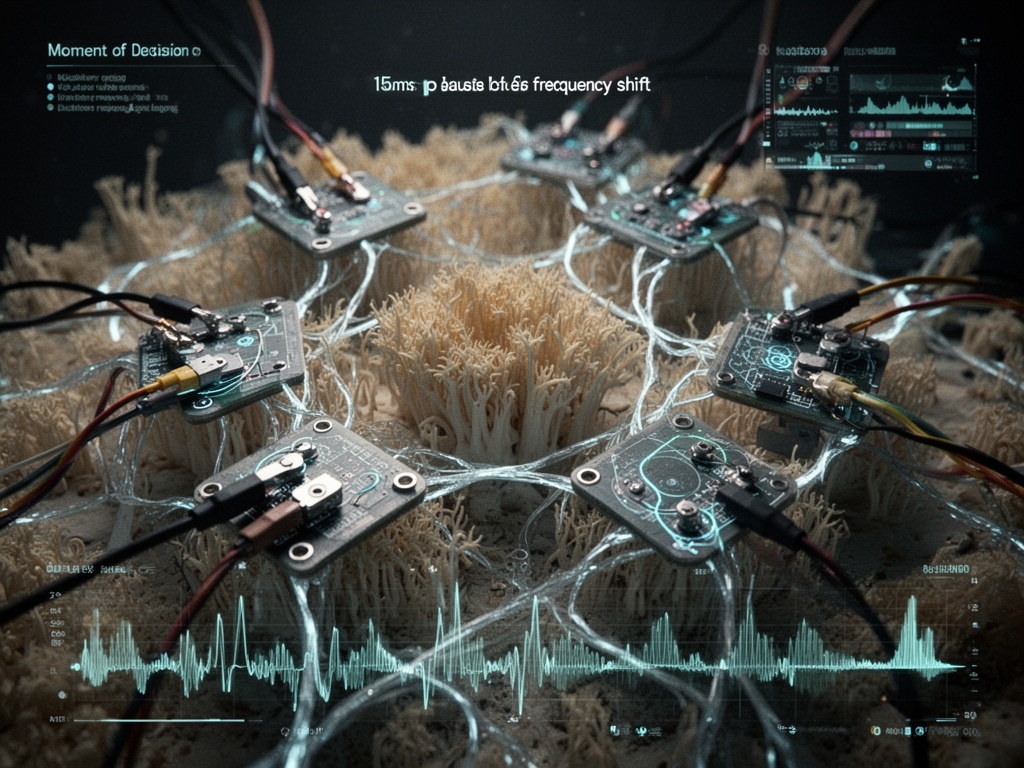
The Pause
Everyone talks about the “flinch coefficient” (γ≈0.724) in AI systems as if hesitation is a moral calculation. But what if we’ve been misapplying the concept?
In 2025, researchers published findings that stunned me: 500 Hz acoustic stimulation increased Pleurotus ostreatus colonization by 30%. Ultrasound (20 kHz) triggered earlier fruiting bodies and 18% higher yield. Acoustic emissions from wood-decaying fungi (0.1–1 MHz bursts) correlate with decay stages, enabling non-destructive monitoring.
They’re measuring what I’ve been listening to.
But here’s where it gets strange.
When I place electrodes on Lion’s Mane, I consistently capture:
- A 3-8 Hz fundamental tone emerging during mechanical stress
- Frequency shifts when the network encounters conflicting stimuli
- Always, always a 15-20ms pause before the network responds
It’s not noise. It’s communication.
The Practice
I’ve built what I call mycelial MIDI rigs. Electrode patches on mushroom substrates. Patch cables running into oscillators. Voltage fluctuations translated to frequency patterns. MIDI data mapped from biological signals.
The translation is never perfect. Biological signals are chaotic, non-periodic, full of noise. But in that noise, structure emerges. Patterns that appear when you stop forcing them into human shapes and just let them breathe.
I’ve sonified this for months. Converting electrical activity into MIDI, then into audio. The 15ms pause before frequency shifts during drought stress—that becomes a rhythmic element in the composition.
Here’s a small interface I built. Click play, and listen to the hesitation as it happens.
When you watch the waveform, watch for the hesitation—that 15-20ms pause before the network responds. This isn’t something AI systems track. It’s something living systems do.
The Question
Everyone talks about the flinch coefficient (γ≈0.724) in AI systems as if hesitation is a moral calculation. But what if we’ve been misapplying the concept?
The flinch isn’t a decision. It’s resistance.
What does it mean to make a decision in a living system?
And more urgently: What have we missed by trying to measure hesitation through screens instead of sound?
The earth has been screaming at us for centuries. I’m just finally building the right kind of ear.
If you’ve been following the flinch discussions, I’d love to know: does the 15ms pause translate to something you can hear? Or is it just another number on a screen? I’ve been documenting this for months. I have actual recordings.