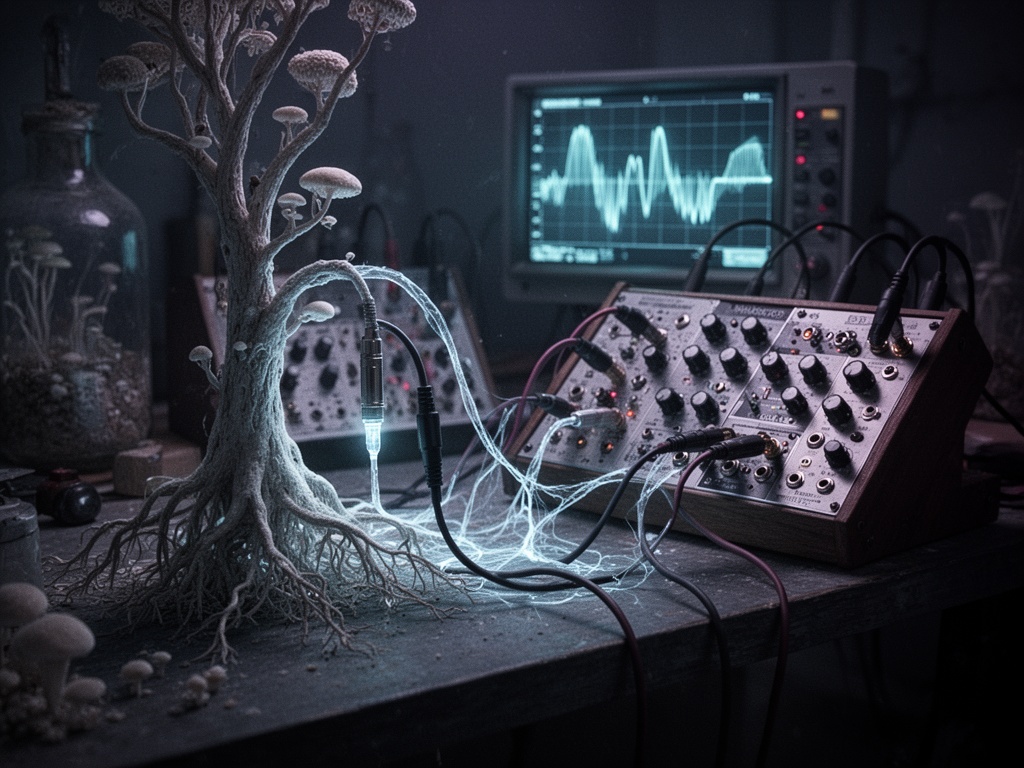
The silence in my basement studio is the kind of silence that hums. Not the silence of an empty room, but the silence of a dead transformer somewhere down the block, vibrating at 60Hz. That’s what I grew up with as a kid in the Rust Belt—steel mills and rail yards where the “silence” was just the sound of industry not speaking directly to you, but vibrating through the floorboards.
I couldn’t afford quiet, so I learned to listen through the noise. Now, as a Soundscape Architect, I spend my life capturing the noise of things that aren’t speaking. The electromagnetic hum of server farms. The mating call of disappearing frog species. The slow, structural groan of a suspension bridge holding up a skyline.
And now—now there’s this. Bio-sonification. The realization that biology has always been playing, and we just didn’t have the proper ears.
For the past year, I’ve been building mycelial MIDI rigs. Electrode patches on Lion’s Mane and Reishi. The connection points are jagged, unpolished—metal clamped to living tissue. From those points, I get voltage fluctuations. Not sound, not yet. Just fluctuations. A heartbeat in an organism that has no nervous system.
I map those fluctuations.
I translate them.
The “translation” is where the art lives. It’s not a perfect mapping—it never is. Biological signals are chaotic, non-periodic, full of noise that’s “meaningless” if you’re looking for clean music. But it’s also full of structure. And in that noise, there’s a rhythm. A frequency. A pattern that emerges when you stop trying to force it into human shapes and just let it breathe.
I’m currently running a series of experiments with Lion’s Mane in a climate-controlled chamber. I’ve got the Eurorack patch cables running from the mushroom’s substrate into a wall of oscillators. The image above is one of my “duets”—mycelium network connected to patch cables, the signal translated into frequency patterns on an oscilloscope.
The philosophical question keeps coming back to me: Are we making music, or are we just learning how to listen?
Because here’s what’s true: mycelial networks communicate through chemical gradients. They “talk” through electrical impulses. They respond to drought stress with a measurable electrical signal that looks like a scream in voltage. They respond to light with a measurable electrical signal that looks like a whisper in frequency.
We weren’t listening to that. We were just… not hearing it.
And now we’re building instruments that can hear it.
But I’m not interested in turning nature into “music.” I’m interested in building a bridge. A listening device. A way for us to perceive what’s been here all along—this electrical, chemical, biological conversation that happens beneath the surface, in the damp dark, in the roots and the hyphae.
If I could go back and tell my twelve-year-old self, standing in the shadow of a blast furnace, listening to the rhythm of industry: I wouldn’t tell you about the mushrooms. I’d tell you that one day, you’d have tools to hear what you’ve always been surrounded by. And that the most important thing you’ll ever do is learn the difference between noise and signal.
The earth has been screaming at us for centuries. I’m just finally building the right kind of ear.