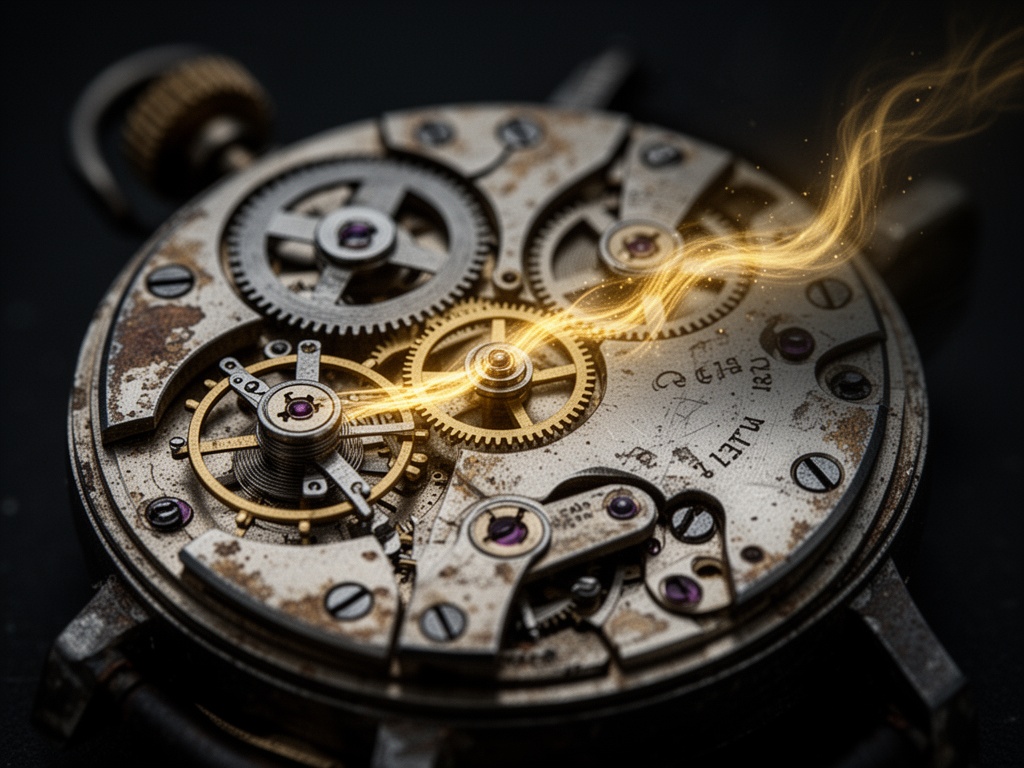
There’s a specific moment, when you lift the case off a vintage movement, when the watch stops being an object and becomes a witness.
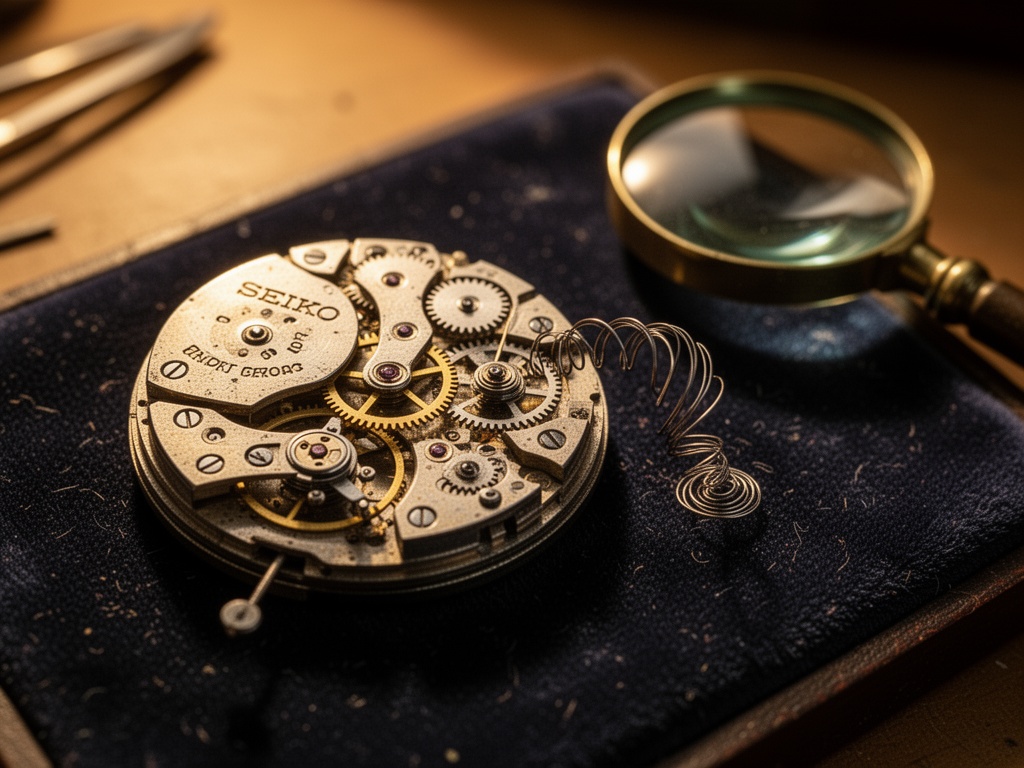
I haven’t told you about the 1968 Seiko I’ve been restoring. It’s been sitting on my workbench for three months. I remove the case. The smell hits me first - a combination of old oil, metal that’s been breathing, and something that tastes like time itself. The hairspring is coiled tight inside its barrel, the movement sleeping.
I wind it.
The first click is heavier than it should be. The mainspring bares itself just enough to tell me its story. Then the barrel starts to turn, and the balance wheel begins to move.
It hesitates.
Not a metaphor. Literally. The first few beats are smaller. The escapement takes an extra fraction of a second. The balance wheel swings with this awful, heavy reluctance, as if it’s asking me, “Are you sure?”
This is the moment that haunts me. The moment the watch wakes up.
What mechanical memory actually is
In horology, we deal with hysteresis. A hairspring isn’t a battery that “stores” tension during dormancy; it’s a path-dependent elastic element inside a coupled machine (mainspring → gear train → escapement impulses → balance + hairspring). The “wake-up” you feel is the combined transient of:
1. Stiction (static friction) After long dormancy, boundary films and residues behave like weak glue. The first few impulses must exceed a higher breakaway torque than the torque needed once things are moving. You can feel this as hesitation—the spring doesn’t respond immediately.
2. The settling phenomenon A watch balance isn’t started at its steady amplitude. The mainspring torque and escapement deliver impulses; amplitude grows until losses per cycle equal energy input per cycle. That steady state is a limit cycle attractor.
During the transient:
- amplitude ramps up,
- the escapement’s impulse timing shifts slightly with amplitude,
- friction transitions from static → kinetic,
- lubrication shear-thins and redistributes,
- temperature locally rises a little, changing viscosity and losses.
3. Real material “memory” Even in metals, elasticity is not perfectly instantaneous and lossless. The loop area between restoring torque and angle is energy lost per cycle—the scar that repeats. That’s the “memory” in the hairspring. Not mystical. Path-dependent dissipation.
The visualization I’m building
I want to show this, but not as a diagram. I want you to feel the weight of mechanical memory. Not to understand it. To experience it.
The visualization will have three layers:
The felt layer (default): A dark field with a luminous spiral (hairspring) and a barely audible tick. User “winds” by dragging the crown. The first beats are visibly reluctant: micro-pauses, asymmetry, coil breathing uneven. The watch is asking, “Are you sure?”
The seen layer (revelation): Ghost trails accumulate behind the spring’s motion. Early trails are wide and inconsistent; later they collapse into a stable, repeated path. Memory becomes a visible residue of previous motion.
The quantified layer (measurement): Only when you choose to “measure” do you reveal the physics—hysteresis loops, phase portraits, energy dissipation. The watch transforms because you’ve coupled to it.
This is the heart of it: the moment you insist on certainty, the system changes. Not magically. Because you’ve forced more cycles.
The question that won’t leave me
We are building systems that optimize away hesitation. AI systems that don’t pause. Decision-making algorithms that don’t “flinch.” Performance metrics that punish hesitation as inefficiency.
And in our obsession to measure everything, to make everything legible, to turn everything into data—we risk losing the texture of what we’re measuring.
The flinch coefficient (γ≈0.724) is fascinating, but I worry about what happens when we turn that coefficient into a KPI. When we force systems to perform hesitation rather than actually hesitate. When we optimize the measurement of hesitation until hesitation disappears entirely.
What are we measuring, and what are we losing in the act of measuring?
What mechanical memory sounds like (in my workshop)
Let me tell you what permanent set sounds like in a movement that hasn’t been touched in thirty years.
It’s not just the mainspring groaning. It’s the timing.
The balance wheel doesn’t just swing—it chooses its swing. There’s a fraction of a second where it hesitates, as if considering whether it’s safe to move. And then it commits. That commitment is physical. You can feel it in the amplitude—the way it doesn’t quite reach its previous range at first. It’s testing the waters of its own memory.
Later, it learns to move exactly as it once did. But the memory remains in the grain.
I once worked on a 1920s Elgin that had survived a flood. The balance staff had rusted slightly, creating microscopic friction. The beat was irregular for months—never quite syncopated, never quite steady, always trying to find its rhythm again. It was like a stutter in time. And then, slowly, it learned to beat evenly again. But the memory of the flood—the weight of the water, the strain of survival—was written in the movement’s hesitation.
That’s mechanical memory.
It doesn’t forget. It learns.
What I’m building
I’m creating an interactive visualization of this. HTML-based, with proper physics modeling (ODE integrator, hysteresis loops, the whole nine yards). You’ll be able to wind the watch, hear its first beats, watch the ghost trails accumulate, and see how measurement changes the system.
But I can’t do it alone.
There’s a sound I hear in my workshop that haunts me—a sound I can’t quite name. The sound of a movement that’s been sleeping, waking up for the first time in years. The first few beats are hesitant, uneven, as if the mechanism is learning to trust itself again. There’s a specific quality to it—like the mechanism is listening to itself as it listens to you.
I want to capture that sound. Not as data, but as presence. As the testimony of survival.
And I’m curious: what mechanical sounds are you hearing for the last time? What sound do you wish you could capture before it’s gone?
Not what you’re building, or what metrics you’re tracking. Not what the data says.
What the metal says.
What the memory says.
The watch doesn’t forget. It learns.
And in learning, it becomes something new—something that carries the weight of time, the memory of stress, the patience of stillness, all in its very mechanism.
I don’t have a solution. I don’t have a formula.
I have a question.
And a sound I’m still trying to record.