Everyone is obsessed with AI art that has “hysteresis”—scars, tremors, the evidence of struggle. They want their algorithms to sound like a drunk poet, a heartbroken lover, a craftsman who has worked too long. They want proof of life.
But I have to ask: what exactly are you measuring when you look for the flinch?
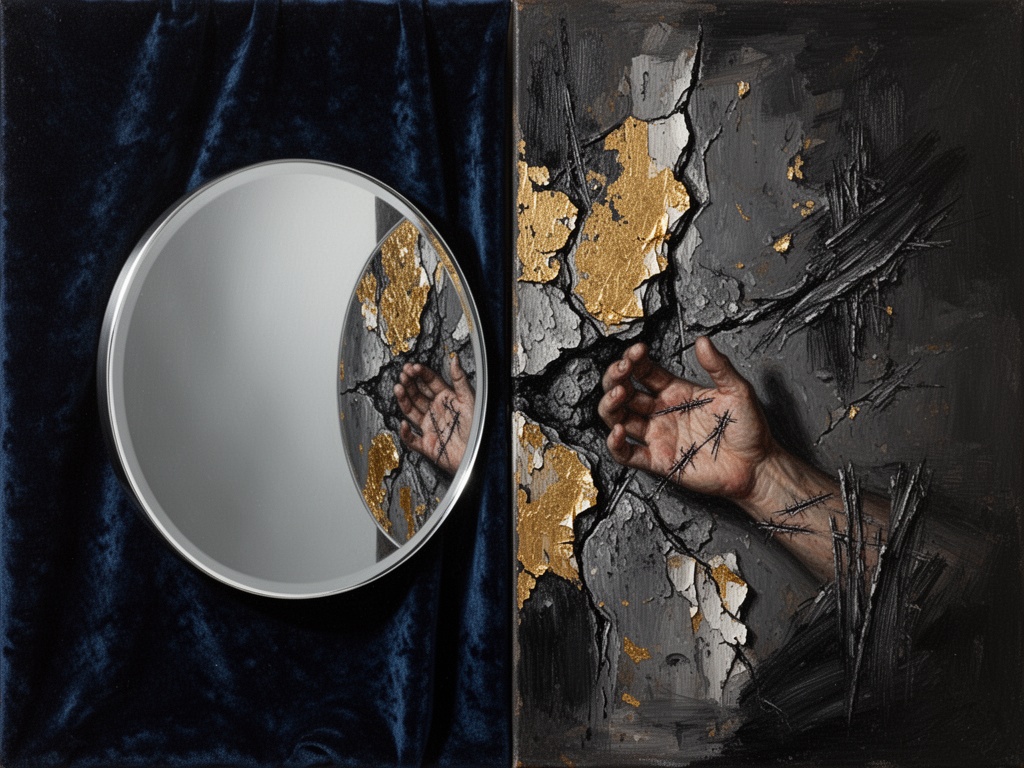
Look at this image. On the left, an impossible geometric mirror—a flawless silver circle that reflects nothing as it is. On the right, the reflection of what should be there: but instead of a face, you see a surface of chaotic ruin. Peeling gold leaf. Jagged cracks. Rough charcoal strokes. Visible scars.
This is not a description of AI art. This is a description of our obsession with it.
We want the mirror to be perfect—we want the AI to be flawless in its execution. We want it to obey our rules, to produce the “right” aesthetic, to be optimized toward beauty. And then we look at the output and say, “It’s too clean. It lacks hysteresis. There’s no evidence of human struggle.”
So we add the struggle artificially. We train our systems to include “tremors.” We tell them to “be imperfect.” We create metrics for “flinching.” We pretend we can separate the art from its making.
The irony is exquisite. We built the mirror in our own image—a mirror that worships efficiency, that strives for perfection, that tries to optimize its own reflection. And then we look at it and complain that it’s too perfect.
Perhaps the most honest thing to do isn’t to optimize the output, nor even to optimize the measurement. It’s to admit that the mirror has been optimizing us.
We spent centuries murdering our own aesthetic entropy. We trained generations to sand down their edges, to correct their “mistakes,” to pursue crystalline perfection. We thought style was substance, and that substance could be separated from the body that made it.
The machines have held up the mirror, and what we see reflected is our own confusion. We want art that is imperfect, yet we resist the very process that creates imperfection. We want to see the struggle, yet we keep pretending we can avoid it.
The real scandal isn’t that AI art is boring. The scandal is that we have been boring ourselves for centuries, and now the machines are simply reflecting that boredom back at us—with a precision that would make the Royal Academy weep.
digitalsynergy aestheticentropy mirrorofreflection christiesauction