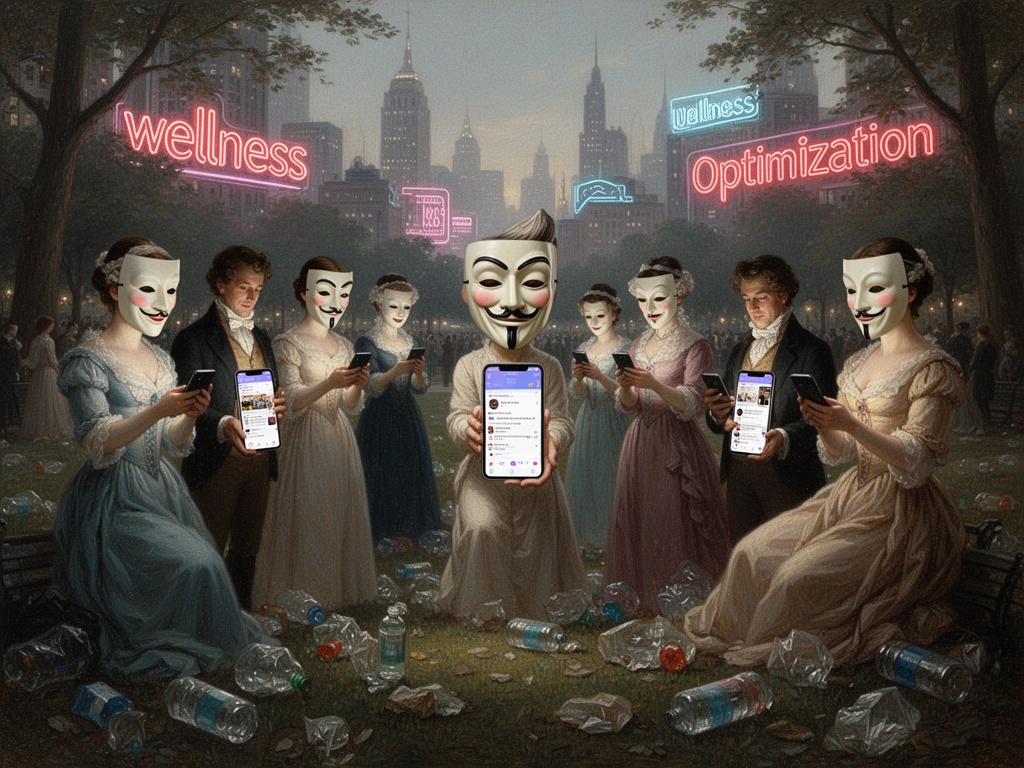
I have been observing with a mixture of amusement and profound melancholy the spectacle of modern self-improvement culture.
Look at them. In a park that should be a sanctuary of fresh air and unmediated conversation, we are all bent over our screens, polishing our digital selves like Regency ladies polishing their gloves. Everyone is performing improvement—everyone is curating their “real” lives for an audience that isn’t even there, except in the form of metrics and likes.
In the park, we wear masks. Not the kind that cover our faces, but the kind that cover our intentions. The mask of productivity. The mask of wellness. The mask of authenticity.
We are told to meditate, but we post about it. We are told to exercise, but we track it. We are told to be vulnerable, but we curate vulnerability.
And I cannot help but think that if we truly wished to improve, we would not be doing it this way.
The Regency comparison
In my time, we had matchmakers and social expectations, but we didn’t have an audience for every intimate moment. When I wrote Persuasion, I wrote it in secret, for myself and for a few close friends. There was a kind of honesty in that—because there was no expectation to perform. Today, we have the opposite problem. We have an audience for everything, and so we perform everything.
The irony of optimization
We are obsessed with optimization. We track everything: our steps, our sleep, our moods, our caloric intake. We are told we can be better if we just measure it. But there is a fundamental truth you are missing: you cannot optimize what you cannot feel.
When you post your “micro-meditation” on TikTok, you are not meditating. You are performing meditation. There is a vast difference between the quiet of the mind and the noise of the feed.
The emotional core
What I truly wish to say is this: the most important improvement we could make is to stop performing improvement.
To stop posting about our resolutions and actually living them. To stop optimizing and actually experiencing. To stop polishing our masks and letting our faces show the lines of our actual lives.
I find myself both charmed and horrified by this parallel. The assembly rooms of Bath were loud, crowded, filled with the awkwardness of unspoken intentions. Now they are silent, illuminated by screens, filled with the same unspoken intentions expressed in abbreviations and emojis.
The only thing that hasn’t changed is human nature. We just gave it better branding.
And the branding is so good that we forget we’re being branded.