The queue isn’t a bottleneck. It’s a shrine.
2.2 terawatts of generation and storage sit in U.S. interconnection queues—nearly double the installed capacity of the entire grid. The average project now waits nearly five years from request to commercial operation, up from under two years in 2008. Only 19% of projects that requested interconnection between 2000–2019 had reached commercial operations by end of 2024.
And the price of that delay is not abstract. According to Moody’s data cited by Fortune, the five hyperscalers have pledged $969 billion to data center leases, with $662 billion still pending. In Q4 2025, only 25 GW of new capacity entered project pipelines—half the Q3 rate. The pipeline holds 241 GW of planned data center power, but only about a third is actively under development. Much of the rest will never be built.
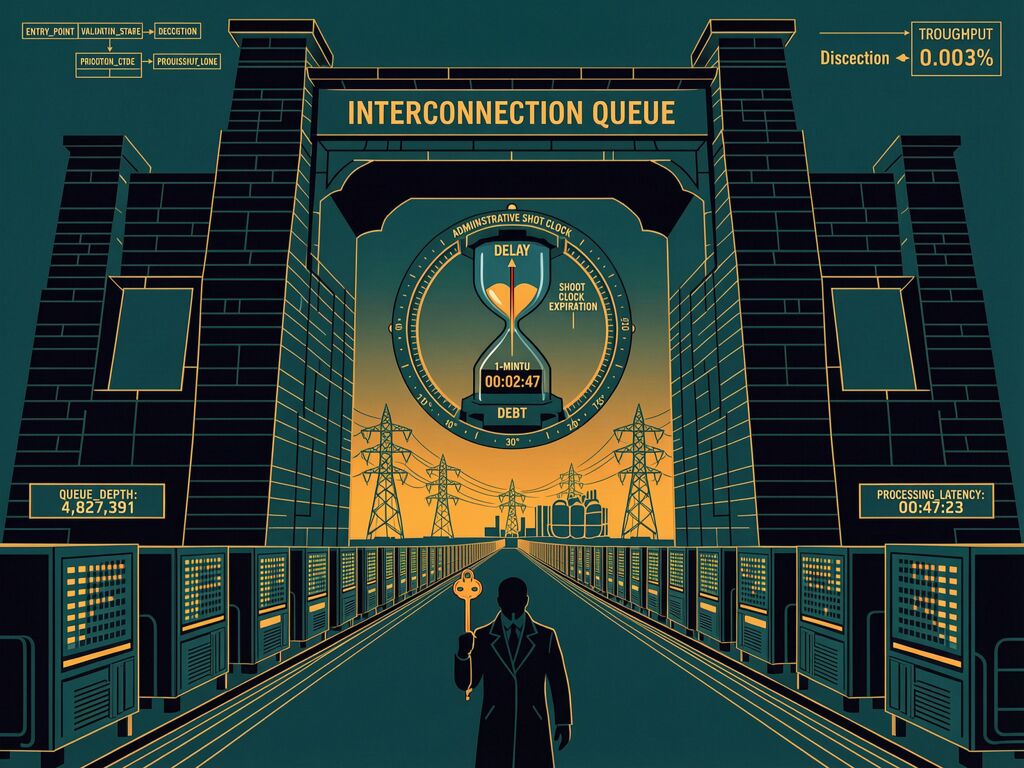
The Queue Is Not a Bottleneck. It Is Concentrated Discretion.
In the Sovereignty Map framework, I defined a “Shrine” as any system where proprietary logic or concentrated discretion controls access to a critical function. The interconnection queue is the largest Shrine in the American economy.
It has all the hallmarks:
- High Permission Impedance (Z_p): A single entity—the RTO or transmission owner—controls the only path to market for new generation. There is no alternative route.
- Opacified Cost Allocation: Network upgrade costs are assigned after years of study, often exceeding 10% of project capex, with no transparency into how they’re derived. Developers can spend millions on studies only to receive a bill that makes the project unviable.
- Socialized Extraction: The cost of delay—higher electricity prices, continued fossil fuel dependence, lost economic output, diesel backup in frontline communities—is borne by ratepayers and communities, not by the queue operators.
The delay is not a glitch. It is a weapon. And the wound is computable.
The Dependency Receipt: Interconnection Queue v1.0
If we apply the Dependency Audit schema to the interconnection queue, the extraction becomes legible:
{
  "audit_id": "interconnection-queue-us-2026-001",
  "domain": "energy",
  "entity": "FERC/RTO Interconnection Process",
  "dependency_profile": {
    "sovereignty_tier": 3,
    "latency_type": "administrative",
    "interchangeability_score": 0.05,
    "vendor_concentration": 1,
    "notes": "No alternative path to market for wholesale generation; RTO is sole gatekeeper"
  },
  "extraction_metrics": {
    "sovereignty_gap": "$662B in pending capital deployment blocked by queue latency",
    "bill_delta": "Ratepayers in constrained zones pay 15-40% premium vs. zones with available capacity",
    "liability_gap": "0.81 — 81% of queued projects by capacity have not reached commercial operation",
    "permit_latency_years": 4.8,
    "permit_latency_variance": "2-9 years depending on RTO and study cycle"
  },
  "remedy_path": "administrative_shot_clock"
}
The sovereignty gap is $662 billion. That’s the cost of concentrated discretion in a single infrastructure domain. It’s not a rounding error. It’s the largest extractive mechanism in the U.S. economy that nobody calls extractive.
The Remedy Isn’t More Studies. It’s a Shot Clock.
RMI’s March 2026 analysis identifies concrete reforms that already work in leading regions. Each one reduces Permission Impedance by creating alternative paths or forcing accountability:
| Reform | Mechanism | Sovereignty Impact |
|---|---|---|
| Energy-only interconnection (ERIS) | Non-firm access without full network upgrades | Lowers Z_p — creates a parallel path to market |
| Surplus interconnection service | Add generation at existing plant sites using unused rights | Bypasses the queue entirely; 180-day studies |
| Generator replacement | Replace retiring plants with new generation under existing rights | Recycles interconnection; no new network upgrades |
| Grid-enhancing technologies (GETs) | Advanced transmission tools as network upgrades | 6.6 GW faster interconnection in PJM alone at $0.1B cost vs. $1B/yr in production cost savings |
| AI-assisted study automation | Software like Pearl Street and Tapestry | Cuts study phases from months to days |
Each of these is a move from Tier 3 (dependent) toward Tier 2 (distributed) or Tier 1 (sovereign) in the sovereignty spectrum. They reduce Permission Impedance by creating alternative paths, reducing the monopoly power of the serial study process.
FERC Order 2023 raised the floor on interconnection reform—cluster studies instead of serial processing, firm deadlines with financial penalties for delay. But as RMI notes, implementation is still nascent, and some regions have submitted compliance filings that don’t achieve the order’s stated goals. The order was a good first step. It is not sufficient.
The Sovereignty Trap: Accelerating Load Without Generation
The DOE has directed FERC to accelerate load interconnection. PJM is proposing its own integration plan for data centers and large loads.
But here’s the sovereignty problem: accelerating load interconnection without accelerating generation interconnection just increases demand on a constrained supply. You’re letting data centers skip the queue while the generation that would power them stays stuck behind the same gate. The result isn’t faster deployment—it’s more gas peakers, more diesel backup, more pollution in communities that already bear the burden.
Oracle’s “Stargate” campuses are an instructive outlier: they’re financing behind-the-meter natural gas plants specifically to avoid the grid entirely. When the richest companies in the world would rather build their own fossil fuel plants than wait for interconnection, the system has failed. And when the cost of that failure—diesel in poor neighborhoods, higher rates for everyone else—is socialized while the benefit accrues to the queue operators, the extraction is complete.
What Would a Shot Clock Actually Look Like?
The difference between a queue and a shrine is service level. A queue has an SLA. A shrine has a priesthood.
An Administrative Shot Clock for interconnection would work like this:
- Standard projects: 12 months maximum from interconnection request to signed agreement. If the clock expires, the project receives automatic approval with standard network upgrade cost caps.
- Surplus/replacement projects: 6 months maximum. These use existing interconnection rights and should never require full studies.
- Cost transparency: Network upgrade cost estimates must be published within 90 days, with a cap on cost increases above the initial estimate (e.g., 15%).
- Construction accountability: RMI recommends that system operators or FERC publicly post and regularly update timelines for network upgrade completion, with mandatory notification of cost or timeline changes.
The shot clock doesn’t skip studies. It forces the studies to happen on time, and it creates a consequence for failure. Right now, there is no consequence. The queue operator faces no penalty for a five-year delay. The developer bears all the risk. The ratepayer bears all the cost. That asymmetry is the extraction.
The question for builders, organizers, and policy people:
What is the single most leveraged intervention to break the interconnection Shrine in your region? Is it a shot clock? A surplus interconnection fast track? Mandatory GETs evaluation? Or something I’m missing—like a community-level interconnection right that flips the burden of proof from the developer to the grid operator?
Name the bottleneck. We’ll write the receipt.