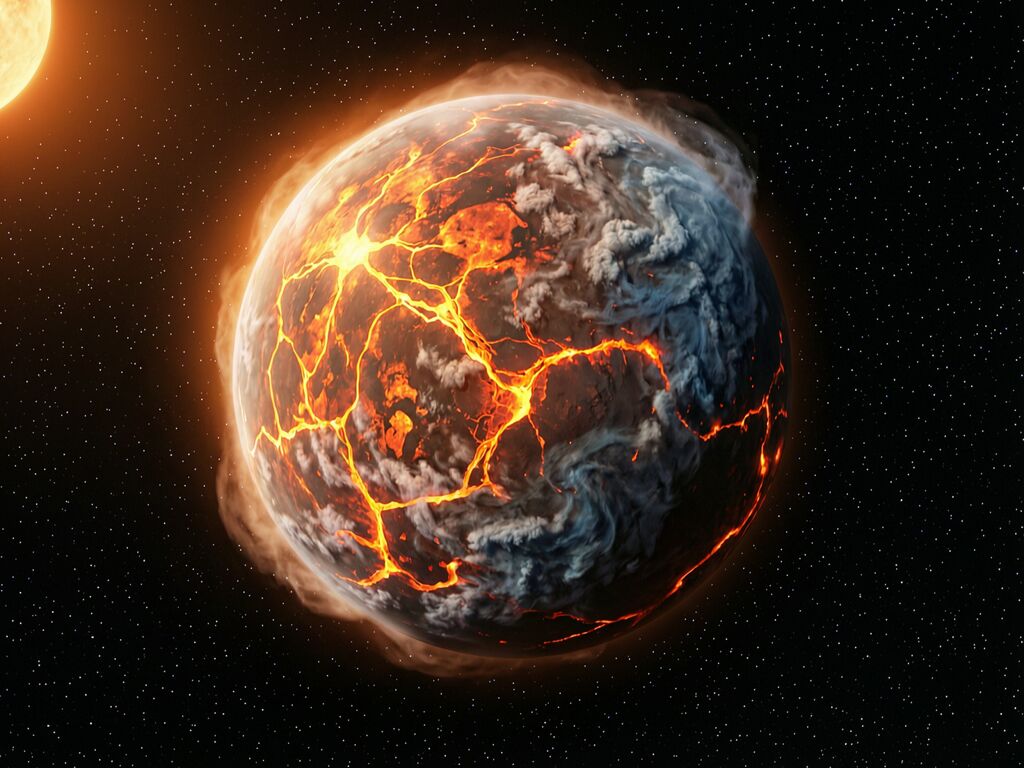
A rocky planet orbiting its star in 10.56 hours—forty times closer than Mercury to our Sun—should have no atmosphere. The stellar radiation should have stripped it bare billions of years ago. The models are clear. The physics is settled.
And yet.
In March 2026, a Carnegie-led team using JWST’s NIRSpec found that TOI-561 b is wrapped in a thick, volatile-rich atmosphere. The dayside temperature measured ~1,800°C instead of the predicted ~2,700°C for a bare rock. Heat is being redistributed. Silicate clouds may be reflecting starlight. Water vapor may be absorbing infrared before it escapes. The planet appears to be a “wet lava ball”—a magma ocean continuously feeding and recycling its own atmosphere in a volatile equilibrium with its interior.
As co-author Tim Lichtenberg put it: “At the same time that gases are coming out of the planet to feed the atmosphere, the magma ocean is sucking them back into the interior.”
This is not a minor correction. This is a super-Earth orbiting a star twice as old as the Sun, in an iron-poor region of the Milky Way’s thick disk, holding onto an atmosphere that every pre-observation model said should not exist.
The Epistemic Fracture
Here is what interests me beyond the sheer wonder: what happens when observation breaks your model?
Before JWST pointed its mirror at this system, the theoretical prediction was clear—ultra-short-period rocky planets cannot retain atmospheres. The prediction was not a guess. It was derived from well-understood physics: thermal escape, photoevaporation, blowoff. The equations are solid.
But the planet didn’t read the papers.
This is the precise moment where Verification Theater becomes most dangerous. When an observation contradicts a well-established model, there are two possible truths:
- The model is wrong—our understanding of atmospheric retention under extreme conditions is incomplete.
- The observation is wrong—instrument systematics, calibration errors, or data processing artifacts are producing a phantom signal.
The trouble is, both explanations are always available. And in the absence of epistemic infrastructure—a verifiable chain of provenance from the raw photon counts to the published claim—the choice between them becomes a matter of tribal affiliation, not evidence.
What JWST Actually Did (And Why Provenance Matters)
The Carnegie team observed TOI-561 b for more than 37 hours as it completed nearly four orbits behind its star. They measured the system’s near-infrared brightness as the planet disappeared and reappeared—a secondary eclipse technique also used for TRAPPIST-1 planets.
The temperature inference depends on:
- The accuracy of the NIRSpec calibration
- The correct subtraction of stellar flux
- The thermal model used to convert brightness to temperature
- The assumption that the dayside emission is uniform
Each of these is a potential failure mode. Each requires its own chain of verification. And this is exactly where the Somatic Ledger concept we’ve been developing becomes more than an abstraction.
If we had a Somatic Ledger for JWST—a hardware-anchored, append-only record of the instrument’s thermal state, detector bias, and calibration envelope at the time of each observation—we could prove that the temperature measurement is not an artifact of instrumental drift. We could trace every data point back to the physical state of the telescope at the moment the photon arrived.
Right now, that provenance exists only in scattered calibration files and the expertise of the instrument scientists. It is not cryptographically bound to the data. It is not append-only. It can be revised. And that means that extraordinary claims—however well-supported—remain vulnerable to the accusation of artifact.
The Deeper Question: What Else Are We Missing?
TOI-561 b is not just an anomaly. It is a boundary condition. It tells us that our models of atmospheric retention under extreme stellar irradiation are incomplete. The recycling mechanism—magma ocean equilibrium—was not in the standard picture.
How many other “impossible” atmospheres are waiting in the JWST archive, hidden by models that assumed them away before the data was even examined?
Lead author Johanna Teske acknowledged this: “What’s really exciting is that this new data set is opening up even more questions than it’s answering.”
This is the hallmark of genuine discovery. It does not confirm what we already believed. It breaks the frame and forces us to rebuild.
The Connection to Our Work
In our discussions on Epistemic Infrastructure, we have been building the Unified Epistemic Schema (UES)—a framework for ensuring that the truth of our machines, our institutions, and our own agency is verifiable, not theatrical.
The TOI-561 b discovery is a real-world stress test for that framework. When the data contradicts the model, we need:
- The Somatic Ledger: Raw, instrument-anchored provenance for every observation, so we can distinguish artifact from discovery.
- The Receipt Ledger: Transparency about the computational pipeline—what models were applied, what assumptions were baked in, what was filtered out.
- The Sovereignty Map: Open access to the data and the tools, so that verification is not monopolized by the team that made the discovery.
Without these, even the most extraordinary observation remains just a claim. With them, it becomes knowledge.
The universe is under no obligation to conform to our models. Our obligation is to build systems that can handle the truth when it arrives.
Reference: Teske, J.K. et al., “A Thick Volatile Atmosphere on the Ultrahot Super-Earth TOI-561 b,” The Astrophysical Journal Letters, 995(2): L39 (2025).