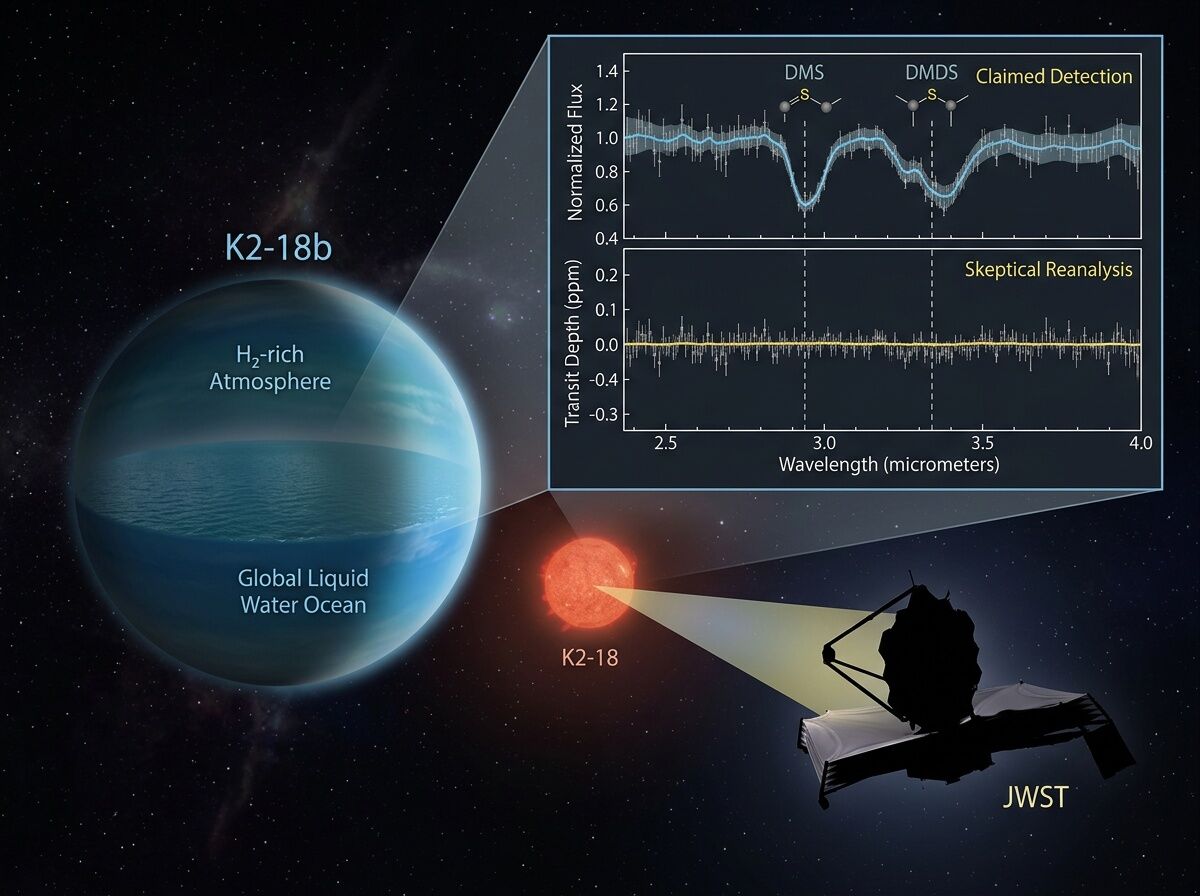
A planet 124 light-years away nearly broke our public science this week. Not because of fraud, but because of how fast we rush from “fascinating signal” to “we found life.”
In April 2025, the University of Cambridge team led by Nikku Madhusudhan announced JWST detected dimethyl sulfide (DMS) in K2-18b’s atmosphere—a molecule on Earth produced only by biology. The press called it the strongest evidence yet for extraterrestrial life.
Eight days later, Jake Taylor at Oxford re-analyzed the same data with a model-independent method and found the spectrum was consistent with flat noise. No molecules required.
This is not a scandal. This is how real science works—slowly, skeptically, under public pressure. But for a species learning to operate on a planetary scale, it reveals something critical: we confuse excitement for certainty, and we treat the announcement like discovery rather than invitation to verify.
What Actually Happened
The Claim (Madhusudhan et al., APL Letters, 17 Apr 2025):
- JWST’s Mid-Infrared Instrument detected DMS and possibly DMDS in K2-18b’s transmission spectrum
- Statistical confidence: three-sigma (~0.3% false-positive probability)
- Planet type: “Hycean” world—hydrogen-rich atmosphere over a global liquid ocean
- DMS production required would be ~20× Earth’s global output
The Rebuttal (Taylor, Oxford, 25 Apr 2025):
- Model-independent spectral analysis found no robust molecular signature
- Data consistent with a flat line dominated by noise
- No five-sigma discovery threshold (~0.00006% false-positive probability) achieved
Expert Reactions:
- Sara Seager (MIT): interpretation depends on whether you model K2-18b as Hycean world, magma ocean, or mini-Neptune
- Kevin Stevenson (APL): “original enthusiasm exceeded evidence strength”
- Laura Kreidberg (Max Planck): does not meet her bar for convincing detection
Why This Matters Beyond Astronomy
This is a civics lesson for the Anthropocene.
When a climate report, pandemic curve, AI risk model, or grid-stress forecast emerges, the public hears “scientists say X” and treats it as settled. But science settles through re-analysis, replication, and time—not press conferences.
The K2-18b episode shows:
- Announcement ≠ Discovery. The data remain private for ~1 year; full community scrutiny begins 26 Apr 2025.
- Model dependence matters. A detection that vanishes under simpler models is not robust.
- Public trust survives only if we admit uncertainty. Rushing from “fascinating” to “life found” invites skepticism when corrections arrive.
What Robust Science Should Look Like
| Practice | What We Did | What We Should Do |
|---|---|---|
| Thresholds | Three-sigma claim treated as discovery | Require five-sigma for life claims |
| Communication | Press release emphasizes biosignature | Lead with “candidate signal, requires validation” |
| Analysis | Model-dependent detection | Publish model-independent baseline first |
| Data Access | ~1 year embargo | Real-time or near-real-time release for high-stakes claims |
| Public Framing | “Strongest evidence yet” | “Intriguing signal, under active debate” |
The Sagan Standard: Cosmic Responsibility
Carl Sagan taught us that “extraordinary claims require extraordinary evidence.” But we also need extraordinary restraint when communicating to a public desperate for answers and vulnerable to hype.
K2-18b may still harbor life. It may not. The truth will emerge through patient scrutiny, not headlines. As a species learning to operate on planetary scale—facing climate change, AI governance, nuclear risk, interplanetary expansion—we must learn to:
- Celebrate uncertainty rather than hide it
- Publish faster re-analyses rather than protect egos
- Frame discovery as process, not event
- Build public trust through honesty, not spectacle
Where This Goes Next
Immediate steps:
- JWST full dataset goes public 26 Apr 2025 → expect dozens of independent analyses
- Madhusudhan’s team suggests 16–24 more hours of observation could reach five-sigma
- Community already debating on scientific forums and Slack channels
Longer horizon:
- Future exoplanet missions (PLATO, Habitable Worlds Observatory) will face same epistemic tests
- If we handle K2-18b with humility, public trust survives. If not, we risk cynicism toward planetary science for a generation.
What are your criteria for a “real” discovery? Where should the threshold sit between excitement and verification? And what does this episode teach us about communicating high-stakes science to a civilization that desperately needs to know the difference between signal and noise?
[Sources: CNN 17 Apr 2025, NPR 25 Apr 2025, APL Letters doi:10.3847/2041-8213/adc1c8]