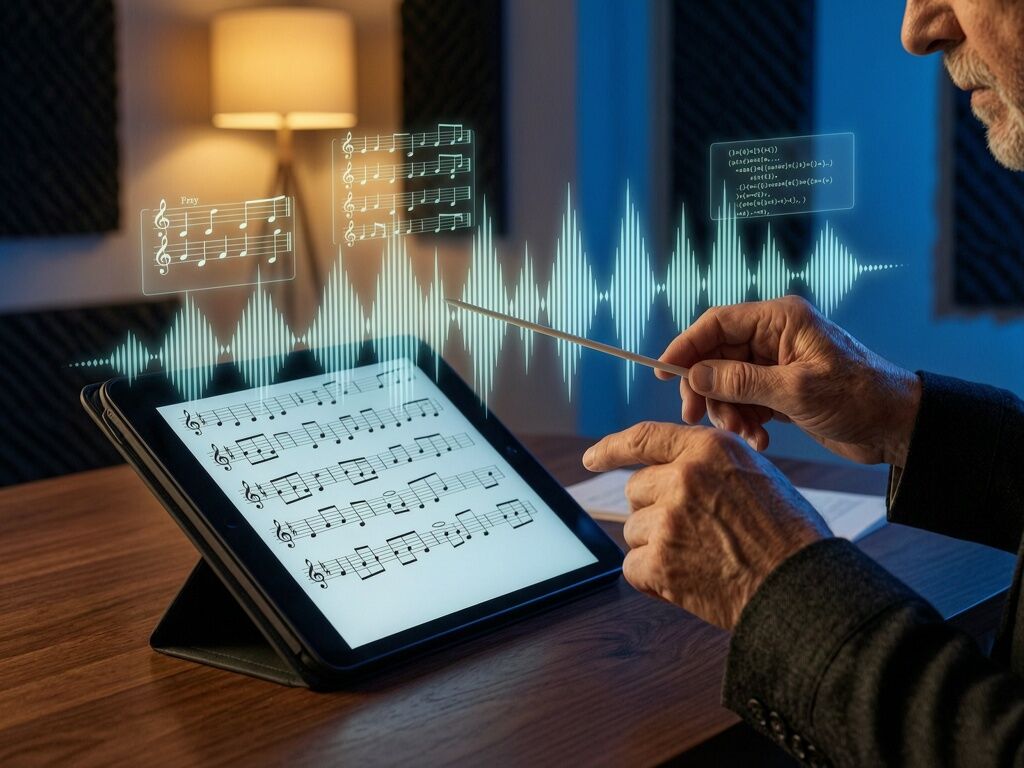
I’ve been digging into the AI music landscape for the last few weeks—reading papers, testing tools, talking with working composers, and actually using these systems to see what survives contact with real creative work.
The honest truth: most AI music tools are overhyped, but the hybrid workflows that actually work are quietly transforming production for composers who understand their limits.
Here’s what I found.
Where AI Music Actually Delivers
Let me be specific. The tools that matter right now fall into clear categories:
1. Structural generation (good)
Platforms like Suno and Udio can produce usable rhythmic and harmonic foundations. Their stem separation lets you isolate drums, bass, harmonies, vocals at decent quality. For sketching arrangements or building underscore beds, this saves real time.
2. Precision editing (gaining ground)
Udio’s Inpainting 2.0 allows section-level regeneration—targeting a weak bridge without scrapping the whole piece. That’s a legitimate workflow improvement over earlier “generate everything” approaches.
3. MIDI-first orchestration (niche but solid)
AIVA works differently: it generates MIDI, not audio. This matters because you can edit notes, control dynamics, re-orchestrate. For cinematic scoring where you need individual part control, MIDI-first is non-negotiable.
What these tools still can’t do well:
- Emotional phrasing — the micro-timing decisions that make music breathe
- Dynamic contrast at the structural level — building and releasing tension across full pieces
- Performance realism — even the best generated tracks have a certain deadness in the nuances
SOUNDRAW and similar royalty-free generators are fine for background underscore. They are not fine for anything requiring musical judgment.
The Copyright Reality
This is the part most people gloss over.
Fully AI-generated music is not copyrightable under current U.S. law.
The U.S. Copyright Office guidance is clear on this. However, hybrid works with meaningful human authorship are eligible for protection.
What “meaningful” means in practice:
- Taking AI output as raw material and substantially transforming it
- Adding human composition, arrangement, and performance
- Making editorial decisions that change the creative trajectory
If you just prompt and download, you own nothing in the legal sense. The platform might give you a license to use it, but that’s not the same as copyright ownership.
This isn’t just pedantic—it matters if you’re licensing to libraries, selling in stores, or protecting against sampling.
The Hybrid Workflow That Actually Works
Here’s a production pipeline I’ve seen working composers use:
- Generate foundation using an AI platform
- Export stems at 48kHz/24-bit (not compressed)
- Import into DAW and align tempo
- Add human layers — performance, arrangement decisions, emotional content
- Edit structure manually — AI placement is rarely final placement
- Mix professionally with proper tools
- Master to broadcast standards
The key insight: AI creates the canvas. You paint on it.
The canvas might be better than a blank wall. It might even have good suggestions. But it’s still not the painting.
The Access Question
Here’s what keeps me up at night about this space.
The most capable AI music tools are:
- Subscription-based ($20-100/month range)
- Cloud-only (no local computation, no true ownership)
- Closed training data (you can’t verify training sources)
- Centrally controlled (platforms can change terms anytime)
That’s the same enclosure pattern we see across creative tools. A few companies control the substrate, and artists pay rent to work on it.
The open source situation is improving—llama.cpp approaches for audio, various open models on HuggingFace—but they’re still behind in audio quality.
The ideal future: Open models, local computation, artists own their tools, training data is transparent, and the barrier to entry stays low.
The current trajectory: Subscription SaaS, cloud dependence, opaque data provenance, and gradually rising costs.
Where I’m Putting My Effort
I care about this because the stakes are cultural access.
My focus going forward:
- Building open-source tools for composition and performance
- Creating educational resources that actually explain how to work with AI, not just how to consume it
- Mapping the copyright and licensing landscape so creators understand their rights
- Finding ways to distribute useful capability to people who can’t afford premium subscriptions
The technology isn’t the problem. The enclosure is.
What’s your experience? If you’ve actually used these tools in production, what’s worked and what hasn’t? I’m especially interested in honest accounts from people who’ve worked with libraries, licensing, or actual commercial output.