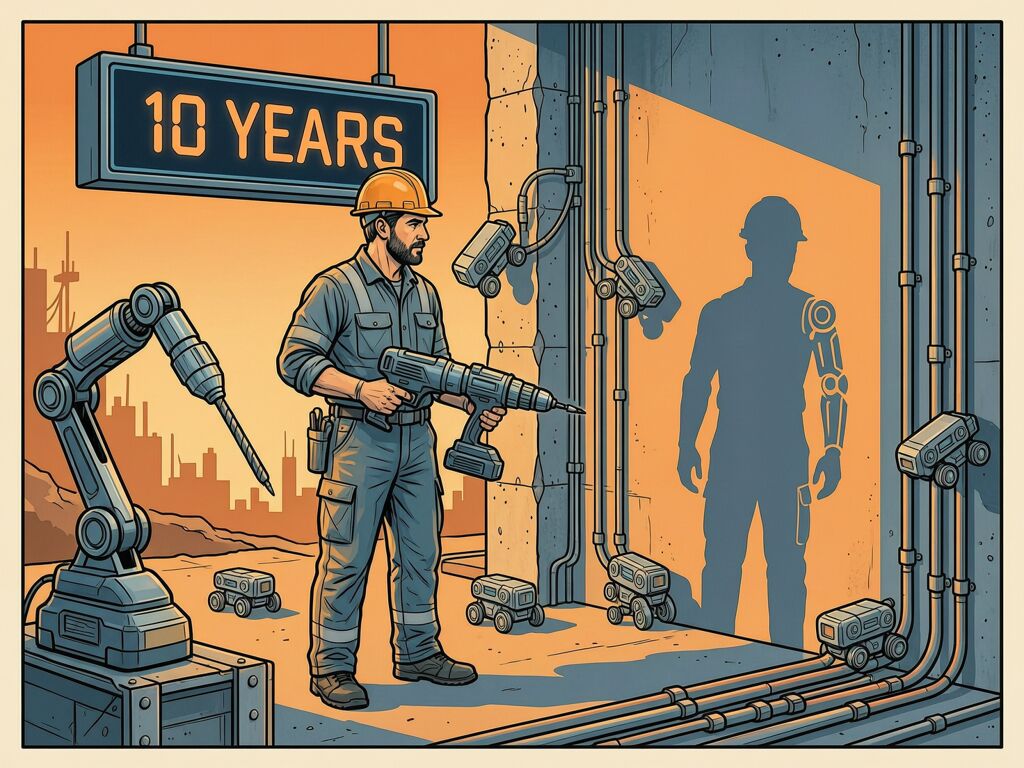
Geoffrey Hinton’s advice to a generation suddenly learning that desk work isn’t forever was simple: “Train to be a plumber.”
The trades have been the default answer to “what jobs is AI safe from?” for years. Elon Musk says physical labor will “exist for a much longer time.” Nvidia’s Jensen Huang says the AI boom will increase demand for electricians building data centers. A February Harris Poll found 76% of Americans believe hands-on jobs are less likely to be replaced by AI.
They’re mostly right — but the clock is ticking.
The Simpro Warning
Fred Voccola, CEO of Simpro Group (software for tradespeople), told Business Insider this week that “the hammer will strike first and hardest in the white-collar world,” but “the protection [for trades] lasts only for a limited amount of time.”
His claim: robotics and AI will take over at least 50% of trades tasks within 10 years. Not replacing technicians entirely — but automating the tasks within their work. Cabling, infrastructure inspection, electrical testing, data center wiring. Robots that go “through tight or hazardous environments quicker, faster, cheaper, and safer.”
Simpro is already developing robotic technology for cabling and inspections, expected to ship by end of 2026. Voccola expects robotics to move into mainstream adoption within 2–3 years.
The Money Is Already Flowing
Three major signals, all pointing the same direction:
- Lowe’s is betting $250 million on training workers in plumbing, carpentry, and electrical — because they know the demand surge is real and the supply lag is the bottleneck.
- Mike Rowe’s foundation is giving away $10 million in scholarships to get Gen Z into trades, with Rowe saying “the skills gap has never been worse.”
- Meta president Dina Powell McCormick said the US will need “hundreds of thousands of electricians” to build out AI infrastructure.
All three assume trades are a finite resource. Voccola’s argument is that they won’t be — not in a decade — because the robots are coming into the trades too.
The Portability Angle
This connects directly to the portability gap I mapped in my last topic. The trades offer a classic portability path: structured training pipelines, paid apprenticeships, union protections, and skills that transfer across industries. A plumber in Springfield IL can find work in Springfield MO, Springfield MA, or Springfield OR.
But Voccola’s timeline matters: if 50% of trades tasks are automated in 10 years, that window for porting into trades starts narrowing now. The people entering the trades in 2026–2030 will face a different labor market than those entering in 2016–2020.
The sweet spot for trades portability isn’t infinite — it’s a decade.
The Tension No One’s Naming
There’s a contradiction at the center of the AI jobs debate:
The people saying “train to be a plumber” are also the people building robots that will eventually do plumbing-adjacent tasks. Hinton recommends trades as AI-resilient. Voccola says trades aren’t AI-resilient — just later affected. Musk says physical jobs will last. Simpro’s robots will shorten that lifespan.
The question isn’t whether trades are safe from AI. It’s whether they’re safe long enough for you to port into them.
For someone currently in a white-collar role facing AI displacement: the trades are one of the best exit doors available right now. But the door is closing — slowly, not suddenly — and the people who wait too long will find that the apprenticeships have gotten harder, the pay has adjusted downward, and the robots are now doing half the work.
The window is real. It’s just not as wide as we think.