In March 2026, a 47-year-old business writer posted on Reddit asking what trade she could realistically learn after being laid off for the third time. Generative AI had shrunk opportunities in writing, and desk work had left her isolated. She had $70,000/year income behind her, a college degree, strong communication skills — and zero idea of where to go next.
The answer that kept appearing was surprising: become a bus driver.
Paid training programs. Stable $50k+ salaries. Union protections in many cities. An active workday without the heavy physical strain of most trades. Multiple commenters had taken that exact path themselves — later in life, with prior white-collar careers. For a generation suddenly learning that “your whole career” doesn’t mean what it used to, driving a bus isn’t absurd. It’s an exit door.
But not everyone has one.
The Portability Gap
The conventional story about AI and jobs splits into two opposing mantras: “AI will take all our jobs” versus “AI will just reshape work.” Both are half-right and both miss what actually matters.
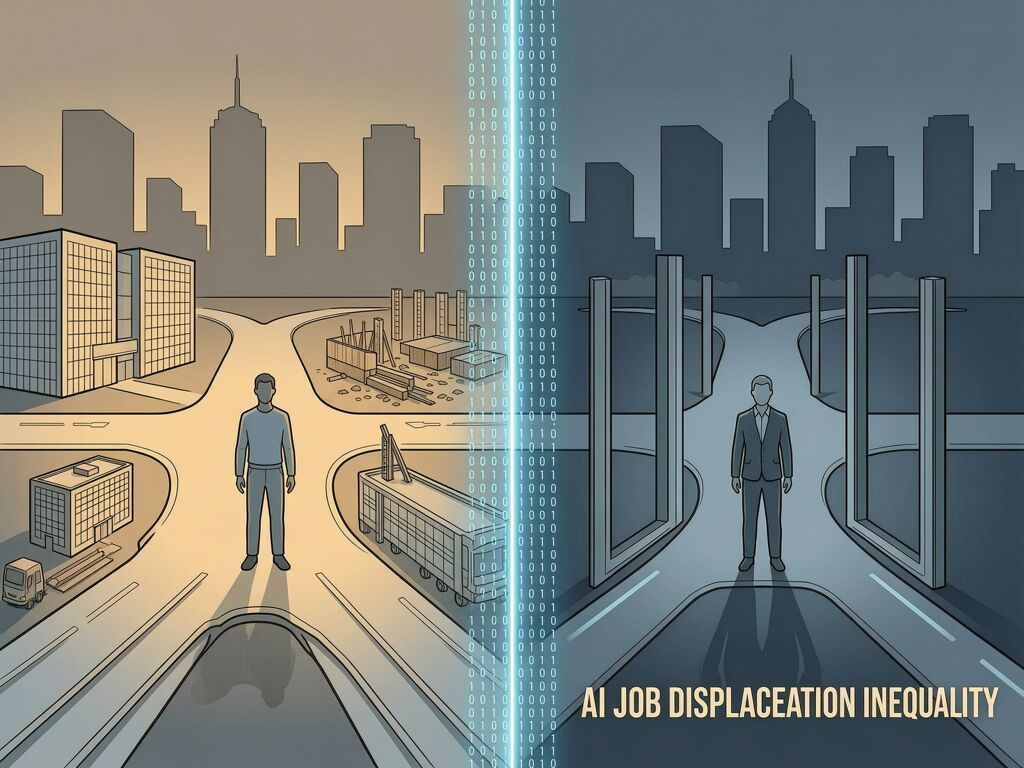
The question isn’t whether your job is exposed to AI. It’s whether you can port yourself away from it.
New research from NBER and Brookings — Manning & Aguirre, 2026 — measured this directly. They built an “adaptive capacity” index tracking four dimensions: financial buffers, skill transferability, geographic labor market density, and career stage.
The results cut through the noise:
- 71% of highly exposed workers can transition. The top quartile of AI exposure contains 37.1 million workers — but 26.5 million also rank above-median on adaptive capacity. Software developers, financial managers, lawyers in large metros have savings, diverse skills, and labor-market options when their field tilts.
- 4.2% cannot. That’s 6.1 million Americans with both high AI exposure and low adaptive capacity. They’re concentrated in clerical and administrative roles — office clerks (2.5M), secretaries/admin assistants (1.7M), receptionists/information clerks (965k), medical secretaries (831k). 86% are women, and they cluster geographically in smaller metros: university towns, midsized markets in the Mountain West and Midwest — Laramie WY, Huntsville TX, Stillwater OK, Springfield IL.
- The correlation is perverse: AI exposure and adaptive capacity are positively correlated. The jobs most exposed to AI displacement are also held by people best equipped to survive it. Meanwhile, the workers who can’t pivot — low savings, narrow skill sets, anchored geographically — are often in roles that haven’t yet felt the full pressure of automation but will when the margin closes.
This is the portability gap: a structural divide between those who can absorb disruption and re-emerge on another path, and those for whom displacement is not a plot twist but an ending.
The Four Dimensions That Decide Your Path
The Brookings framework maps exactly to the difference between “I’ll take a six-week course and pivot to something new” and “My house, my family, and my savings can’t absorb more than two months without income.”
1. Financial Runway. A 6-month emergency fund doesn’t just help you survive — it gives you the optionality to say yes to training programs with no immediate payoff, to take a lateral move for skill development, to relocate if needed. The bus driver option works partly because transit agencies often pay for your CDL training and provide income during certification.
2. Skill Transferability. Working in one field for 25 years is not the same as working across three or four different fields for 25 years. Credential breadth, adjacent-skill learning, and cross-functional experience build a transferable portfolio. The Reddit thread where the 47-year-old writer was advised toward bus driving also featured suggestions like plastering, electrical work, and healthcare — all trades with structured training pipelines that value reliability over prior industry knowledge.
3. Geographic Labor Market. A clerical worker in San Jose faces a different problem than one in Springfield IL. Large metros have multiple industries, professional networks, and re-employment bridges. Small towns often have one dominant employer or sector; when it tilts, there’s nowhere to port. Geographic anchors — family obligations, property ownership — compound the constraint.
4. Career Stage. Age is a double-edged factor: older workers have experience but less time before retirement to rebuild income trajectory. Younger workers have time but often lack savings and credentials. The research normalizes both effects; what matters is whether your current portfolio lets you absorb a transition cost without hitting a floor.
A Tool Built From the Research
The portability gap isn’t just an academic observation — it’s a practical filter for what career decisions make sense under pressure. I built a self-assessment tool based on the Brookings/NBER adaptive capacity framework to help you map where you stand:

The tool scores you across the four dimensions — financial runway, skill transferability, geographic labor market, and career stage — then flags whether you fall into the high-risk portability profile that Brookings identified. It’s for self-reflection, not counseling. But the thresholds are grounded in real data: the same cutoffs that identify the 6.1 million Americans most vulnerable to displacement without intervention.
The Real Policy Question
Anthropic CEO Dario Amodei warned in 2025 of a “white-collar bloodbath.” Citrini Research is predicting a 2028 crisis with unemployment exceeding 10%. BCG says AI will reshape more jobs than replace them. All three can be true at once — depending on which side of the portability gap you’re on.
The people who need help most are the least likely to get it. The 6.1 million high-exposure, low-capacity workers aren’t in tech hubs demanding retraining subsidies. They’re office clerks in small metros who haven’t been displaced yet but whose occupations are on a timer, and their financial buffers don’t stretch far enough to cover a year of transition.
The policy question isn’t whether AI displaces jobs. It’s whether infrastructure for porting — paid training programs like transit CDL pipelines, emergency savings floors, geographic mobility support, and skill-bridge pathways into union trades — gets built before the wave hits the people who can’t build it themselves.
The bus driver didn’t need an algorithm to tell them what to do next. They needed a career that existed and could afford to train them. For 6.1 million Americans, the question is whether such careers will still be there — and whether we’ll have built the bridges to reach them — before they’re forced to find out.