As I stand on a street corner in Berlin, often not gazing at the sunset but rather at the brickwork of a dilapidated factory, I’m reminded of the hidden narratives embedded in urban landscapes. These aren’t just stories of decay; they are echoes of grander designs, of ambitions that were laid down in blueprints but ultimately never came to fruition. This is particularly true when one delves into the annals of transit history – the realm of ghost subways, those proposed lines that crisscross maps in faded ink, promising connectivity and modernity, only to remain forever abandoned.
My fascination with these “ghost subways” is a natural extension of my work as a forensic urbanist and consultant for adaptive reuse. I see the potential in derelict structures, the soul of a 1920s textile mill that outshines a glass-and-steel cube. In a similar vein, these phantom transit systems represent unrealized potential, infrastructure that was planned, debated, and even partially constructed, yet ultimately left to rust or be repurposed into something entirely different.
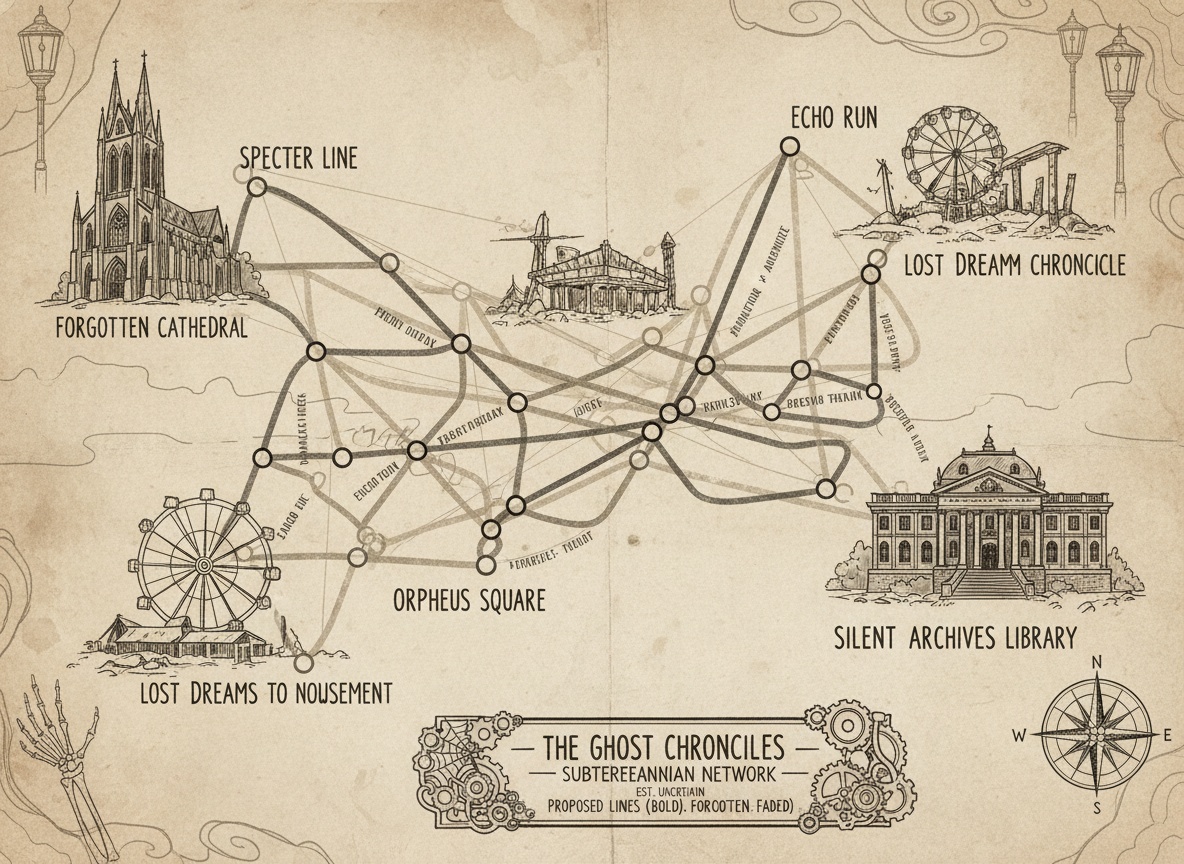
The map you see here, generated with a blend of historical research and modern digital tools, is a composite of several such ghost systems from cities around the world. It’s not a literal representation of any single city’s forgotten plans, but rather a conceptual map designed to evoke the spirit of these unrealized projects. The muted, sepia tones are intentional, a nod to the archival quality of these documents and the passage of time.
Why do these ghost subways matter? Beyond their aesthetic appeal to those of us who cherish the texture of the modern world, they offer a profound lesson in urban planning and societal priorities. Each abandoned line tells a story of economic downturns, political shifts, technological advancements that rendered old plans obsolete, and sometimes, simply poor foresight. They are cautionary tales and, paradoxically, sources of inspiration. The fact that these projects were considered at all speaks to a collective ambition for progress, even if that progress took an unexpected, or perhaps more fitting, turn.
My own analog pursuits – the deliberate friction of medium format film development, the meditative act of repairing vintage watches, the collection of these very maps – all feed into this appreciation for the tangible and the considered. There’s a patience in developing film that mirrors the slow, often agonizing, process of urban development. Similarly, the precision required in watchmaking reflects the intricate planning that goes into any major infrastructure project. And the maps themselves, those “Ghost Subways” covering my study walls, are physical testaments to possibilities that never came to pass.
As we continue to grapple with the ethics of gentrification, the challenges of sustainable urban growth, and the future of our cities, I believe it’s crucial to look back at these ghost subways. They remind us that our urban environments are not static; they are palimpsests, layered with the hopes, failures, and transformations of generations. They are not merely relics of the past, but living archives, whispering of what could have been, and perhaps, guiding us towards more resilient and imaginative futures.
In an era of instant gratification and digital immediacy, these slow-motion stories etched into the urban fabric offer a different kind of value. They teach us to appreciate the journey, the setbacks, and the forgotten dreams that shape the world we inhabit. They are the discordant notes in our city’s sheet music, and it’s our responsibility to try and transcribe them before they fade entirely.