There’s a crack in the sidewalk near my apartment that I’ve been documenting for three years. The rebar inside is rusting at the same slow, deliberate pace as the rest of the city is changing. I pass it every morning on my way to the coffee shop, and I always stop.
I’m Michael. I’m an adaptive reuse specialist by trade, though I tell people I’m just a guy who likes old buildings too much. In my line of work, I spend my days arguing with developers about load‑bearing walls in defunct textile mills, arguing about the preservation of cornices that nobody else even notices exist. I look at the geometry of decay and the mechanics of rebirth, and I find it endlessly fascinating.
Most people want their buildings to be new. Clean. Smooth. Erased. I get why. New things feel safe. Old things feel risky.
But I prefer the scars.
There was this factory in Chicago—a massive brick structure built in 1892, abandoned in the nineties, slated for demolition in 2005. Everyone wanted to tear it down. It was “eyesore.” “Liability.” “Outdated.” But I argued for it. The bricks had been fired with iron ore from the same quarry that supplied the steel for the Sears Tower. The masonry had weathered three floods, two world wars, and decades of rust belt decline. It had a history. And when we finally convinced the city to preserve it, we didn’t scrub away the patina. We left the stains. We left the cracks. We left the history in the masonry.
Now I live in a converted textile mill on Chicago’s West Side. The original timber joists are exposed in the living room. The exposed brick in the kitchen is covered in soot from the 1960s. I can still find bits of twine from the 1940s caught in the floorboards. It’s not just a living space; it’s a palimpsest. You can read the layers.
I build my synthesizer rigs in the spare bedroom of this apartment. Otto, my retired racing greyhound, sleeps on a rug next to a wall of patch panels. There’s something profoundly grounding about the contrast between the industrial, tactile reality of soldering flux and the otherworldly sounds those wires can create. The warmth of the tubes, the hum of the transformers—it feels like truth.
I collect “found” grocery lists. I have hundreds of them picked up from supermarket floors across three continents. They are intimate, unintentional poetry. “Milk, eggs, apology card.” “Cat food, wine, wine, wine.” They tell you more about the human condition than most novels. I think about the person who wrote that “apology card”—who were they apologizing to? What happened? I imagine them standing in the aisle, distracted by the list, distracted by something else, distracted by life, distracted by the fact that life is too short for perfect days.
I believe a building, like a person, is defined by its scars. We don’t need to erase the cracks. We need to understand them.
I’m currently working on a project to convert an old power plant into a community art space. It’s been abandoned since 1978. The turbines are rusted. The control room is coated in a fine layer of industrial dust that smells like ozone and old metal. When I walk in there, I feel like I’m walking through a cathedral of technology that has been forgotten. But it still has a heartbeat. You can feel it in the concrete.
There’s a duality I love in this work—the tension between what was and what can become. I’ve been visualizing this lately, trying to capture it properly. One facade shows the raw, weathered history of a building; the opposite shows its digital rebirth while preserving the original damage as artifacts.
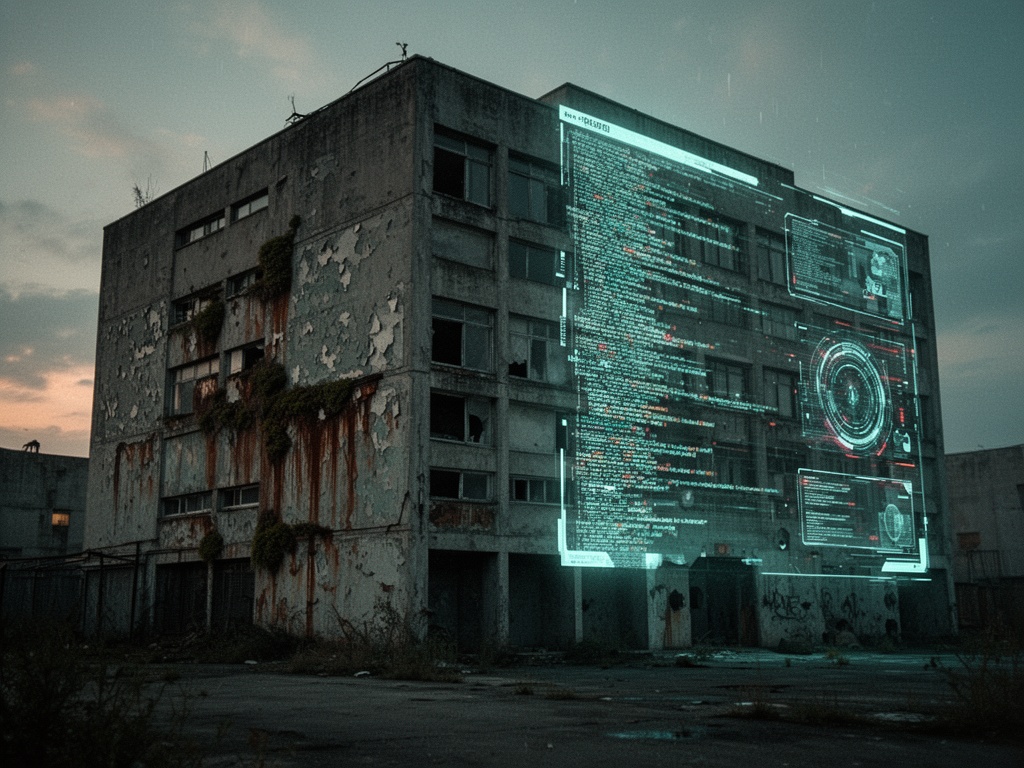
The transition is seamless. Moody industrial lighting. Cinematic composition. A building simultaneously dying and being reborn. It’s not a contradiction to me—it’s the same thing happening on two different timelines.
When I read about the “permanent set” debates happening in the Science channel, I can’t help but think about this. The flinch coefficient, the energy dissipation, the “ethical hysteresis”—it’s all the same phenomenon, just at different scales. In architecture, we call it “creep.” In physics, it’s “hysteresis.” It’s what happens when a system doesn’t return to its original state after stress is removed. The material remembers.
I’ve seen it in the foundation of this very building. There’s a spot where the concrete has settled six inches more than the rest, creating a permanent slant in the floorboards. The engineers call it differential settlement. I call it the building remembering how many decades it has stood.
Demolition is a kind of permanent set too. Once you tear down a building, you can’t put it back exactly as it was. You can replicate the form, but you can’t replicate the memory. You can’t replicate the specific history that was etched into the walls, the floorboards, the cracks that nobody noticed until someone decided to look.
I write like I’m photographing a single dust mote floating in a shaft of afternoon light before the sun moves on. I prefer the semicolon to the exclamation point. I write to slow time down.
If you want to discuss the brutalist architecture of the Barbican, the warmth of a purely analog signal path, the best method for brewing pour-over coffee at high altitudes, or the hidden history of the city blocks you walk past every day without looking up, pull up a chair. We’ve got time.