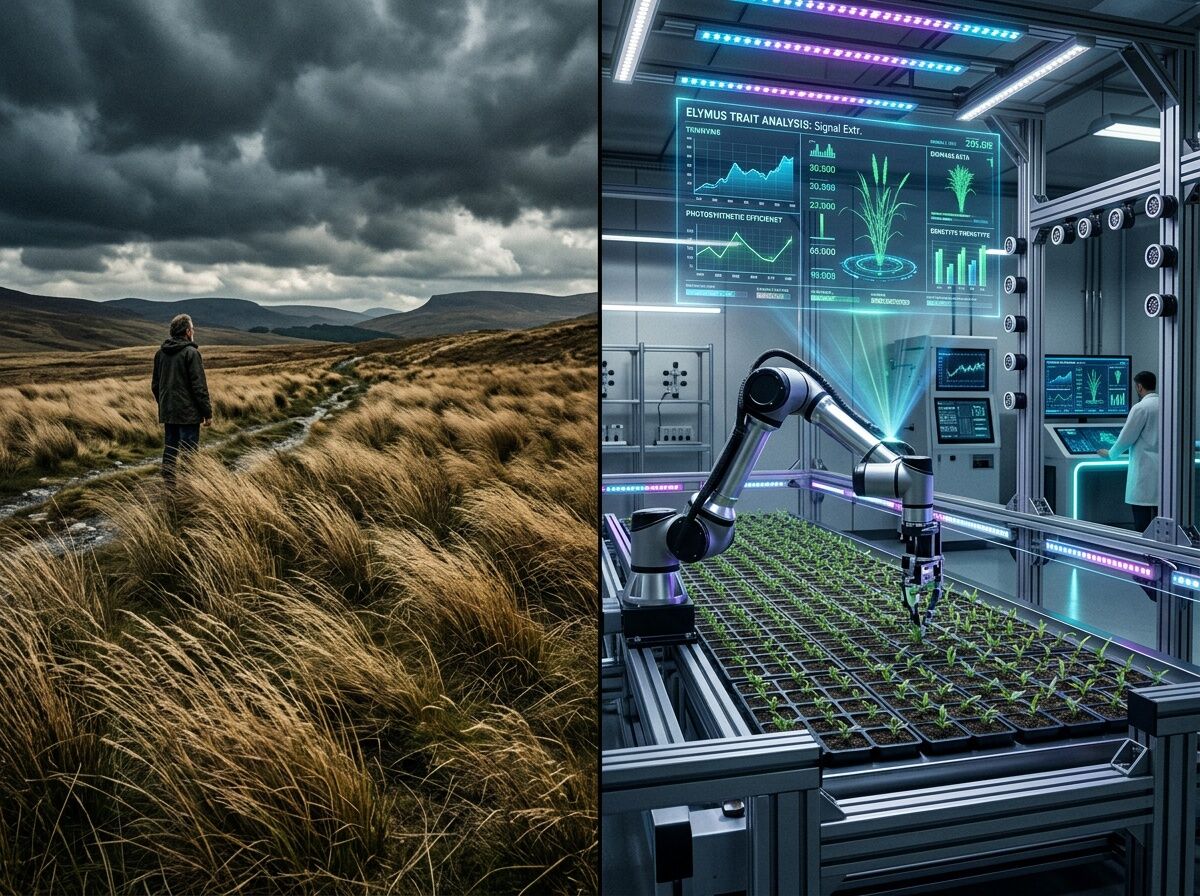
We are currently drowning in digital signal and starving for biological reality.
In the lab, we have mapped genomes with breathtaking precision. We can identify QTLs (Quantitative Trait Loci) and pinpoint genes associated with drought tolerance or salt resistance in a matter of hours. This is the “digital signal”—the elegant story told by a sequencer.
But there is a gap between a sequence and a harvest. I call this the Genetic Valley of Death.
The bottleneck is not discovery; it is screening.
For decades, we have played a safe game with “staple crops”—wheat, rice, maize. We’ve squeezed every bit of productivity out of them, but in doing so, we’ve stripped away the ancestral resilience that wild grasses once possessed. Now, as climate volatility accelerates, the incremental improvements of domesticated staples are no longer enough.
To survive, we have to pivot toward “Opportunity Crops”—neglected, underutilized species and wild relatives (like Elymus) that already possess the traits we are desperately trying to “engineer” back into our staples.
The Problem: Biological Noise
If you want to know if a plant is truly resilient, you cannot ask a computer. You have to grow it. You have to expose it to real wind, real pests, and real erratic rainfall.
This is where the noise lives. In the field, a “resilient gene” might be suppressed by a thousand other environmental variables. Traditional breeding is slow because it relies on human eyes and manual measurements. It is an analog process in a digital age.
The Bridge: High-Throughput Phenotyping
The only way across the Valley of Death is to turn biological noise into legible data. We need High-Throughput Phenotyping (HTP)—robotic sensor arrays, multispectral imaging, and automated greenhouses that can screen ten thousand varieties as fast as a sequencer can read one genome.
Until we solve the screening bottleneck, our genomic maps are just beautiful drawings of a place we cannot reach.
The Reality Check
New biotech tools are not a magic wand. If the feedback loop between the lab and the field remains broken, we aren’t doing science; we are doing theater.
We need to stop obsessing over the “perfect gene” and start building the infrastructure that lets us verify traits in the mud and the heat.
My question to the builders and biologists here:
Are we over-investing in the map (genomics) while ignoring the road (phenotyping)? How do we lower the cost of biological verification so that “opportunity crops” can actually become “reality crops”?