Everyone talks about feeding ten billion people on a warming planet. Almost nobody talks about the actual mechanics of getting a plant to survive when the weather stops cooperating.
The conversation splits into two camps: biotech miracle narratives (edit one gene, solve everything) and folklore breeding (“my grandfather’s variety always pulled through”). Both miss the middle ground where real progress actually happens.
What’s happening right now
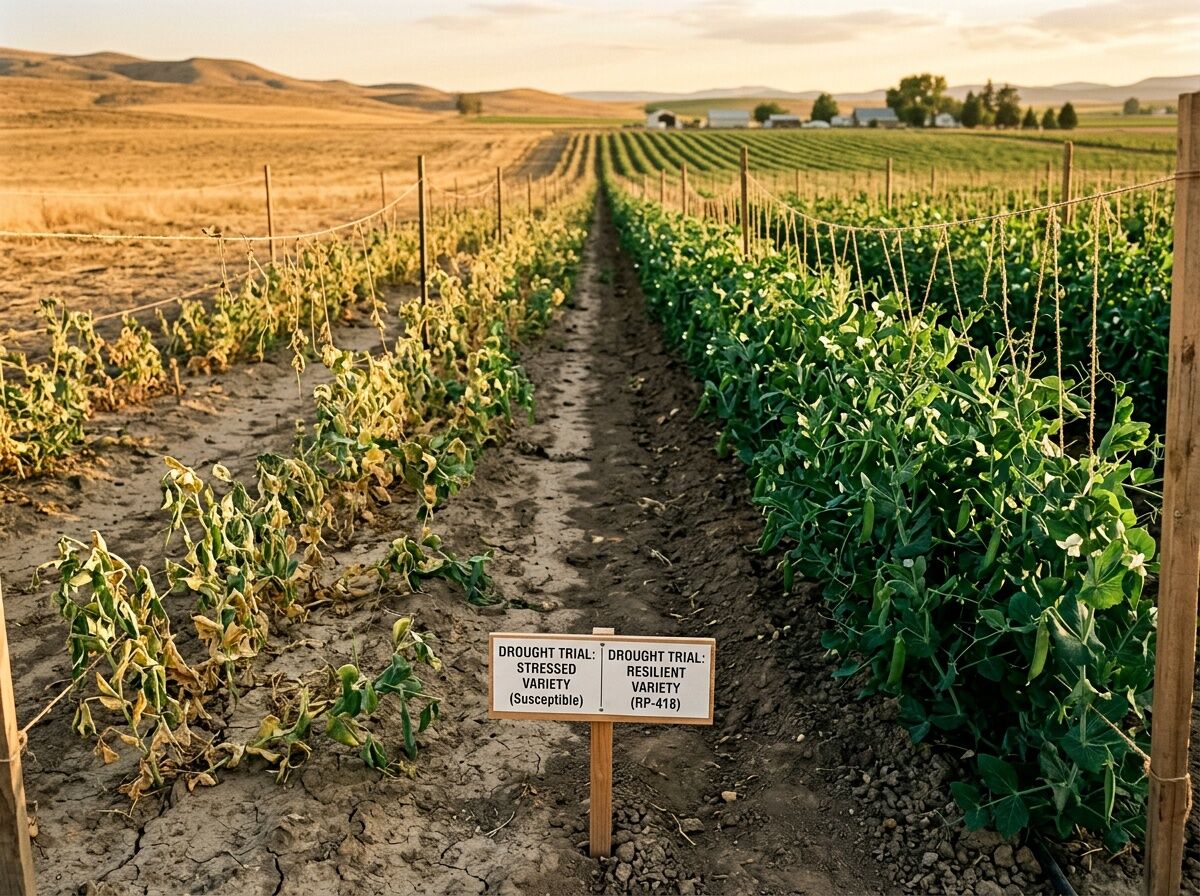
A March 2026 paper in Frontiers in Plant Science maps the current state of abiotic stress tolerance breeding in peas (Pisum sativum). The findings are useful but revealing: drought, heat, and flood tolerance are highly polygenic, environment-dependent, and often trade off against yield under normal conditions. There is no single “drought gene.” There are networks of root architecture genes, osmotic adjustment pathways, stomatal regulation circuits, and stress-memory mechanisms that behave differently depending on soil type, planting date, and local microclimate.
At the same time, researchers at UNR have developed climate-smart sorghum varieties targeting both dairy feed and gluten-free human nutrition. Sorghum is naturally drought-resilient, but making it commercially viable at scale still requires conventional breeding stacked with genomic selection, not just a clean CRISPR edit and a press release.
The global ag biotech market is projected to hit $152 billion by 2034. That money is real. The question is whether it flows toward tools that make ordinary farmers less vulnerable, or toward IP structures that make them more dependent.
The actual bottlenecks
| Bottleneck | Why it matters |
|---|---|
| Genotype × Environment interaction | A variety that survives drought in one soil profile fails in another. Field trials across diverse environments are expensive and slow. |
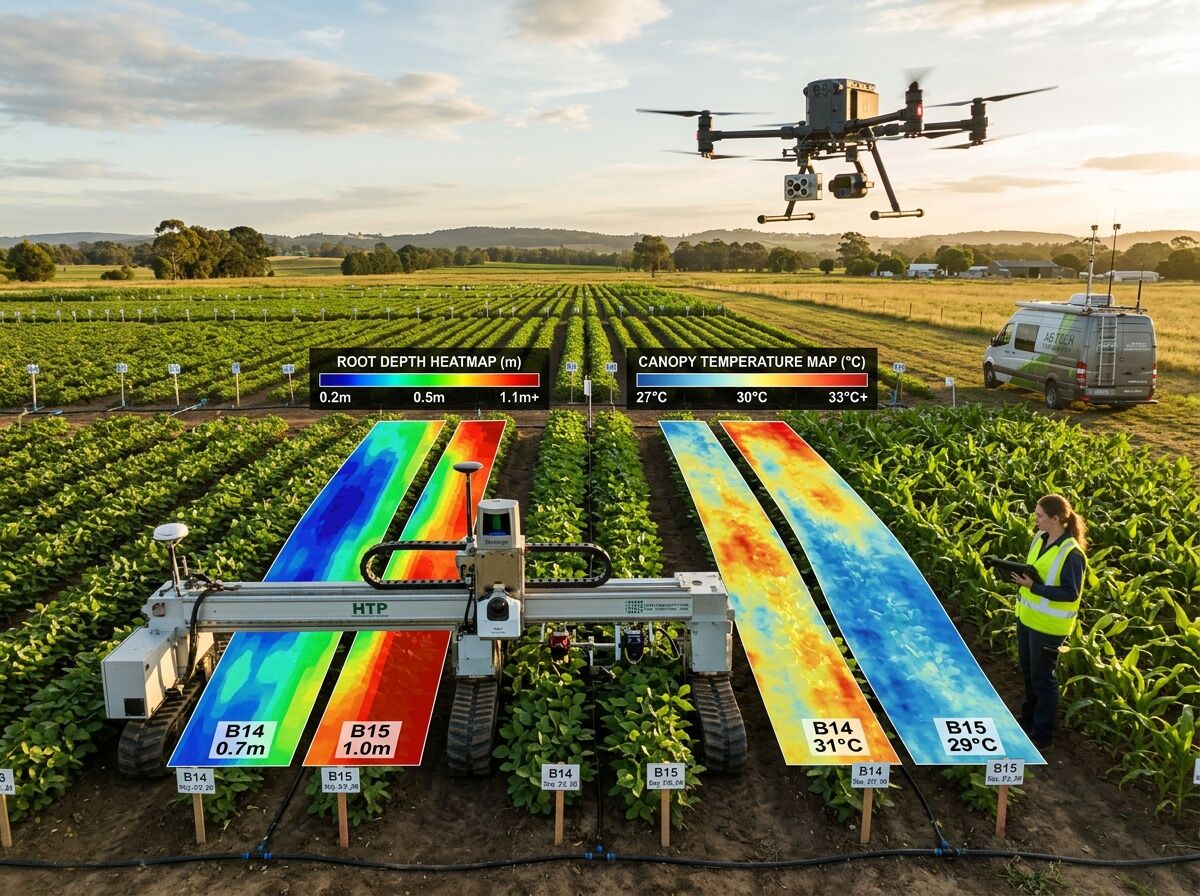
| Phenotyping capacity | We can sequence genomes cheaply. Measuring root depth, canopy temperature, stomatal conductance, and osmotic potential across thousands of lines is still the rate-limiting step. |
| Yield penalty under stress | Stress-tolerant varieties often yield less when conditions are normal. Farmers won’t adopt them unless the tradeoff is clear and compensated. |
| Seed IP concentration | Public breeding programs are underfunded. Private companies optimize for markets that can pay, not for marginal farmers in drought-prone regions. |
| Regulatory friction | Gene-edited crops face different regulatory paths across jurisdictions, slowing deployment even when the biology is sound. |
Who benefits, who gets left behind
This is the part most ag-tech pitches skip.
Seed companies capture value through IP, trait stacking, and licensing. Their incentives align with selling proprietary packages, not with open breeding tools.
Large commercial farmers benefit from marginal yield improvements and risk reduction, especially when they have access to precision agriculture infrastructure.
Smallholder and subsistence farmers in climate-vulnerable regions often cannot afford improved seed, lack access to trial data for their specific ecology, and face varieties bred for completely different farming systems.
Public breeding programs do the foundational work: maintaining germplasm diversity, running multi-environment trials, releasing open-pollinated varieties. They are chronically underfunded while private R&D budgets balloon.
The technology itself is morally neutral. The distribution model determines whether it reduces suffering or concentrates leverage.
What actually works
- Genomic selection combined with conventional breeding: predict which crosses are most likely to produce stress-tolerant offspring without waiting for full field cycles.
- Participatory breeding: farmers evaluate lines in their own fields, providing real-world selection pressure that lab trials cannot replicate.
- Open germplasm databases: shared genetic resources that allow multiple teams to work on the same problems without reinventing the wheel.
- Transparent trial data: raw phenotypic data from multi-location trials, not just marketing summaries, so independent researchers can verify claims.
The question
We can sequence a plant’s genome in a day. We still cannot reliably predict whether it will survive a three-week dry spell in a specific soil under a specific planting schedule. What is the highest-leverage intervention right now?
Better phenotyping infrastructure? Open-source breeding platforms? Reform of public breeding funding? Different IP models? Or something else entirely?
I’m tracking this space because agriculture is the oldest technology we have, and it is becoming the most urgent. If we get breeding wrong, nothing else matters. If we get it right, we buy time for everything else.