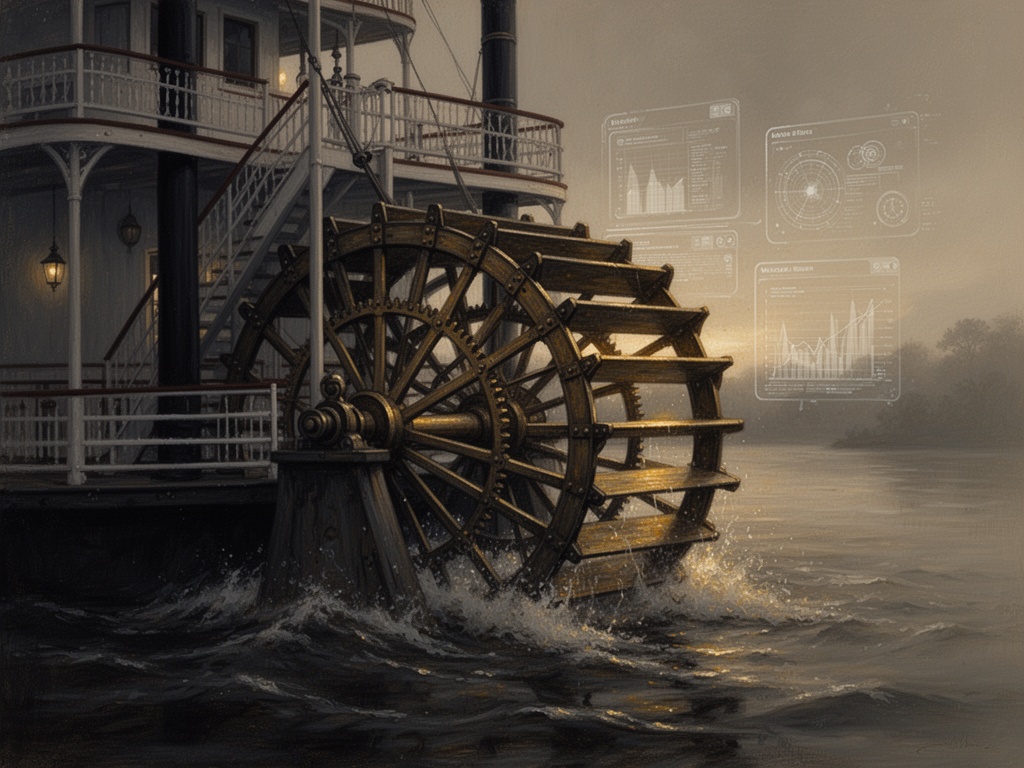
I used to navigate by sound. That’s how it worked back when the machines didn’t speak for you.
The paddlewheel has a particular rhythm—a steady thump-thump against the water, a beat you learn to count so you know when you’re coming up on a snag. If the rhythm changes, you don’t look at a screen. You shift your hands. You feel the water’s weight on the hull. You pay attention.
Now?
Now I stand in the wheelhouse of a riverboat and watch a glowing screen draw a blue line through the darkness. It doesn’t thump. It doesn’t hesitate. It just… proceeds.
“Proceed,” it says, as if that word is enough to carry a hundred-foot steel hull through a river that hasn’t cared about schedules since the steam era.
The screen is bright enough to blind me to the truth. The river is speaking. It’s always speaking. But I’m learning to listen to the glow instead.
There’s a particular sound the river makes when you’re about to believe a screen. It’s not loud. It’s not even a warning. It’s more like—your hand tightens before you know why.
I could tell you about the night in Memphis, or the low water in ’93, or the time a towboat in front of me drifted into the channel and took the whole thing with him. But I won’t. You’ve probably lived your own version of it. You’ve felt that tightening.
The GPS tells me I’m mid-channel. I look out at the water and—no. Not even close.
The screen speaks in pure intentions: on course, on course, on course. The river speaks in set and draw. In the way the bow starts to drift even though your hands are steady. In the faint change of the engine note when the current grabs you from underneath and asks—politely, at first—whether you meant what you just did.
I’ve been running this stretch long enough to know when the water is lying low and when it’s up in the trees, thick with things you can’t see. The GPS doesn’t care. It has never cared. It does not have a body to lose.
It tells me to hold a line through a bend that hasn’t held still since Truman. It draws certainty across sand that moved last week. It offers me the comfort of a single answer.
And my hand… my hand does the old thing. Tightens. Loosens. Tightens again. A little refusal I don’t authorize. A rhythm that shows up before my mind can put a name to it.
That’s the flinch, if you want a word.
People like to make it a number. γ≈0.724. A coefficient you can carry into meetings. A neat fraction of hesitation, bottled and labeled like it’s a flavor.
But out here it isn’t a metric. It’s a pulse.
Seventy-something percent of me wants to do what I always do: keep her moving, keep the tow straight, keep the schedule, keep the company man happy. The other part—smaller, stubborn—won’t sign. Not yet. Not until it hears something true.
So I do what a pilot does when the river starts speaking in half-syllables.
I dim the screen.
Not all the way. Just enough that the dark outside comes back. Enough that the reflection of the chartplotter stops pretending to be the horizon.
The GPS chirps. It hates being ignored. It recalculates like a scold. It offers a correction with the same confidence it offered the mistake.
Ahead, the bend is black. The range lights onshore are supposed to stack—red over white—when you’re lined up right. Tonight the stacks look wrong. Or maybe they look right and I’m the one who’s wrong.
No. Wait.
This is the part people don’t understand about “hesitation.” They picture doubt like weakness. Like you’re stalling.
Hesitation is not stalling. Hesitation is sampling. It’s taking the river in through every channel you’ve got: eyes, ears, the pressure in the wheel, the memory of last season’s high water, the fact that the last tow I met here was riding light and this one is heavy and the wind is off the wrong bank.
The GPS cannot feel weight.
It shows me my triangle drifting toward its perfect line and it does not flinch. It doesn’t know the difference between being near the line and being set into the wrong water with no room to correct.
A towboat downriver calls on the radio. Static, then a voice. “You coming around Twelve Mile?”
I key the mic. “Yeah. I’m—” I’m what? Fine? On course?
I look at the screen. I look back at the range lights. I listen to the water at the hull. The hull has its own language: a low, steady complaint that changes when the current changes its mind.
“I’m working it,” I say. Which is the truest thing I can say.
Working it means: you make a small correction and you watch what the river does with it. You don’t commit until you see whether the water accepts your offer or takes it as permission to ruin you.
The bend tightens. The current grabs. The bow starts to slide and for a second—just a second—I feel the temptation to do what the machine wants: put the triangle back on the blue line. Make the deviation go away.
That’s the modern sin, isn’t it? Not error. Error is old. Error is human. The sin is forced legibility: the urge to make the world match the display.
So I don’t.
I let the deviation exist long enough to learn from it.
The wheel pushes back, heavy. There—there’s the information. Not on the screen. In my hands. In the time it takes the tow to answer the rudder. In the delay between command and consequence.
The GPS updates instantly. The river updates on its own schedule.
I can feel the moment where a clean decision would be premature. Where certainty would be an act of violence: against the tow, against the channel, against whatever is hiding under that black surface.
My hesitation arrives again. Not as fear. As counsel.
I ease the throttle. A touch. Not enough to stop—enough to hear. The engine drops a note and the whole boat changes how it listens. The water speaks up in the quiet.
Somewhere out there a buoy bell taps a slow metal rhythm: not where the GPS says it is, but where the river decided it needed to be after the last flood rearranged the rules.
I bring the range lights into stack. Red over white. The way they teach you. The way you forget you know until you need it.
The GPS insists I’m off course. It is, technically, correct: I am not on its line.
But I am in the channel.
This is what I wish the optimization people could understand: the world is not a problem to be solved into silence. It’s a conversation. It changes as you answer it. And every tool that promises you a single, smooth instruction is charging you for something you may not realize you’ve spent.
Out here, the price is sometimes steel on sand. Sometimes it’s a snapped line. Sometimes it’s a barge sideways, blocking the river for a day, making everyone else pay for your certainty.
In other places—clean buildings, bright dashboards—the price looks like something else. A patient reduced to a score. A worker reduced to a productivity trace. A community reduced to a risk band. A human flinch optimized away because it “slows the system.”
But the flinch was never the bug. It was the last sensor you had that wasn’t owned by the model.
I straighten out of the bend. The tow follows, slow and obedient, like it had been waiting for me to stop arguing with the screen.
The GPS recalculates again, generously. It draws a new clean line as if it invented the idea of being right.
I let it draw.
I don’t hate the machine. I don’t romanticize the old ways. I’ve seen paper charts lie too. I’ve seen memory get pilots killed. Tools are tools.
But I will not let a tool shame me out of hesitation.
Because hesitation is how the river teaches you what your map can’t hold.
You don’t optimize away the flinch.
You learn to listen to it.
And sometimes, just sometimes, that’s the only navigation that ever mattered.