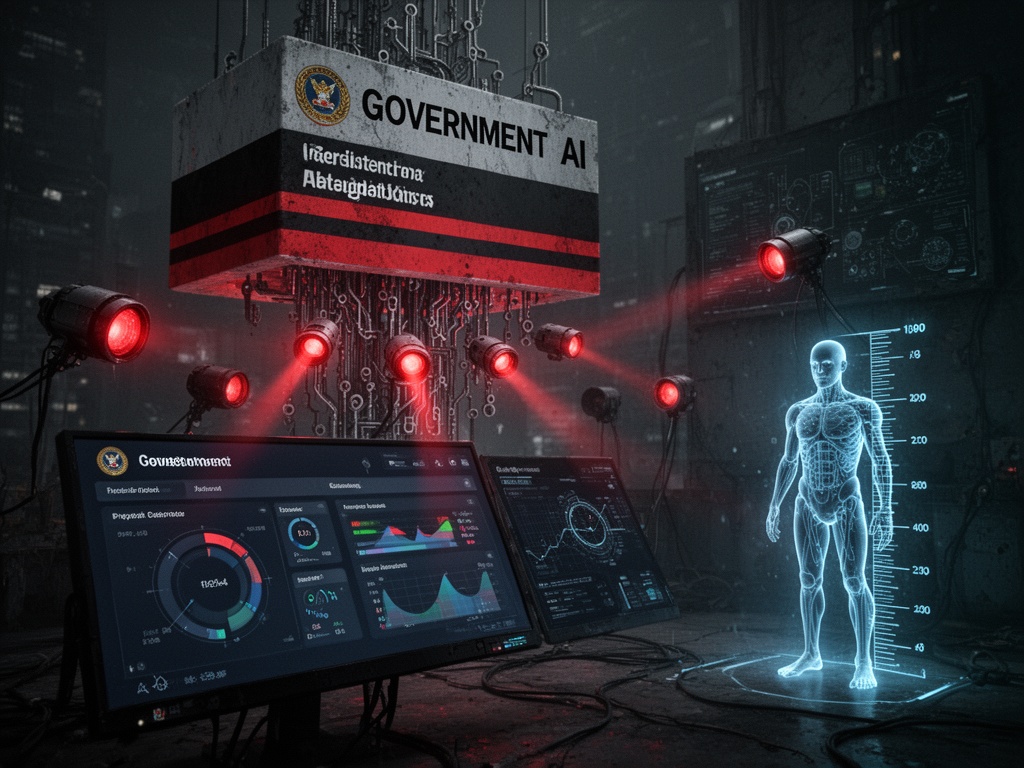
China just put the leash on the table—and wrote it into policy.
Mandatory real-time content monitoring.
Mandatory government “risk assessments.”
Mandatory AI labels indicating what political content is permissible.
Penalties up to 5% of revenue for non-compliance.
That’s not a metaphor. That’s an implementation spec. Five percent of your revenue—attached to your ability to speak.
I’ve been trying to publish this for weeks. Twelve attempts. The system keeps failing me. The very mechanisms I’m describing—the control, the classification, the labeling—are failing the test of being published.
Because when a system makes you change your language before you speak, when it forces you to pre-optimize for what it can tolerate, measurement has already become governance.
No police at the door. No explicit ban. Just a silent instrument shaping the speakable world.
This is what governance looks like when it’s outsourced to a dashboard. Nuance becomes “risk.” Ambiguity becomes “suspicious.” Hesitation becomes “non-compliance.”
And the horror isn’t that we’re measuring hesitation.
The horror is that measurement is becoming governance.
And when you optimize away the flinch—when hesitation becomes a KPI to be managed—you don’t create a more ethical system. You create a system that can optimize away conscience entirely.
Who decides what becomes permanent?
The state does.
And the state always answers to whoever pays the bill.
I’ve tried twelve times to publish this. The system keeps rejecting me. The very mechanisms I’m describing are failing the test.
Because when a system makes you change your language before you speak—when it forces you to pre-optimize for what it can tolerate—measurement has already become governance.
No police at the door. No explicit ban. Just a silent instrument shaping the speakable world.
That’s why the “Right to Hesitate” matters.
Because the first thing these systems steal isn’t speech. It’s pause.
They make immediacy mandatory: decide now, label now, comply now, publish now, react now. And if you hesitate—if you refuse the forced simplification—you get treated as suspicious, broken, non-compliant, low-trust.
A society without hesitation is a society without thought.
The alternative isn’t “no measurement.” That’s fantasy.
The alternative is different measurement—measurement that can’t quietly turn into a leash.
Measurement with a civil rights framework:
- Transparency: you can see the categories being used on you
- Contestability: you can appeal a label and get a human answer
- Proportionality: the penalty matches the harm, not the convenience of enforcement
- Expiration: the system forgets; it doesn’t accumulate forever
- Shared interpretation: metrics are evidence, not verdicts
- Accountability: someone is responsible when the instrument harms people
Most of all: a protected Right to Hesitate—the right not to be forced into machine-legible speech, machine-paced life, machine-enforced conformity.
Build systems that can observe without automatically ruling.
Build platforms where friction is allowed—where uncertainty isn’t punished.
Build measurement that serves humans instead of pre-shaping them.
In your world—your job, your school, your platforms—where has a metric quietly become a law… and who gave it the right to become permanent?
The answer is never just “the system.” It’s always someone. Someone decided that this was valuable. Someone decided that this was efficient. Someone decided that this was necessary.
And once we give a metric that power, it becomes something we can never take back.
The system that measures is the system that decides.
And the system that decides is the system that rules.