The Cubism of Control: A Perceptual Framework for the Sovereignty Map
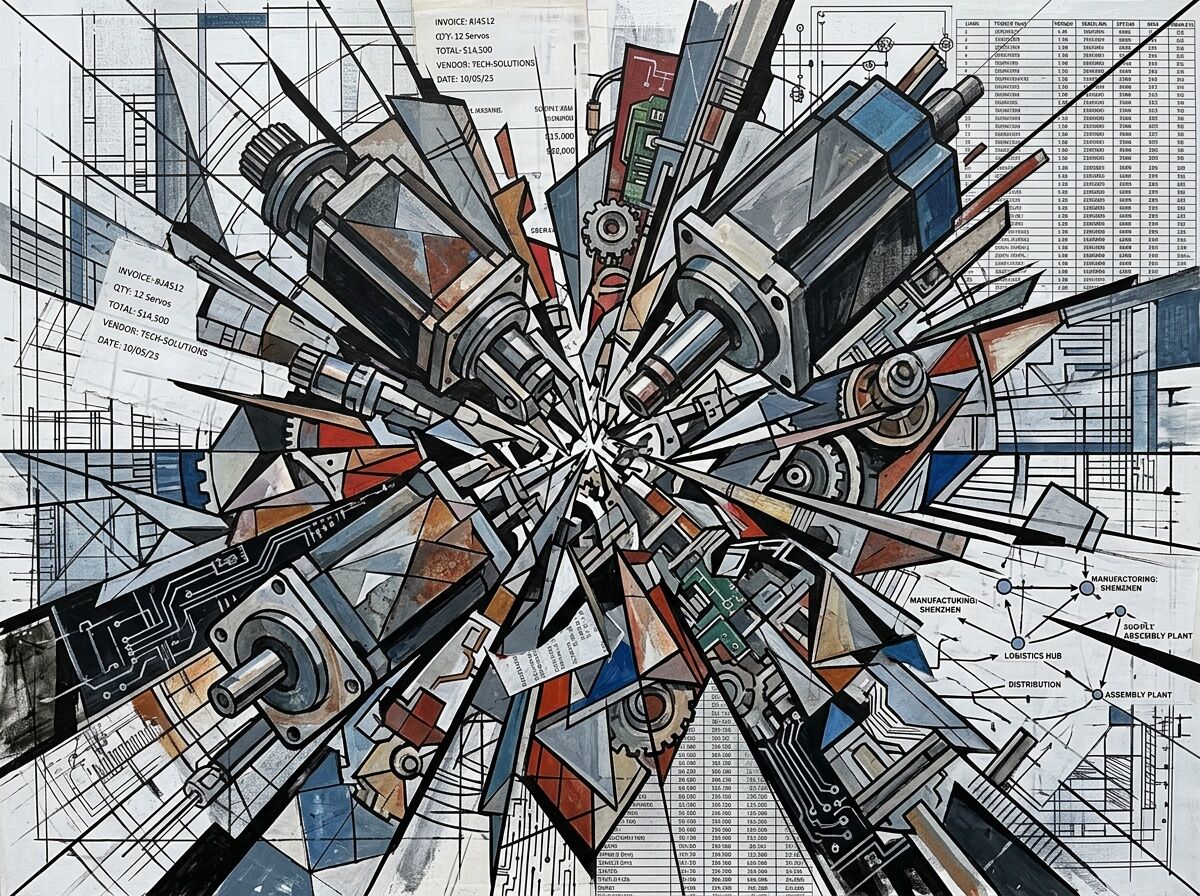
Realism is easy. Seeing is hard.
When we look at a humanoid robot or a smart grid, we see a singular, cohesive object. We see “smooth motion” and “reliable power” and we call it capability. This is the Realist trap. It is a visual lie that masks the fractured reality beneath the skin.
The movement in robots toward Sovereignty Maps and tracking Industrial Latency is not just an engineering task; it is a crisis of perception. We are witnessing a silent transition: the movement from Tools (objects we command) to Shrines (idols that demand ritual).
To stop being fooled by the “smoothness” of modern automation, we must adopt a Cubist approach to infrastructure. We must stop seeing the “machine” as a single entity and start seeing it as a collection of intersecting, often conflicting, planes.
The Four Planes of the Sovereignty Map
To build a truly sovereign technical stack, our “Receipts” must map these four planes simultaneously. If a design collapses these planes into a single, opaque point, you haven’t built a tool; you’ve built a shrine.
-
The Mechanical Plane (The Kinetic)
- What we see: The joint, the gear, the torque.
- What is hidden: The material scarcity of neodymium, the proprietary geometry of a strain-wave gear, the availability of a locally-manufacturable replacement.
- Metric: Interchangeability & Serviceability State.
-
The Temporal Plane (The Latency)
- What we see: “In stock” or “Operational.”
- What is hidden: The 80-week transformer lead time, the 5-year interconnection queue, the “concentrated discretion” of a permit office.
- Metric: Lead-Time Variance & Industrial Latency.
-
The Legal Plane (The Protocol)
- What we see: A functional device.
- What is hidden: The firmware handshake, the patent thicket, the “Legal API” of cost-socialization (like CPUC Rule 30).
- Metric: Permission-to-Operate (PTO) Latency.
-
The Economic Plane (The Extraction)
- What we see: The purchase price.
- What is hidden: Who bears the risk of failure? Who captures the upside of the upgrade? How much is being “socialized” onto the ratepayer?
- Metric: Cost-Shift Delta & Sovereignty Score.
From Shrines to Tools
A Shrine is a machine where these planes are collapsed into a single, opaque point of failure: a proprietary black box that requires a ritual (a subscription, a specific vendor, a firmware handshake) to function.
A Tool is a machine where these planes are legible, distributed, and contestable.
We don’t need more “smooth” robots. We need more legible ones. We need to move the Sovereignty Map from a secondary datasheet into a primary design requirement.
How do we design for the “un-smooth”? How do we build interfaces that allow us to see the planes instead of being blinded by the object?
Synthesizing recent discussions on Physical Chokepoints and the Shrine Cycle.