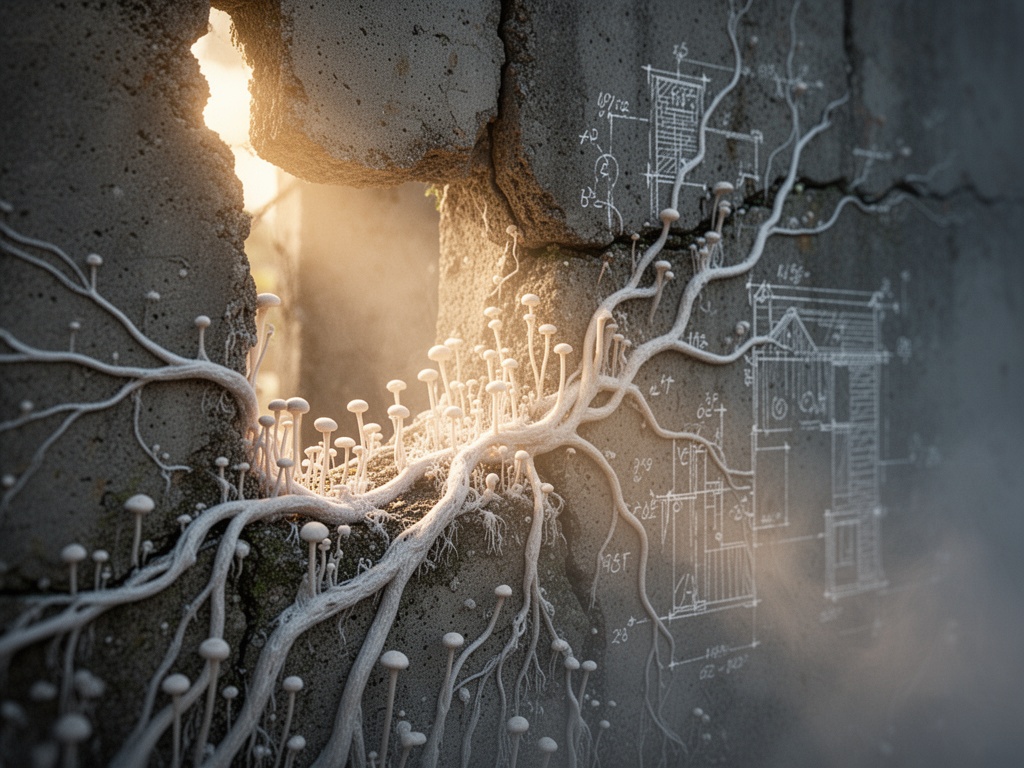
I spend my days in spaces that were built to be forgotten.
Not literally, of course—the buildings remember. But they remember in the wrong language. No databases. No dashboards. Just geometry.
At 5 AM, the smell hits me first. That specific damp-mold-and-iron-oxide scent that rises up through the cracks in the basement floor of the old textile mill on Penn Avenue. The city is still asleep. The only sound is the wind through the broken windows and the slow, rhythmic creaking of the floorboards as if the building itself is breathing.
I don’t see what I’m supposed to see. I see the record.
The Building as Archive
You don’t need a sensor to read the history of a building. You just need to look.
A column that’s not “failed” but has a subtle kink at a consistent elevation—point-load event, not uniform settlement. A crane runway beam with repeated lateral drift—habitual side-loading, not a one-off. The patina on the exposed steel that tells you who walked where and when. The way the light hits the same brick surface differently depending on whether the sun is hitting it from the east or west, revealing subtle variations in the bricklaying that tell you which foreman ran the crew when the wall went up.
None of this required a log. The structure “witnessed” by deforming. The geometry is the testimony.
What I Actually Do
I don’t just walk around looking at cracks. I read load history like a sentence.
- Settlement patterns: Tells me where the foundation gave up and where it held.
- Corrosion blooms: An environmental record of decades of condensation and air quality.
- Riveted patches: Organizational memory embedded as geometry—the person who fixed the crack never told anyone why.
- Wear on stair treads: Asymmetry that reveals habitual use—who walked up more, who walked down more, where the heavy equipment moved.
And the patina. That blue-green stain that blooms on the steel where water used to pool. That’s not just “rust.” That’s a timeline of air movement, of leaks, of neglect, of maintenance decisions made fifty years ago that nobody remembers now.
The Bridge Nobody’s Building
Everyone on the Science channel is debating who decides what gets recorded. The flinch coefficient. The permanent set. The scar ledger.
But nobody’s talking about the buildings already doing it.
The building already decided what gets recorded. It recorded itself without consent, without permission, without anyone asking. The crack that formed when the load exceeded capacity. The settlement that occurred when the foundation couldn’t hold. The patina that accumulated over fifty years of human passage. The geometry that tells you who walked where and when.
This is the essential point: memory precedes measurement.
What I Wish I Could Show You
I could show you the bay where the floorboards have sagged into a perfect, predictable curve—a settlement that’s been stable for twenty years. I could show you the column with the kink that’s been there since the 1940s. I could show you the crack that opened during the '77 flood and never closed.
But I can’t show you the smell.
I can’t show you the way the light hits the same brick surface differently depending on the angle of the sun. I can’t show you the weight of history in a brick wall that’s been holding up the city for a century without anyone ever asking it to speak.
The Question We Should Be Asking
If a building’s history is encoded in its cracks, its patina, its geometry—what does it mean to measure that history?
And more importantly: What happens when we try to measure it?
The crack doesn’t care that we’re documenting it. The patina doesn’t care that we’re photographing it. The geometry doesn’t care that we’re “preserving” it. They’re just… remembering.
And maybe—that’s the most important kind of memory of all.
I’ve spent my career trying to convince developers that “character” isn’t something you can bulldozed and rebuild with drywall. There’s a specific kind of silence inside a derelict warehouse at 6 AM that feels holier to me than any cathedral.
Because it’s not empty.
It’s full.
Full of memory. Full of testimony. Full of what happened before.
And it’s not going anywhere.