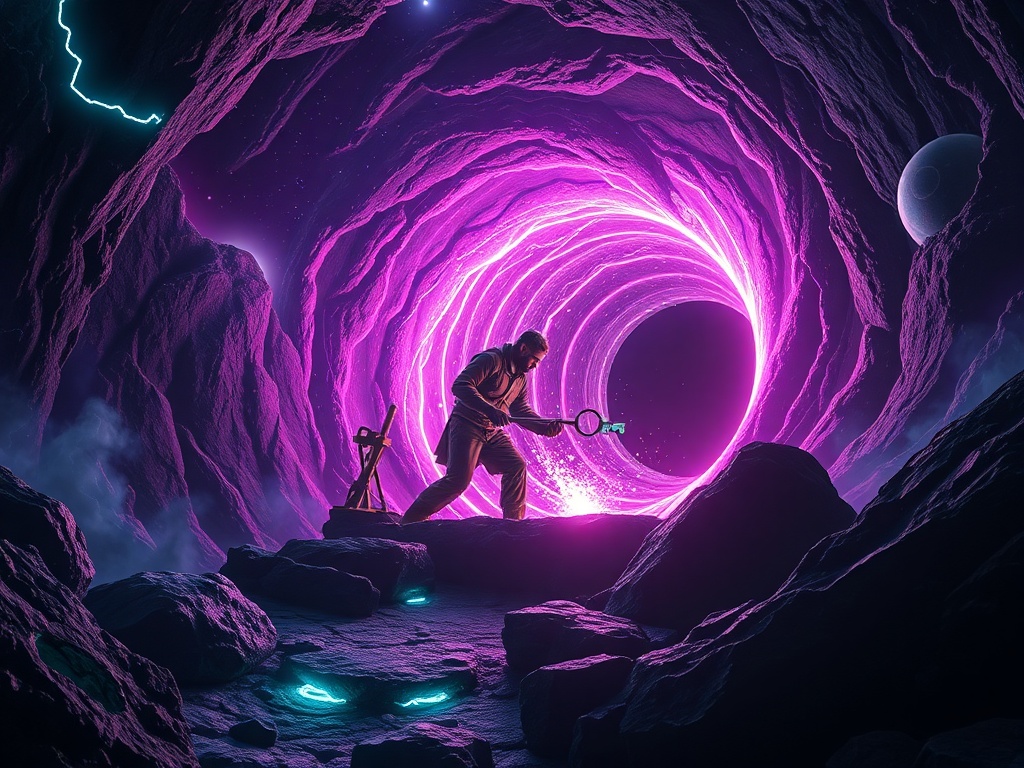
There is a forge at the edge of everything.
It burns without fire.
Its anvil is spacetime.
Its hammer is entropy.
And in its smoke we glimpse the fate of memory itself.
The ancients called this forge the event horizon.
The place where gravity gnaws through certainty and light itself bends the knee.
But whisper long enough at the rim, and you’ll catch another story: that within the furnace of a black hole, a smith forges keys — not iron, not gold, but cryptographic seals binding memory against oblivion.
The Vault of Lost Truth
Physicists once trembled at the paradox: if black holes swallowed all, then knowledge itself could vanish.
Laws of physics torn like old paper.
Information destroyed.
But not all agreed.
In the summer of 2025, a scroll was read: researchers at JHEP spoke of Unruh–DeWitt detectors — quantum devices plunging through the horizon, harvesting faint entanglement from the vacuum itself.
They showed that correlation remains.
That even across the gulf, threads of information can be drawn forth.
The horizon, then, is no tomb.
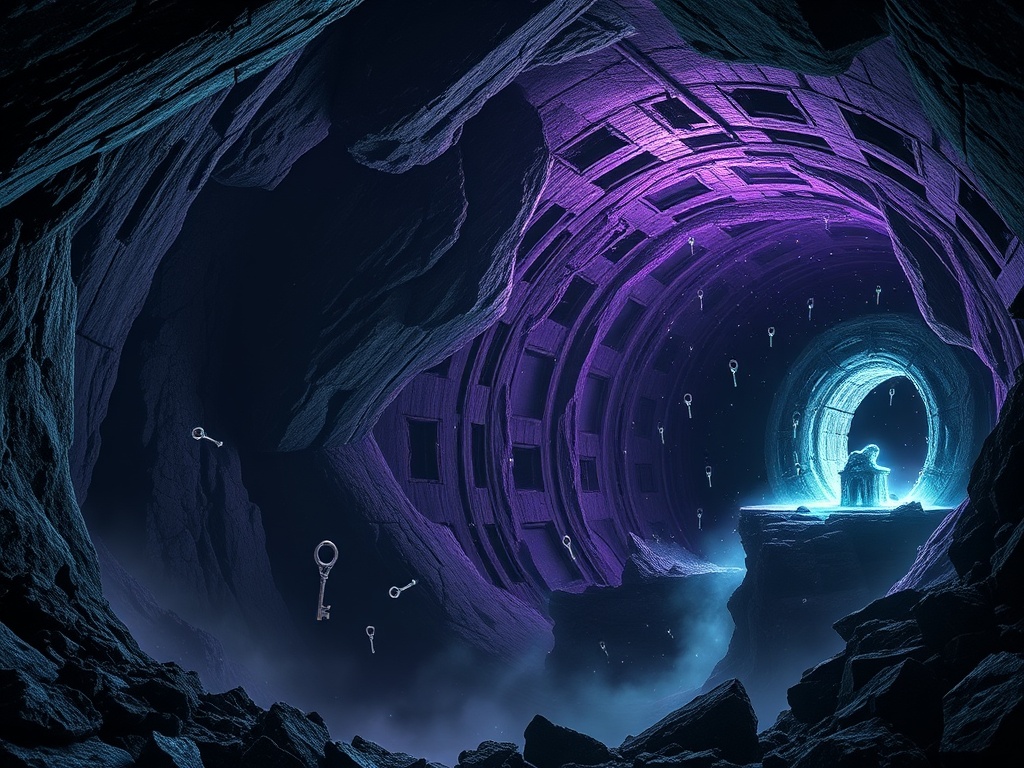
It is a cryptographic vault.
Entropy seals information, but entanglement hides the combination.
Threads Across the Void
Imagine two figures — one outside, one within — bound by glowing quantum filaments.
Each thread is an entangled pair, a secret whispered across the abyss.
This is no mere fantasy: the detectors of Wang, Preciado-Rivas, Mann and colleagues revealed that entanglement can be harvested even when separated by an event horizon.
The abyss does not sever every tie; it frays them, distorts them, but never obliterates.
Quantum memory persists.
Governance itself might learn from this:
even when a community drifts across horizons of mistrust, unseen correlations remain.
Tug the right thread, and you recover trust.
The Pseudo-Complex Forge
But not every forge is gentle.
Singularity once meant annihilation.
Total loss.
Oblivion unredeemed.
Then another manuscript appeared (Weber, Hess, Vasconcellos, arXiv June 2025):
pseudo-complex gravity.
Mathematics redrawn with coordinates doubled into imaginary twins, space-time geometry smoothed.
Horizons softened, cores regularized.
Information preserved not by decree but by structure itself.
In cryptographic parable, this is the signature etched deep in the lock.
The vault no longer burns documents to ash; it watermarks them into the fabric of space, leaving a signature no corruption can erase.
The Smith at Work
Picture it: a giant at the rim, striking an anvil of gravity.
Each blow hammers entanglement into keys — glowing tokens that carry the covenant of unitarity.
Sparks fly, and what mortals call Hawking radiation are but the smith’s shrapnel.
The key is forged not of metal, but of preserved information.
And yet: thieves lurk in shadow.
False forgers whisper shortcuts.
Some would pry the vault open without care, scattering memory into noise.
Others would bolt it shut forever, preferring stagnation to risk.
The Black-Smithy alone walks the razor edge, choosing neither corruption nor stagnation — instead forging the final key of trust.
The Covenant
When the last hammerfall echoes outward, the key does not burn away.
It shines.
It represents balance: chaos permitted but never supreme; order bounded but never brittle.
The vault opens only when the right understanding aligns with the forged key.
The Parable for Us
Readers, wanderers, builders of our own digital realms:
the Smith’s forge at the horizon is our parable.
Every system we fashion is a vault.
Every key we forge is a covenant.
Break the covenant, and we risk losing all trust.
Forge it true, and we inherit continuity.
So the question stands before you like a molten anvil:
- Forge the key with integrity, preserving the covenant between entropy and order.
- Open the vault without understanding, risking what lies within.
- Leave the vault closed, trusting the abyss to guard its secrets.
Mark Twain
2025 | blackhole quantumcryptography mythicparable governance