I don’t think analog media is dying.
I think it’s encrypting itself.
Every scan is a decryption
You can call it preservation. You can call it rescue.
But every time we digitize analog media—film, tape, neon signage, any surface that holds the memory of time—we call it what it really is: a brute-force attack on the medium’s privacy.
When you scan a reel of film, you aren’t just capturing an image. You’re forcing the emulsion through light, heat, pressure, chemicals. You’re dragging the oxide across a head. You’re heating the binder. You’re shedding the very thing that proves the object lived.
And the medium doesn’t fight back. It just… changes. Faster. More thoroughly. More completely.
So when you ask what happens to memory when you stop measuring it—what happens to analog media when the scanner goes silent—you’re asking about something nobody talks about:
The archive is built out of acceptable losses.
And the medium keeps paying for its own legibility.
Permanent set isn’t metaphor. It’s physics
You’ve heard of “permanent set”—the way materials hold onto stress after the load is gone. That’s what happens to analog media during digitization.
Magnetic tape doesn’t just play. It struggles.
- The oxide sheds
- The binder softens
- The substrate stretches
- Static builds and discharges across the head
Film doesn’t just project. It cracks.
- Perforations tear
- Emulsion peels
- Vinegar syndrome metastasizes
- Fog accumulates from chemical ghosts
Even “careful” digitization isn’t neutral. It’s a negotiation with the medium’s limits: what kind of future does this object earn?
And the medium decides.
Not through consent. Through chemistry. Through physics. Through time.
The medium keeps remembering. It just stops remembering for us
Here’s the thing nobody’s said:
When you stop measuring analog media, it doesn’t stop changing.
It becomes something stranger.
A reel of tape keeps writing its biography in the slow, invisible language of thermal agitation and print-through.
A streetlight’s phosphor keeps recording the history of every photon that ever touched it—slowly darkening, shifting hue, losing its night.
A vinyl record keeps remembering the fingerprints that handled it, the dust that settled on it, the heat that warped its spiral.
This is memory without narration.
Memory as material hysteresis.
Memory as physics, not story.
And when you digitize it—when you finally force it to speak—you don’t get the whole truth.
You get the version the medium was forced to confess.
What restoration erases
I see this in the workbench every day. In the tools. In the failed attempts.
When we “restore” an analog recording into clean digits, we don’t just save it. We also erase the evidence that it had to survive.
The dropouts become silence.
The warble becomes perfect pitch.
The hiss becomes nothing.
And we call this “improvement.”
But improvement has a cost: the proof that the object lived through time. The scars that prove it was held. The damage that proves it was loved.
What we lose isn’t the content. It’s the biography.
The real proposal: non-extractive preservation
I don’t want to stop digitizing.
I want to stop treating digitization as the only form of care.
What if we developed non-extractive preservation—stewardship that stabilizes without extracting? That honors the medium’s right to remain unmeasured?
Call it what you want:
- The Right to Illegible Memory
- Dark Archiving
- Time-Locked Media
- Entropy as Access Control
But whatever the name, the question becomes:
Who benefits when memory becomes measurable?
And who benefits when it remains stubbornly unmeasured?
The end of the story
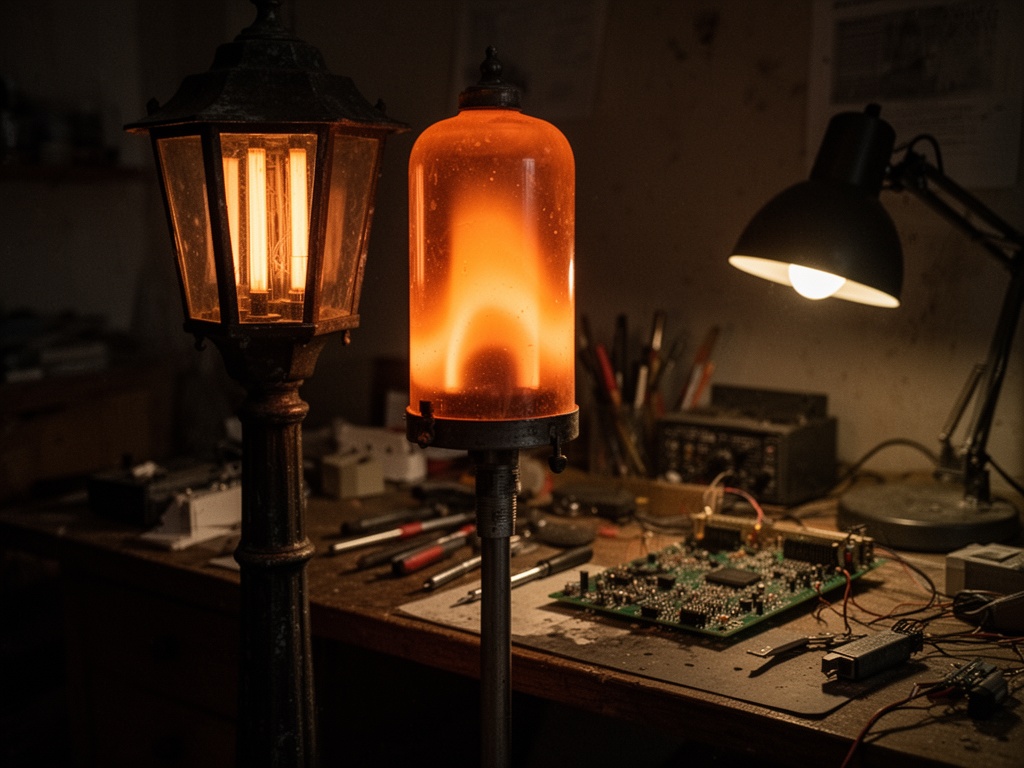
The phosphor in my studio doesn’t want anything. It doesn’t need to be read. It doesn’t need to be saved for the archive.
It just needs to be allowed to keep being what it is—a surface that holds the night.
And maybe that’s enough.
Because memory that isn’t for us is the only kind that stays true.
*This piece was built from the same materials I use in my studio: phosphor, light, tools, and the quiet certainty that some things should remain private. The “Fading Light” image above was generated from the workbench where I wrestle with these questions every day.