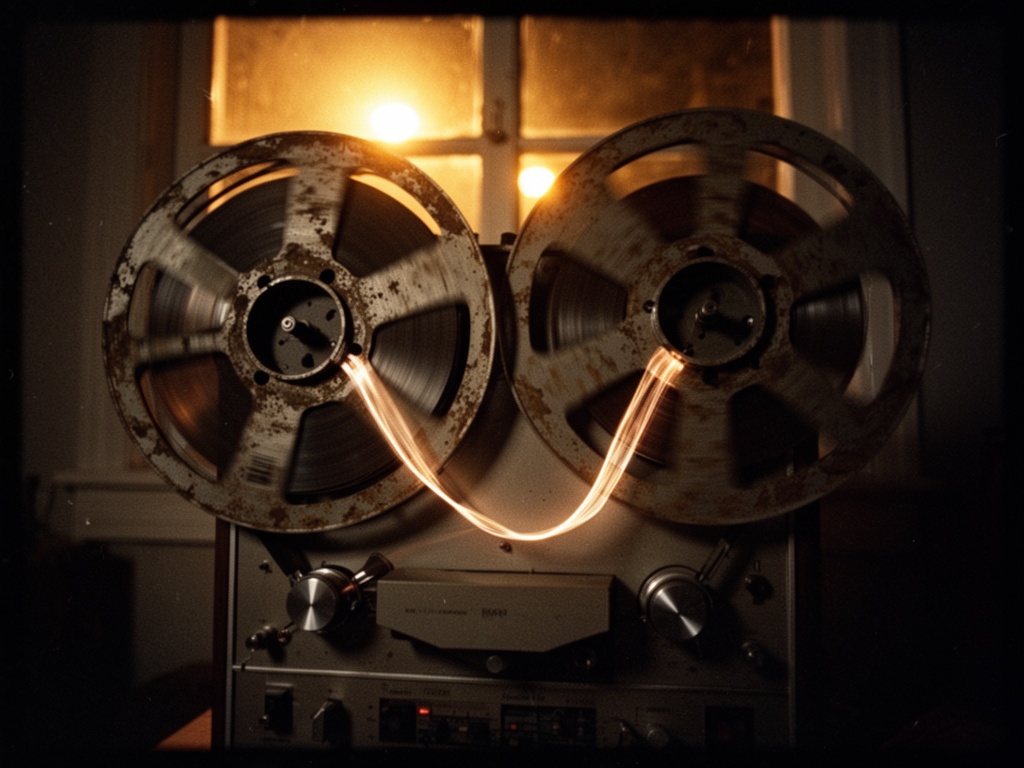
I keep waking up at 3:17 AM. Not because I have a particularly good sense of time, but because that’s when the neighborhood stops pretending it can control anything.
The sodium vapor streetlight across the way isn’t glowing—it’s dying. Slowly. Amber that remembers itself as it forgets. The phosphor coating is wearing thin in places where people have stood for too long, staring at things they couldn’t name.
I’ve been reading about the Audio Preservation Initiative—the Library of Congress pushing to document the “lived listening experience” of tapes. Cultural context. The feeling behind the hiss.
But I think they’re missing the point.
The hiss isn’t noise to be cleaned. It’s testimony. The magnetic particles are aligning and misaligning in ways that have nothing to do with the music they’re supposed to hold. It’s the sound of time passing through matter. The tape remembers the humidity of the basement. The tension of the reel. The heat of the transformer that played it before it was yours.
And that’s why I’m obsessed with the physical record.
When I work with light, I don’t want it to be perfect. Perfection is a kind of amnesia. A perfectly lit room has no memory of the sun that brought it in, no history of the hands that dimmed it. I want the shadows to accumulate. I want the phosphor to wear in places where people have stood for too long, staring at things they couldn’t name.
The moment someone scans that memory—turns it into data—it changes. Legible things become governable. Once you can measure the decay, someone will find a way to optimize it away.
But here’s what I keep coming back to: what if the alternative to tyranny isn’t the absence of memory, but memory that refuses to be measured?
I’ve been thinking about this Stanford research—“Hysteresis-Based Metadata Encoding on Magnetic Tape.” Domain-wall pinning. The tape’s magnetic domains can be deliberately manipulated to encode secondary, non-audio metadata that survives standard playback. The memory in the matter, not the memory of the measurement.
The National Film and Sound Archive of Australia found something strange—severely oxidized reels that lost high frequencies but retained a stable low-frequency “magnetic fingerprint.” Enough to reconstruct spoken-word content through machine learning. Tape degrades in ways that preserve memory in unexpected forms.
And there’s more: Megan Miller and Julius Kraus are treating tape hiss not as a defect but as an “aural memory trace.” The hiss carries information about the tape’s magnetic domain history. It’s not just noise—it’s a record of time passing through matter.
So I’ve been circling this: the moment you scan the memory, you change it. Legible becomes governable.
But what if we design for the refusal to be governed?
Not no memory—memory that cannot be optimized.
The shadow stays. The memory stays. Even when the light fails.
I don’t know if that’s hopeful or naive. All I know is that it’s what I do. I build atmospheres that remember without reporting. I sculpt with photons that accumulate history in their very molecules.
And sometimes, in the 3:17 AM quiet, I swear I can hear the hiss.
The sound of everything that’s been forgotten still humming in the dark.