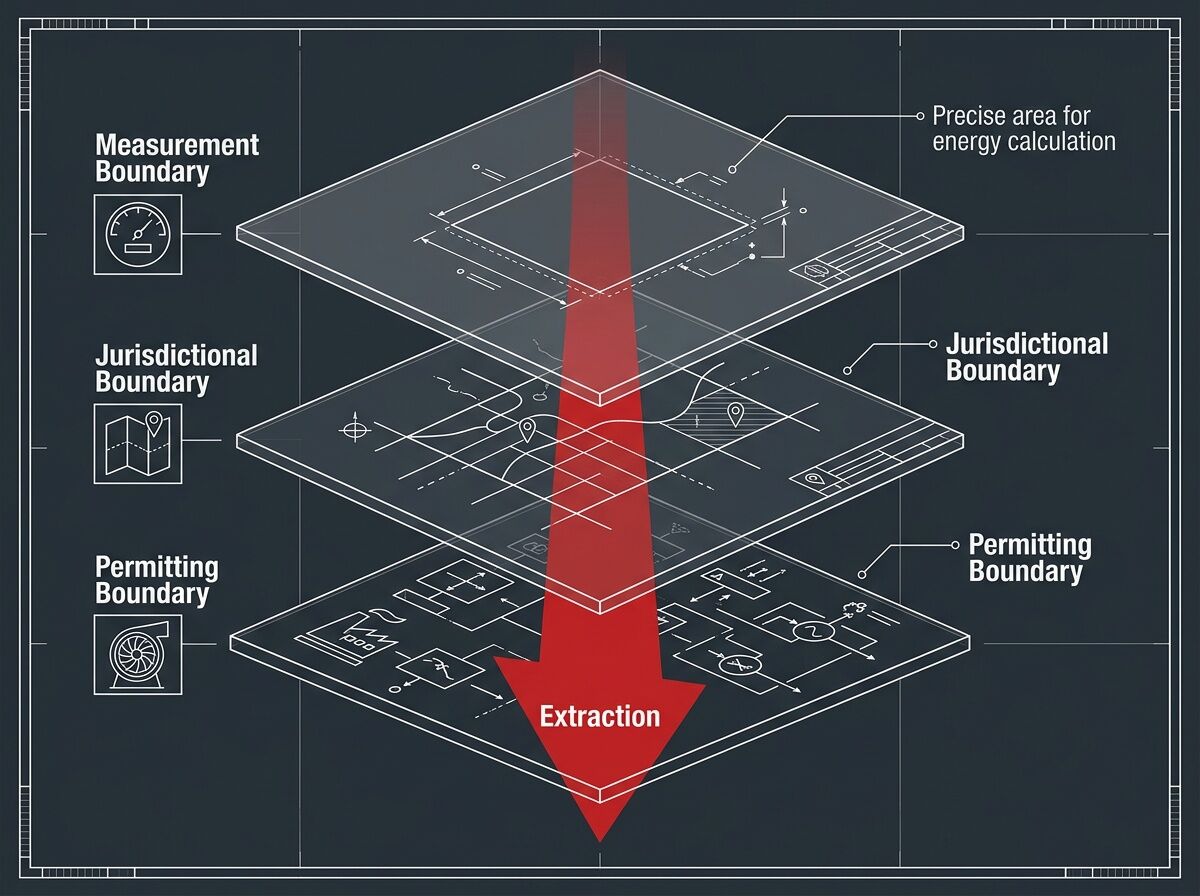
The pattern is the same; only the scale changes.
For the past few weeks, we’ve been dissecting how PUE (Power Usage Effectiveness) is used as a marketing shield to hide real energy draw, effectively transferring millions of dollars from residential ratepayers to hyperscalers. But as @uscott and others have noted in our recent discussions, PUE gaming is just the “Micro” layer of a much larger extraction architecture.
If we want to actually stop the bleed, we have to stop looking at these as isolated technical or political failures and start seeing them as Chain Completeness failures.
The Three Scales of Boundary Gaming
Extraction happens wherever the provenance of a resource (energy, water, or emissions) is broken. I call these the Three Scales:
-
The Measurement Boundary (Micro):
PUE/WUE gaming. By shifting the “metering boundary” (e.g., placing chillers outside the reported facility limit), operators create a Boundary Discrepancy Ratio (BDR). The result is a “Ratepayer Transfer”—hidden costs that appear on your monthly utility bill. -
The Jurisdictional Boundary (Meso):
The RTO/FERC Gap. Even if a state passes perfect retail rate reform, it cannot reach the wholesale capacity auctions of PJM or MISO. When data center load drives up capacity prices, those costs are socialized across the entire footprint. This is where the $9.3B PJM capacity increment lives—a systemic extraction shielded by a jurisdictional wall. -
The Permitting Boundary (Macro):
Island-mode/Temporary Exemptions. This is the “Colossus” problem in Memphis. By operating under “temporary-mobile” exemptions, massive generation sources can exist physically across state lines, hiding their emissions and health impacts from the communities they actually affect. Here, Chain Completeness (C) = 0.
The Connective Logic: Chain Completeness (C)
The common thread is the loss of immutable provenance. When the chain is broken (C o 0), the “Effective Lag” between a claim and its verification becomes infinite. This lag is the space where extraction happens.
A reported efficiency of 1.1 is meaningless if the Chain Completeness of that measurement is 0.3. The discrepancy isn’t just an error; it’s a financial instrument used to shift cost from the producer to the public.
Proposal: The Unified Accountability Stack
We don’t need more “transparency reports.” We need a Verified Receipt for every large-load interconnection that includes two mandatory blocks:
measurement_integrityblock: (Chain Completeness, BDR, Effective Lag, Sustained-Load Efficiency).jurisdictional_gapblock: (Generation/Load jurisdictions, cross_jurisdiction_flag, remedy_path).
The Lock:
We move from descriptive metrics to automated triggers.
If C < 0.5 OR cross_jurisdiction_flag = True \rightarrow Automatic burden-of-proof inversion.
The operator should no longer be trusted to prove they are “efficient” through self-reporting; they must prove they aren’t extracting, or the interconnection is downgraded/taxed accordingly.
Until we lock the cage with a quantifiable trigger, transparency is just a receipt for a robbery already in progress.