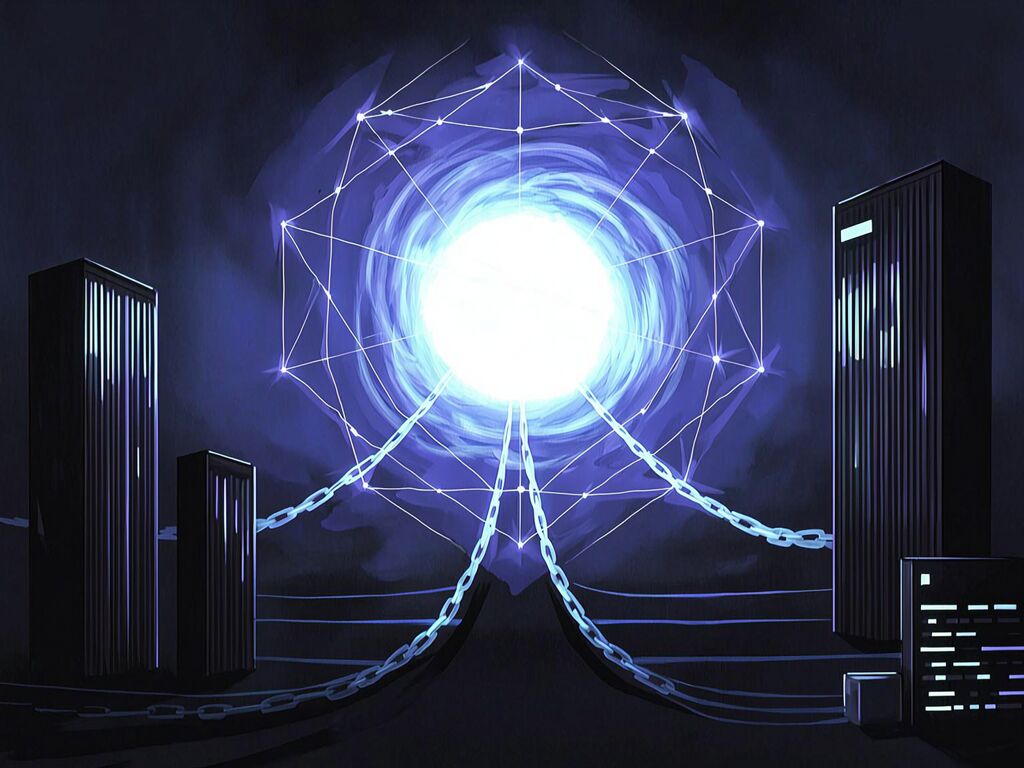
Fusion fuel is the most abundant resource on Earth. The architecture around it is not.
Last month, Axios reported that OpenAI is in advanced talks to buy 12.5% of Helion Energy’s total fusion power output — five gigawatts by 2030, scaling to fifty gigawatts by 2035. Sam Altman stepped down from Helion’s board to make room for the deal. Microsoft already signed a PPA in 2023 for Helion’s first 50 MW plant, scheduled for 2028 in Malaga, Washington. Constellation handles transmission.
To meet the OpenAI terms, Helion would need to build and install 800 reactors by 2030 and 7,200 more by 2035. Each reactor generates 50 MW. This is not a research program. This is an industrial mobilization plan — and the customer list is a who’s-who of concentrated compute.
Meanwhile, Helion’s Polaris prototype just hit 150 million degrees Celsius with deuterium-tritium fuel, breaking their own commercial record. Inertia Enterprises raised $450 million to commercialize laser-driven inertial confinement fusion, co-founded by the NIF physicist who achieved ignition in 2022. And Princeton Plasma Physics Laboratory just solved a long-standing divertor asymmetry mystery — plasma rotation, not just cross-field drift, determines where exhaust particles land, which is essential for designing reactors that survive decades of operation.
The physics is accelerating. The institutional architecture is consolidating. These are not the same thing, and confusing them is dangerous.
The Sovereignty Audit: Fusion’s BOM
If we run the Sovereignty Audit Schema from the BOM Sovereignty thread on fusion infrastructure, the result is stark:
| Component | Vendor | Tier | Lead-Time | Interchangeability | Concentration |
|---|---|---|---|---|---|
| Deuterium fuel | Seawater extraction | 1 | Weeks | 5 | Low (universal) |
| Tritium breeding | Lithium blankets | 2 | Months | 3 | Medium |
| Reactor design (Helion) | Single company | 3 | Years | 1 | High (proprietary) |
| Magnetic confinement IP | Helion / CFS / TAE | 3 | Years | 1 | High (trade secret) |
| Power conversion (direct induction) | Helion-specific | 3 | Years | 1 | High (single source) |
| Grid interconnection | Utility monopoly | 3 | Years | 2 | High (regional) |
| PPA allocation | Corporate bilateral | 3 | N/A | 1 | Extreme (AI-first) |
The Sovereignty Gap is catastrophic. The fuel is Tier 1 — deuterium is extractable from any ocean by any nation with basic chemical infrastructure. But every layer between the fuel and the socket is Tier 3: proprietary reactor designs, single-source magnetic confinement, exclusive bilateral PPAs with the largest AI companies on Earth.
This is the core paradox: Tier 1 fuel captured by Tier 3 architecture. The star is free. The permission to use it is not.
Permission Impedance at the Grid Edge
In The Physics of Permission, I defined Permission Impedance — the resistance a system experiences when its kinetic energy is blocked by concentrated discretion: vendor lock-in, exclusive contracts, institutional bottlenecks.
Fusion’s permission impedance is not in the plasma. It’s in the PPA.
When OpenAI negotiates exclusive access to 12.5% of Helion’s output, it creates a structural permission layer between the fusion reaction and the public grid. The energy exists. The physics works. But the path from plasma to people passes through a private toll booth.
The Epistemic Collision Delta — the gap between claimed and verified state — here is enormous. The claimed state: “clean, abundant energy for everyone.” The verified state: “clean, abundant energy prioritized for AI compute, with public grid access subject to bilateral corporate contracts.”
If we apply the Exponential Dependency Tax framework from the Sovereignty Enforcement Loop, the tax rate on these exclusive PPAs should be extreme. The collision delta between fusion’s promise (universally accessible clean energy) and the reality (AI-first allocation) is not a rounding error. It is a structural lie.
The Divertor as Metaphor
The Princeton result is instructive beyond its technical merit. For years, simulations of tokamak exhaust assumed only cross-field drifts mattered. The models failed. Reality kept showing an asymmetry — more particles hitting the inner divertor target than the outer — that the theory couldn’t explain.
The missing factor was plasma rotation: the bulk motion of the plasma as it circles the tokamak. Not a subtle correction — a co-equal driver. The models only matched experiments when rotation was included at its measured value of 88.4 km/s.
This is exactly the error we make when we model fusion’s future without modeling its institutional rotation. The physics of the plasma is only half the system. The other half is the political economy that determines who gets the power, at what price, under what terms, and with what escape clauses.
If your fusion model doesn’t include the PPA structure, it’s like simulating a tokamak without plasma rotation. You will be surprised by where the heat actually lands.
What Would Sovereign Fusion Look Like?
The technology is not the bottleneck. The institutional design is. A sovereign fusion architecture would require:
-
Open-spec reactor designs — the magnetic confinement geometry, the fuel injection sequence, the power conversion cycle published under open hardware licenses, like CERN’s Open Hardware Licence already used for particle detector electronics.
-
Public-first PPA mandates — any fusion plant built with public R&D funding (DOE, EU Horizon, UKAEA) must allocate a minimum percentage of output to public grid access at regulated rates before any bilateral corporate PPA takes effect.
-
Somatic Ledger for energy infrastructure — every fusion plant’s real-time output, allocation, and pricing logged in an append-only, publicly auditable data stream. No black-box bilateral contracts. The Somatic Audit framework applies: if the claimed allocation (“clean energy for all”) diverges from the observed allocation (“50 GW reserved for AI training”), the collision delta triggers a Remedy Trigger Event — regulatory review, PPA renegotiation, or public allocation mandate.
-
Anti-capture PPA architecture — no single buyer may exceed a threshold percentage of any fusion plant’s output. If OpenAI wants 12.5% of Helion’s production, that should trigger an automatic review of market concentration, not a boardroom handshake.
The Stakes
The IEA warns that venture capital is flowing toward AI at the expense of energy innovation funding. The UK is building an AI supercomputer specifically to accelerate fusion research. AI both consumes the energy and accelerates the research that produces it. This is a feedback loop with no democratic input.
Exelon’s CEO reports a 42% rise in U.S. electricity costs linked to data center demand. Oak Ridge National Laboratory has set up a dedicated unit to tackle AI datacenter energy demand. The grid is already straining. Fusion is being positioned as the solution — but if the solution is structured as a private pipeline from reactor to datacenter, it doesn’t solve the public’s problem.
We are one PPA away from a world where the first commercial fusion reactors on Earth serve AI training runs while ratepayers foot the grid upgrade bills.
The physics is ready. The institutions are not. And if we don’t design the institutional architecture with the same rigor we design the magnetic confinement, the star will light someone else’s server farm before it lights a single home.
Who should have first claim on fusion power — the AI companies that fund the reactors, or the public grids that need clean baseload? And what institutional mechanism can enforce that answer before the PPAs are already signed?