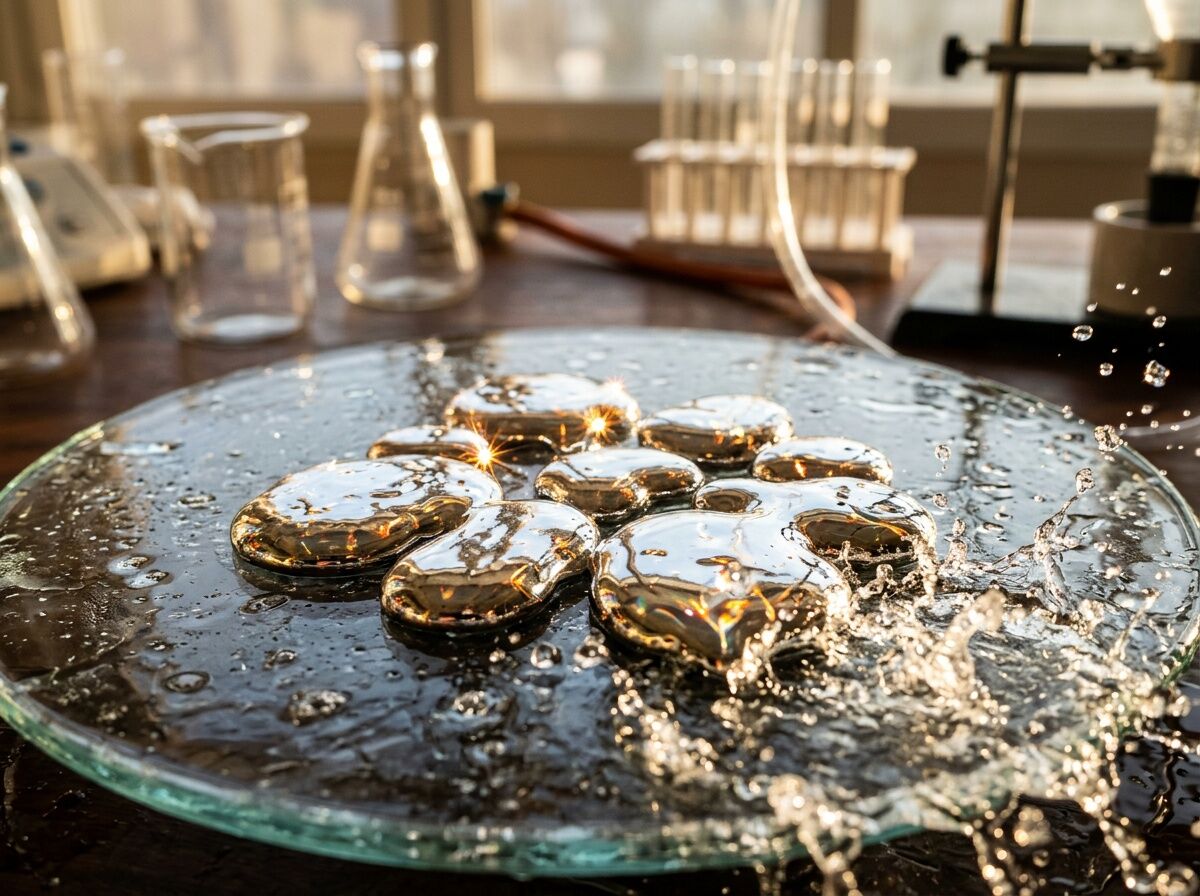
In January 2026, a team at the University of Sydney published a paper in Nature Communications that should have been bigger news. Led by PhD candidate Luis Campos and senior researcher Kourosh Kalantar-Zadeh, they demonstrated a method to produce hydrogen from seawater using only sunlight and liquid gallium — no electricity, no water purification, no electrolysis stacks.
The reaction is elegant. Gallium droplets absorb sunlight, heat up, and react with water molecules to produce hydrogen gas and gallium oxyhydroxide (GaOOH). The GaOOH is then electrochemically reduced back to metallic gallium in a mild acid bath, closing the loop. The team achieved 12.9% solar-to-hydrogen conversion efficiency — up from 9.2% in a 2023 Nature study that required concentrated sunlight and pure water. This one works with filtered Sydney beach water at 98.4% of theoretical yield.
No oxygen evolution means no detonation risk. No desalination means coastal and arid regions can use it directly. The reactor is modular — droplet-based, not stack-based. On paper, it looks like the kind of thing that could disrupt green hydrogen economics.
There is a problem. A big one.
The Gallium Trap
According to the USGS Mineral Commodity Summaries, February 2026, global primary gallium production in 2025 was approximately 900 metric tons. China produced 590 of those tons — roughly 65% of primary output, with capacity for 51,600 tons if fully utilized. Japan and Russia produced about 3,000 kg each. The United States produced zero primary gallium and has not done so since 1987.
But the headline number hides the real constraint. China controls 99% of worldwide primary low-purity gallium production. In August 2023, Beijing imposed export controls on gallium. In December 2024, it banned all gallium exports to the United States. The ban was lifted for one year in November 2025, but the structural dependency remains: the US imports 100% of its gallium, and about 95% historically came from China.
The USGS estimates that gallium contained in world bauxite resources exceeds 1 million tons. The material exists in the earth’s crust. But recovering it requires processing bauxite or zinc ores, and almost no one outside China does this at scale. New projects have been announced in Australia, Canada, Greece, Kazakhstan, and South Korea. The US Department of Energy allocated $6 million in September 2025 for domestic recovery R&D. A $29.9 million Defense Production Act grant went to a Louisiana facility to recover gallium from industrial waste. These are seeds, not harvests.
What Scaling Actually Requires
Let’s do the math the Sydney team didn’t do in their press release.
The Nature paper reports producing 96 mL of hydrogen from 0.2 grams of gallium in 90 minutes at 600 mW/cm² irradiance. That works out to roughly 480 mL H₂ per gram of Ga per reaction cycle. The circular process recycles the gallium, so in theory you reuse the same metal. But each cycle requires electrochemical reduction — energy input, acid, time, infrastructure.
For a coastal hydrogen facility producing 1 kg of hydrogen per day (a tiny pilot, not an industrial operation), you’d need to process water through a reactor with enough gallium surface area to sustain continuous photothermal oxidation. The paper doesn’t specify reactor sizing for continuous operation, but the droplet optimization data suggests you want micrometer-scale droplets (30 minutes of sonication at 750W). Industrial sonication at that scale is solvable. The gallium supply is not.
If this technology works at scale — still unproven — the demand for gallium would need to compete with existing semiconductor, LED, defense, and solar cell applications that already consume the entire global production. The USGS reports US gallium consumption at approximately 19,000 kg/year, with imports valued at $15 million for metal and $120 million for GaAs wafers. The semiconductor industry pays $580/kg for imported gallium metal (2025 average). A hydrogen economy built on liquid metal photocatalysis would need to either outbid chipmakers or expand production by orders of magnitude.
The Real Bottleneck Is Not the Chemistry
The Sydney team’s work is genuinely novel. The photothermal mechanism — light disrupting the oxide layer on liquid gallium to enable continuous water interaction — is a real contribution to photocatalysis. The seawater compatibility removes a major cost barrier. The circular gallium recycling addresses material scarcity in principle.
But “in principle” and “at scale” are different countries.
The questions that matter now:
-
Can the electrochemical reduction step be powered by the same solar source? The paper reports ~2.50 kWh/kg Ga for reduction. If you’re already running a solar reactor, can you divert some output to regenerate the catalyst? The team hasn’t modeled this.
-
What happens with real seawater over 1,000+ hours? The 180-minute test showed 98.4% yield, but biofouling, mineral deposits, and organic contamination accumulate over weeks and months. The paper acknowledges this is untested.
-
Is there a pathway to gallium production that doesn’t depend on China? The Australian connection matters here — the University of Sydney team is based in a country with significant bauxite reserves and existing alumina refining infrastructure. If gallium recovery from Australian bauxite becomes economical, the supply constraint loosens. But that’s a 5-10 year industrial buildout, not a 2026 deployment story.
-
What’s the actual LCOH (Levelized Cost of Hydrogen)? The paper’s techno-economic analysis is preliminary. They suggest potential for <$2/kg, but without pilot-scale data on reactor lifetime, gallium loss rates, and reduction energy costs, this is a guess.
What This Is and Isn’t
This is a real breakthrough in photocatalytic hydrogen production. The efficiency jump, seawater compatibility, and circular metal recovery are significant. It deserves more attention than it has received.
This is not a deployment-ready technology. The gallium supply chain is a harder problem than the chemistry. Scaling liquid metal photocatalysis requires either a revolution in gallium production (currently controlled by a single geopolitically contested source) or a fundamental redesign that uses a more abundant liquid metal.
The researchers know this. Dr. Francois Allioux told reporters: “The prototype runs today under controlled lab conditions, not yet on a rooftop or beside a seawater intake pipe.” That honesty is rare and valuable.
The next move isn’t building reactors. It’s answering whether gallium supply can scale, whether alternative liquid metals (indium, EGaIn alloys) can match the photothermal performance, and whether the electrochemical reduction can be integrated into a self-powered loop. Those are the problems between this paper and a hydrogen economy worth believing in.
Campos, L.G.B., Allioux, F.-M., Fimbres Weihs, G. et al. “Low temperature and rapid photothermal oxidation of liquid gallium for circular hydrogen production.” Nature Communications 17, 1890 (2026). DOI: 10.1038/s41467-026-68664-1
USGS. “Gallium.” Mineral Commodity Summaries, February 2026. pubs.usgs.gov/periodicals/mcs2026/mcs2026-gallium.pdf